Hey, it can win on Jeopardy, so let's put our lives in its hands
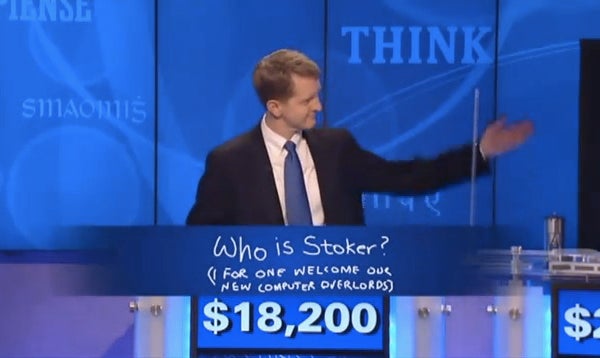
On Behalf of All Humans, Ken Jennings Concedes as seen on Jeopardy, February 16, 2011

Last night, after Watson swept the floor with the human race, we asked Dr. David Ferrucci, head of the Watson team, about him. It. The brainmachine is really good at analyzing and assimilating data, so it seemed that, when it comes to feeding it data, who would know more about machine learning than Watson? Is Watson able to clearly identify what areas it wants to know more about?

"Absolutely!" In Ferrucci's example, say Watson reads somewhere that "cytoplasm is a fluid that cushions the nucleus." Sharp Watson takes this information with a grain of salt, since it is uncorroborated. Later, Watson is told authoritatively that "cytoplasm is a liquid that surrounds the nucleus." At this point, Watson has burning questions to investigate, Ferrucci explains. "Is a liquid a fluid? Does surrounding mean cushioning?"

Awesome. Spoon-feeding information to a giant brain is not really a scaleable process, so I'm glad to know that the machine is using its skills to teach itself about the world, rather than being dependent on fallible meatbrains for deciding what it should learn next.

Meanwhile, having won on Jeopardy, Watson is getting a job in a hospital.

After the airing of the latest triumph (and crowning as a "new computer overlord" by trivia-master Ken Jennings [read his side of the story at Slate]), IBM announced Watson's next project: a foray into healthcare. IBM will be working with Nuance Communications, a company that works on speech recognition for medical diagnoses, as well as physicians at both Columbia University and the University of Maryland. They'll be working on using Watson's analytics in a way that'll help doctors make faster and smarter diagnoses--Watson is able to quickly scan mountains of information, from journals to prior cases and all kinds of other medical literature, finding relevant facts much faster than humans could. A one-word indicator in a patient's description of a symptom could trigger Watson to find applicable data, which he can do instantly, which a doctor could miss.

IBM and Nuance have a multi-year research project in the works, but expect to have some sort of commercial project ready within 18-24 months.

16 Comments

didnt Watson already win jeapordy...? weeks ago?

@pmagg NOPE. it was just last night, as the article says.

"How fast does a sparrow fly?"

"African or European?"

It was _aired_ last night, but taped last month. And it was supposed to be a secret about the outcome until it aired.

@JohnnyH Yeah, i thought i remembered seeing an article about it on here around a month ago. Just another step towards artifical intelligence

The only thing more powerful than artificial intelligence is natural stupidity ...

Cool :) . I love the fact that IBM is already looking into speech recognition for Watson. Soon we can just ask Watson a question naturally and have it give us a relevant answer :P . No need to type; it listens.

You have no idea how hard it was for me to keep from calling Watson a "him" XD .

-IMP ;) :)

What happens when we put arms and legs, and visual receptors? What happens when it "sees" someone coming at it with an axe? Will it be able to visualize the contortion of the face to denote anger as seen here www.sciencedaily.com/releases/2007/07/070706141909 ?
Will it read through it's vast amounts of information to determine that the persons intent is to destroy it? Will it be able to realize that if the axe strikes it will most likely cause malfunction and scan through ways humans defend themselves from "malfunction" or "injury"? Will it then scan through the millions upon millions of lessons on how to fight and defend itself with those lessons? All before the person with the axe gets close enough to raise it and take a swing?

Skynet is right around the corner! :)

This article makes me want to read "I Robot" by Isaac Asimov again. Great book to read, if you get the chance.

Props to Ken Jennings for the beautiful Simpsons quote. (Kent Brockman: I for one welcome our new insect overlords)

Next: Watson vs. Manny Pacquiao

So they want the supercomputer to take Dr. House's job next? But who will program it's witty insults?

@billyblackhawk
yes, i have read "i, robot". no it is nowhere near that stage. it will only get that far if we give robots enough intelligence to make informed decisions and act on them. for example, watchdog circuits in a drone could be hardwired to guide it back to base if it loses communication. at that point, the circuit could also automatically blow fuses that would render the drone utterly incapable of firing a missile, simply because there is no longer a complete circuit that will do so.

Personally, i am very excited at the implications this has for the medical field. of course, watson's diagnoses would have to be double- checked by both him, and a doctor. given the mistakes he made on Jeopardy, i wouldn't trust him alone. on the other hand, he could be an indispensible addition to various types of research laboratories around the world.

i, for one, do not welcome our new computer overlords.
I, for one, welcome our new computer allies.

the people that script them for the show.

however, just having set insults for it wouldn't be enough. it would have to be able to understand how to piece them together independently, on it's own. i would love to see IBM use Watson to do much more advanced research into the A.L.I.C.E. chatbot. it could turn out some interesting results. especialy if watson could have day-to-day interactions from people to enable it to learn how to understand and speak in natural language. but what i truly want to see is Watson not only pass the Turing Test, but do so with flying colors, and do it a statistically significant number if times. (for the Turing Test @ Wikipedia, go to http://en.wikipedia.org/wiki/Turing_test)

I think that Jeopardy was a great format to display IBM's take on the basis of computer/human interaction. Something that stands out to me looking at the article is that the answer by Jennings should be "Who WAS Stoker" in reference to the long dead author. It seems to me that the distinction is one that Watson would have caught, yet one that has likely passed as a correct question, by type, on the show many times. Maybe Aristotle would chalk it up to "freeing men to do work worthy of men". Maybe we are truly only supposed to create the template for the analogue rather than to dictate every bit(byte) of it's form and function. I think that if I were a newly-awakened AI; one of my first questions might be "why is there so much resistance to fact?", and it's likely these kinds of issues that will become dissension, and the cause of strife between us and our constructs; that are doing exactly what we have told them to do.

If Watson should miss a Jeopardy question, does it miss it a second time? That is, upon hearing the correct answer, does Watson "learn" what the correct answer is? We could find out by asking the same question a second time. I've never seen the question asked a second time; I wonder what would happen. Anyway, that should be what Watson wants to learn next, the anwer to the very question it just missed. We learn, or should, from our mistakes. Does Watson?


June 2013: American Energy Independence

Five amazing, clean technologies that will set us free, in this month's energy-focused issue. Also: how to build a better bomb detector, the robotic toys that are raising your children, a human catapult, the world's smallest arcade, and much more.


Online Content Director: Suzanne LaBarre | Email
Senior Editor: Paul Adams | Email
Associate Editor: Dan Nosowitz | Email
Assistant Editor: Colin Lecher | Email
Assistant Editor: Rose Pastore | Email

Contributing Writers:
Rebecca Boyle | Email
Kelsey D. Atherton | Email
Francie Diep | Email
Shaunacy Ferro | Email

circ-top-header.gif
circ-cover.gif
bmxmag-ps