Going by our archives, the only thing more hyped-up than flying cars and humanoid robot assistants were cool futuristic homes — homes that could converge their walls to create new rooms, that could adapt to any environment, and that could play with your children while you took an afternoon nap. In terms of functionality, houses of today haven’t changed much over the past fifty years. We still use good old brick, marble and cement as building materials. We still turn the microwave and TV on by our ourselves. For the most part, we still do our own chores. So what happened?
Click to launch the photo gallery.
In some cases, we dreamed too big, perhaps spiraling into ideas that were decades ahead of their time. In the early 1980s, a band of designers at the Illinois Institute of Technology predicted that by the mid-1990s, we’d be using computers to build fully computerized, shippable, energy-efficient modular housing units. Microprocessors would control the appliances and adjust the ambiance, while robots would hang the laundry. Humans, meanwhile, would lounge around the indoor spas (alas, still not a standard feature) in between watching programs on holographic television sets.
The future that never was makes our Roombas and plasma TVs sound a little quaint, doesn’t it? We’re happy to report, though, that we have plenty of reasons to feel content with our non-computerized houses. In April 1956, a group of researchers at MIT tested plastic houses, the draw being that plastic walls would be easy to hose down on cleaning days. A couple of decades later, Goodyear began testing air-bubble houses, which would situate your family within an unnervingly spacious translucent dome. These days, neither sound particularly appealing, given their vulnerability to natural disasters and local hooligans.
Dismally enough, we predicted in 1982 that in order to conserve natural resources, people living in the year 2000 would be forced to use low-flush toilets and “miserly” shower heads. As much as we love robots and computer-controlled appliances here at PopSci, we’ll profess to choosing hot showers over talking microwaves any day of the week.
Click through our gallery to see more housing projects dreamed up between our pages.
Hanging House: February 1939
Paul Nelson, a modernist American architect and renowned Francophile, imbued his work with a “quality of mechanical lyricism,” as described by British architect Kenneth Frampton. His cagey design for a suspended steel house featured upper rooms that hung from the ceiling and connected by ramps. The structure itself was supported by U-shape tubular steel arches, and although you can’t see it in this black-and-white photo, the steel mesh was covered in diamond-shaped glass panes that were opaque from the outside. The kitchen, laundry, and other service rooms (we’ll assume that means a garage), were located on the ground floor, while the bath and bedrooms were at the top. The study, living room and recreation facilities could be found in the middle. Read the full story in “‘House of the FUture’ Hangs on Steel Arches”
Floating Homes: March 1941
Now here’s a solution to overcrowding. During the early 1930s, several Miami residents built floating homes in Biscayne Bay, where renting an acre’s worth of water space cost a mere dollar. Residents built their houses on atop pilings. Some people even constructed sharkproof swimming pools by enclosing small areas with underwater fences. At its peak, the Biscayne Bay neighborhood boasted 27 houses, which were used a summer getaways and fun places for dinners and fish-frys. Sadly, the idea never really caught on, and the neighborhood went into decline once the novelty wore off. Its location 10 miles from the downtown Miami shores meant that residents had no access to electricity. They needed to transport their own light sources to stay there at night. Exposure to the elements and the susceptibility to hurricanes took their toll on the buildings, and eventually their number dwindled to seven. These days, the area is called Stiltsville, and the buildings are owned by the National Park Service. Read the full story in “Floating Homes”
Stopgap Housing: March 1946
To solve the housing crisis, the Federal Public Housing Authority (FPHA) briefly distributed stopgap homes, or temporary shelters that provided the would-be homeless veterans with a place to live while they looked for permanent quarters. Residents of the Navy’s Homoja village in Annapolis lived in 20-by-48-foot steel Quonset huts. Homes were compact and came with only the most basic furniture. Best of all, families paid only $1 a day for rent. Elsewhere, surplus Army barracks were being converted into veterans’ housing, while Congress moved 100,000 stopgap housing units (leftover from the war) to new sites. These houses were of light frame construction and could be dismantled for shipment. As cheap and convenient as those structures sounded, city planners were concerned that these units would either turn into slums or that they would compete with private housing. Stopgap housing advocates stood their ground, though, insisting that states and localities construct temporary housing or else neglect the millions of veterans coming home from the war. Read the full story in “Stopgap Housing”
Plastic House: April 1956
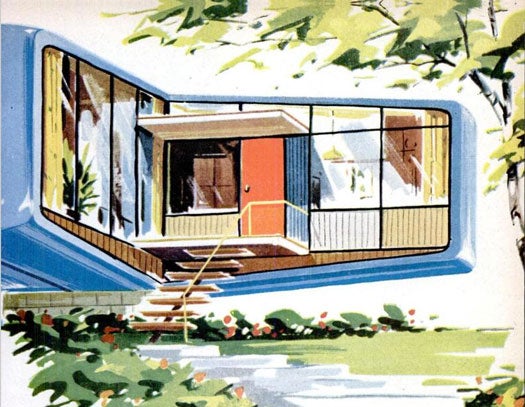
According to the Massachusetts Institute of Technology, the house of the future would be plastic, mass-produced and shaped like a cross. The basic floorplan would consist of a core and four “wings.” The kitchen, bathrooms and furnace would be housed inside the core, while the plastic wings would hold the bedroom, dining, office and recreational areas. The entire structure would be mounted atop a pedestal, making the house look as if it were floating above ground. So, why plastic? Firstly, it’s low-maintenance. To clean your house, hose down the walls. To repair cracks or patch the room, slap some cement into the wounds an consider the job done. Of course, there were a couple of problems, the biggest one being that plastic can become deformed when exposed to heat. MIT did assure us, however, that the designs were experimental, and the purpose of a plastic house was to help designers evaluate plastic as a standard building material. Read the full story in “Plastic House”
Air-Bubble Sun Port: January 1961
All right, you can’t live day in and day out in an air house, but for just $50, it can become a charming addition to your home. We proposed using it as a game room, a photo studio, a pool cover, or an outdoor family playroom that would let you picnic out in the yard even in the dead of winter. The filmy plastic air bubble was easy enough to erect. It required no frame and was supported entirely by air. Like a greenhouse, it trapped enough solar heat to let temperatures rise to around 80 or 90 degrees. You can even add a small electric heater to keep things toasty on gloomy afternoons. To inflate the air house, we wrote, use a small blower (vacuum cleaners and hair dryers work if you’re desperate) and let it run continuously. A self-balancing vent on the side of the dome controls the airflow by opening and closing according to the rise and fall of pressure. Read the full story in “Air-Bubble Sun Port for $50”
Bubble Buildings: May 1973
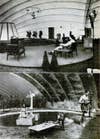
About a decade after we sang praises for the air bubble sun port, Goodyear actually tested a residential air structure for family use. David and Vickie Schumacher, pictured above, participated in Goodyear’s experiment by liveing in this part translucent, part transparent home. Some areas, like the living room, had a floor, while others were left as grass and dirt. Although the Schumachers enjoyed the sunlight and how they could watch the rain falling on the roof, they found the open space and lack of privacy unnerving. David also professed to suffering from “bubble fever,” which is like reverse cabin fever. After returning to Princeton to finish his graduate studies, David organized a non-profit student housing group to develop designs for a residential campus contained within an air bubble. In his proposal, students would live within stackable “roommettes,” which could be connected and transported like blocks within the air structure. Read the full story in “Bubble, Bubble Everywhere”
Computerized House: January 1980
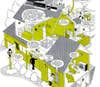
“He’s a butler, babysitter, companion–and sometimes a nuisance,” we wrote when describing Breslin, a computerized house that could do everything from talking to the kids to controlling the garage door. He could tell the time, predict the weather, print out bank balances and communicate with other computers to retrieve news headlines or information from the homeowner’s address books. Breslin, who was programmed by Bill Hawkins, was a personal project more than a commercial venture. That didn’t mean others wouldn’t feel inspired and follow suit, though. In this article, Hawkins described how Breslin would follow one of four preprogrammed schedules, which would tell him when to turn on and off the lights, and how to adjust the temperature. Despite being a computer, Breslin had a deeply personal relationship to his owner. In the morning, he would wake Hawkins up by reading him his appointments and turning on the radio. Since this was the year 1980, you can imagine how much work went into creating Bresin out of an IMSAI 8080 computer. His actual “Home” program was just 52 kilobytes and could load into the computer using the North Star Disk System. A Lear Siegler terminal let Hawkins send and receive data through that system. Read the full story in “Breslin — The Home Computer That Runs My House”
Autonomous Dwelling Vehicle: April 1980
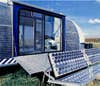
“Was this the American home of the future–this cross between a submarine and a World War II Quonset hut, this metal half-sausage afloat on a sea of mud?” we asked, when we saw Ted Bakewell II and Michael E. Jantzen’s Autonomous Dwelling Vehicle. It certainly espoused the aesthetic and conservation technologies of 1980s house-of-the-future concepts, but its inventors insisted that the house-vehicle hybrid was more of a mobile home than anything. The structure was light enough to be towed long distances. It could float on water and be carried around by a helicopter. As a conservationist, Jantzen helped ensure that the house could run without fossil fuels and hookups to electricity, gas, water, and sewage. As you can see on the left, solar photovoltaic panels generated the structure’s power. The inside of the structure was quite roomy, and if anything, resembled the inside of the air-bubble structures from a decade prior. The home included a dining area, bedroom, bath and food-service area. While preparing meals, the inventors cooked on a renewable fuel stove. A tiny refrigerator could use outside winter air and a solid-state thermionic device to stay cool. The toilet, meanwhile, was of the waterless waste-composing type. Read the full story in “The Liberated House”
Dynamic House: April 1984
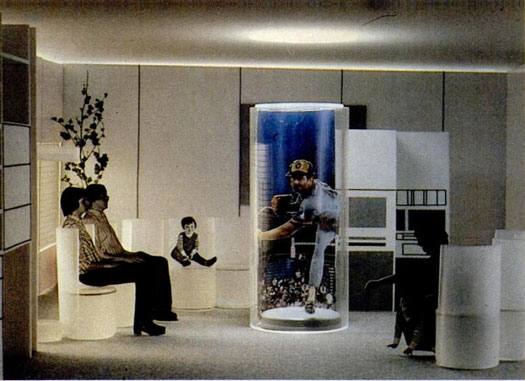
Now this is a house we’d love to live in. Professor Charles Owen from the Illinois Institute of Technology worked with a team of students to design a prefabricated house that could adapt to the weather, expand and contract, program indoor environments, and order around robotic servants that could do your chores. Solar-hydrogen-wind-turbine modules on the roof would generate energy while windows would automatically adjust to to sunlight. The computer-generated designs focused not on houses as a whole, but on on components that could even be installed into existing structures. Pictured at left is the entertainment center, where a family can enjoy programs on a holographic TV set. Other rooms of the house contain moving walls and panels that for enclosing bedrooms or bath areas. Although his design is advanced even for the year 2011, Professor Owens and his team were confident that people would be able to use their technology by the mid-1990s. Read the full story in “The House That Computers Built”
Home of the Year 2000: May 1982
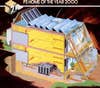
When it came to houses, we dreamed big in the 1980s. We predicted that by the year 2000, Americans would favor clustered townhouses over the typical suburban house-and-yard model. The houses would draw most of their energy from renewable sources, and families will trade luxury showers for “miserly shower heads” and low-flush toilets. As we run out of land space, we’ll move our housing underground, “to take advantage of Mother Earth’s even temperature.” John R. Hagley of the Battelle Columbus Labs said that by the year 2000, houses would plug heating, cooling, plumbing and electricity into one power unit. Futuristic insulation and glazing materials, like electrochromic gas, would conserve energy even further. Aside from environmentally-friendly materials, residents could enjoy technologies like flat-screen TVs and voice-command family computers. Read the full story in “PS Home of the Year 2000”