Video: New Liquid Pistons Made of Magnetic Droplets Could Power Self-Focusing Lenses
We may earn revenue from the products available on this page and participate in affiliate programs. Learn more › A...
We may earn revenue from the products available on this page and participate in affiliate programs. Learn more ›
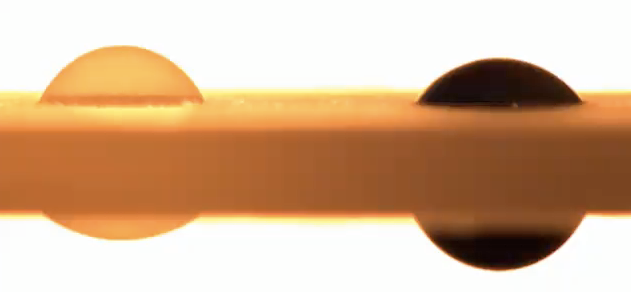
A pair of magnetic liquid drops oscillating in opposite directions can function as a liquid piston, and could one day be used to deliver drugs, power mobile phone cameras or even serve as implantable eye lenses, according to a new study.
Researchers at Rensselaer Polytechnic Institute embedded drops of ferrofluid, a liquid infused with magnetic nanoparticles, into a thin substrate that was submerged in water. Then they exposed the device to a magnetic field to make one of the droplets vibrate back and forth (up or down in the image above), which caused its partner to oscillate in a mirror pattern. This ballet displaces teeny amounts of liquid, moving it from one chamber to another, according to Amir H. Hirsa, a mechanical engineering professor at Rensselaer. The piston is superfast, allowing micro-scale devices with cycling speeds in the kilohertz range.
The liquid piston has no moving mechanical pieces, so it never suffers wear and tear, according to a Rensselaer news release. The droplet duo could be used in a wide array of devices that require reliable resonator action, like an implantable chip that slowly pumps drugs from one chamber to another, Hirsa said.
What’s more, the droplets’ shape constantly changes as they vibrate, so if you pass light through them, they function as a lens that automatically changes its focal length. Hirsa and colleagues took some video from these liquid lenses and they say its quality is comparable to a typical computer web cam. You would need special software to filter out the blurry frames, but Hirsa says it could work for handheld electronic devices as well as potential replacement eye lenses. So instead of a cool pair of frames, you could wear magnets on your head to fine-tune your vision.
Other nanoresonators we’ve seen involve trapping light at different wavelengths to produce a high-definition display. This device would instead focus light to obtain a sharp picture.
The droplets’ speed and vibration strength can be controlled by changing the strength of the magnetic field, according to Rensselaer.
The liquid piston is described in the journal Lab on a Chip.