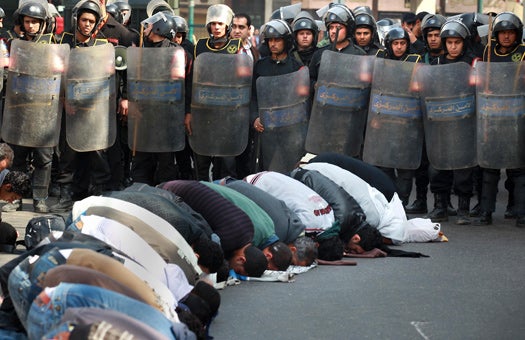
Egyptian Protests Locals pray in the street in front of The l-Istiqama Mosque watched by riot police in Giza on January 28, 2011 in Cairo, Egypt. Peter Macdiarmid/Getty Images

Add “shutting down the Internet” to batons and tear gas as the protest-silencing methods of the modern era. In response to protests simmering throughout Egypt this week, with calls for the president to resign and outcries over the jailing of political dissidents, the government shut off the Internet Friday.

“According to our analysis, 88 percent of the ‘Egyptian Internet’ has fallen off the Internet,’” said Andree Toonk at BGPmon, a monitoring site that checks connectivity of countries and networks, to the Guardian.

The Internet went dead around midnight Egypt time on Friday, and at the same time, the few companies that pipe Internet connections into and out of Egypt went dark as well, the AP said. The government apparently wields enough control over the country’s Internet service providers that it shut them all down at once, something that is unprecedented in the history of the Internet, according to network security expert Jim Cowie.

This is a departure from other regimes’ attempts to quash online communication — typically, a few websites are blocked, not the entire pipeline. That was the case earlier this week, as Egyptian ISPs restricted access to social media sites like Facebook and Twitter. But today, the shutdown reaches far beyond the protesters to Egypt’s entire economy. Cowie’s Internet-monitoring firm, Renesys, said “every Egyptian provider, every business, bank, internet cafe, website, school, embassy and government office that relied on the big four Egyptian ISPs for their internet connectivity is now cut off from the rest of the world. Link Egypt, Vodafone/Raya, Telecom Egypt, Etisalat Misr, and all their customers and partners are, for the moment, off the air.”

The Egyptian Stock Market is still online, however, because the ISP that powers it, Noor Group, was left alone.

In this country, discussions about shutting off the Internet have centered on attacks from other nations. Sen. Joe Lieberman wants to give the president an Internet "kill switch" that would disconnect America from incoming worldwide traffic. But it probably wouldn't work anyway, because hackers would use proxy servers and other workarounds to circumvent any blockade.

That may be why Egypt shut off the whole thing, security experts said — there is no possibility for a proxy, because there is nothing coming in or out.

“There is literally no route. It’s as if the entire country disappeared,” Cowie said.

A wholesale shutoff, rather than some blocked tweets, may be more likely to spark interest from other governments. “We are concerned that communication services, including the Internet, social media and even this tweet, are being blocked in Egypt," State Department spokesman P. J. Crowley said on Twitter.

The Internet and social media were key instruments of communication during the 2009-2010 election protests in Iran, dubbed the “Twitter Revolution” for the site’s importance in allowing protesters to communicate with each other. Now it appears Egypt wants to prevent communication altogether.

[AP]

12 Comments

A dictator always falls the hard way--via violence. Things will keep getting worse until it's a civil war and Mubarak will be tried in an International court eventually or shot and beheaded in Egypt. The guy is worse than the Pharaohs!

is this a preview of america? all it takes is one spark to ignite the flame that is liberty.

Absolute power corrupts absolutely; the wicked are snared in the work of their own hands..the way of the wicked will perish; sic gloria transit tyranus.

Bad Egypt, no pRon for you!

Makes you think twice before moving anything important to "cloud computing" Looks like you could be shut off at any time.

Yes, the comment about cloud computing is very insightful. By its very nature, it's a physical centralization of information.

The more important precedent here is that of a government shutting down a whole country's Internet for a political goal.

No internet => no work.
No work => more time to protest.

Didn't think this one through.

They cut the routers; you couldn't just use a proxy. Also: do you have to be a hacker to use a proxy? mehtinks not...

This is where America, as the hero of sorts, comes in and takes control of the nation of Egypt, or just does so temporarily.

Mubarak is already a US and Israel-friendly dictator. An Israeli minister was interviewed on "Time" and said the protests are a disaster, because "the Arabs" are not ready for democracy.

There are distributed Domain Name Server (DNS) systems in various stages of development that will allow ad-hoc distributed wireless internet connections without any centralized servers.

These work by placing a tiny DNS server on your wireless device that shares information with wireless devices near you. Each tiny server caches ip addresses for recent requests, and forwards new requests to nearby tiny servers until a match is found.

A second stage is used to obtain the content. Each wireless device also contains a tiny server for content. A hundred or two devices in a local area are formed into a subgroup, and subgroups are linked with other subgroups in a tree-like architecture. Since the address of the server having the desired content has been discovered by distributed DNS, a route can be developed through the tree structure to get the content and return it to the client on the requesting device.

Thus internet connectivity can be maintained without wires or centralized servers, and cannot be shut off with a kill switch.

This technology is vital to maintain an open and free society as communication is a right and not a privilege given by the government.

who would want to be such a control freak? something is going on inside the system that they are clearly not telling about. governments and their secrets, sickening.


June 2013: American Energy Independence

Five amazing, clean technologies that will set us free, in this month's energy-focused issue. Also: how to build a better bomb detector, the robotic toys that are raising your children, a human catapult, the world's smallest arcade, and much more.


Online Content Director: Suzanne LaBarre | Email
Senior Editor: Paul Adams | Email
Associate Editor: Dan Nosowitz | Email
Assistant Editor: Colin Lecher | Email
Assistant Editor: Rose Pastore | Email

Contributing Writers:
Rebecca Boyle | Email
Kelsey D. Atherton | Email
Francie Diep | Email
Shaunacy Ferro | Email

circ-top-header.gif
circ-cover.gif
bmxmag-ps