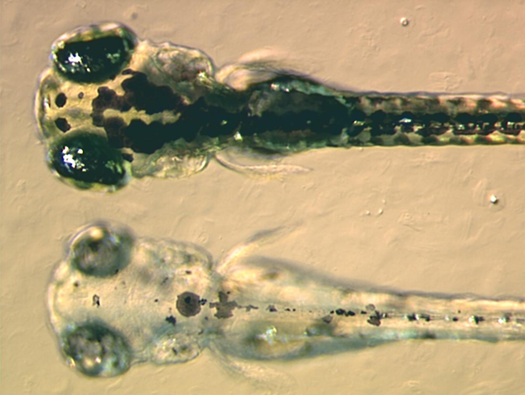
Zebrafish Embryos Mmmmmmmm, zebrafish embryos. Adam Amsterdam, Massachusetts Institute of Technology via Wikimedia

The Journal of Cosmology recently published a special issue concerning the requisites for and perils inherent in a manned mission to Mars, which appropriately touched upon that taboo topic that NASA never talks about: sex in space. But while it might seem like a natural inevitability, sex in space might not be such a great idea, at least from a reproductive aspect. Example: A recent study shows zebrafish embryos brought to term in microgravity develop cranial defects.

Those defects aren’t immediately problematic necessarily, but they’re certainly not good. In the zebrafish, the abnormalities arose in the neural crest cells, which develop cranial cartilage and bone. Assuming the same thing happened in a human embryo, the first-gen spacebaby might not be in such bad shape, but successive generations could suffer.

The research involved placing zebrafish embryos in a bioreactor that spun to mimic microgravity during the fertilized eggs’ development. When the eggs hatched, researchers stained some of the fishes’ cranial cartilage and found that parts of cartilage that support the gills--parts corresponding to the human jaw--were altered. Several months later, when the fish reached adulthood, they stained a few more of the fish, finding they also were abnormal; bone at the base of the skull had buckled on some of the adult fish.

That’s a problem, especially considering previous microgravity experiments on zebrafish have shown similar abnormalities developing in other parts of their bodies. While bioreactors have been previously criticized for creating an imperfect analog to the conditions of outer space, microgravity, it seems, isn’t too kind to embryos designed for life on solid, gravity-laden ground.

[New Scientist]

14 Comments

NASA does not want to talk about the subject, but the study comes from somewhere.If the resources we have here are depleted to the point that this planet will no longer support our species,then humans are inevitably going to get beyond this spawning ground we call Earth. You know scientists are conducting studies. That's not to say that the professionals we call astronauts have probably conducted certain experiments in space utilizing "the right stuff"...but has it been up close and personal? I doubt it....That's probably something that will not be addressed.I don't think we'll ever see a female astronaut come back from a mission being pregnant...will we?.....

Clearly we need to create artificial gravity then. Which shouldn't be too hard considering we could use the same principles a Stanford torus does.

Then there's the whole issue of Mars having less gravity that may cause some serious problems.

humans probably won't be deterred from procreating on colonized planets. they will just have to deal with off-springs looking alien like.

@ NOCELL - there's a vast difference in scale of time between what you're talking about and what NASA wants to talk about in terms of policy right now.

I'm bewildered by the article proper, though. Real zero gravity trials on mice reproduction have been done with previous shuttle missions. The results weren't pretty - mentally and physically handicapped. This fish study seems absurdly redundant (because it's not a mammal and because it's not real zero G, it can't be remotely as representative as the mouse trials.) At any rate, the mechanisms are clear enough - change any of the conditions inside the womb, including gravity, and all the processes that push cells around get offset.

question: how can spinning produce microgravity-like environments?

deegeezee: Spinning causes centrifugal force which is basically gravity (the trolls will have fun with that). My question is, is there a possibility that the fish embreyo were damaged by the centrifuge itself? The report states that the base of the skull was buckled, sounds like a SQUISHED FISH to me NASA... I'm just sayin'.

SOLVE THE ARTIFICIAL GRAVITY PROBLEM
By solving this problem humans will be able to experience proper space travel by overcoming these limitations:

1) help to reproduce "normal" offspring (earth-like gravity)
2) propulsion system not based on stored chemicals (gravity drive)
3) overcome the acceleration limit of the craft due to human cargo (inertial dampeners)
4) extreme maneuverability of craft (gravitational thrusters)
5) time travel (harness the gravity of the universe)

OK, so for now it's all Science Fiction - but if the gravity issue is solved - so much more becomes a possibility.

I think this tells us a lot about the structure of life itself. While we here on Earth have been accustomed to the Earth's gravitational forces for, well, ever...So we know very much about the life and forms that take shape have evolved to(Humans, horses, cells, etc.) This should be the biggest nail in the coffin to "Humanoid" life in space. If we are to find life at some point in space, it will undoubtedly be unlike anything we have ever seen because essentially, the life forms will develop differently in different levels of gravity on top of any of the other millions of factors that would have come together to create and develop the "life forms" in the first place.

I feel that this is definitely something we as humans should think about. We have certainly had the time to explore the the idea that life could possibly be out there and that the universe is vast and wildly variant in it's ways. So why not attempt to find ways to study our own physiology better in different environments? What an amazing time we live in!

Gravity isn't the only way. If we improve a.i. then robots can replace our species as a kind of descendant. We can also manipulate our own genetics, in certain ways we already are by simply changing our environment. In fact if we do leave our home permanently, to do that successfully we may need to evolve ourselves into a new species.

Two thoughts:

I think it was in the beginning of Avatar when they showed the spaceship (or maybe some other movie) but it had to pods attached at a distance to each other and rotating about the central axis of the ship. Obviously to create gravity in the ship. Why hasn't Nasa already done something like this in Space. I'd think we would have to re-perform all these tests under a realistic environment/situation like that in space to get better data. Too many factors to correlate stuff. Space has big time solar radiation, earth has magnetic waves or whatever you call it, etc... I don't want to risk my life in space over correlations. Mechanical correlations, technological correlations, okay, but biological I'm not so sure.

Second, and please don't start a religious debate over this because that is not my intentions. But, as a Christian, I can believe these results as 100% accurate assumming God created us on earth, not in space. Just maybe we are not meant to leave earth, in which case we better start getting along and taking better care of it.

I have a question for those more learned than I among the PopSci readers, haha. I'm just thinking these are fish right? Fish live in water. Water pressure creates an environment with more atmospheres of pressure, so wouldn't the effects of microgravity be more exaggerated in fish because the difference in their gravity would be greater going from under water atmosphere to space like atmosphere. So they'd be going from a usual, say, 3 atmospheres to 0, whereas we'd be going from 1 to 0. Wouldn't that make the effects less drastic in humans than in these fish? Not sure if this is at all a worth while question, but if someone could clarify this for me I would be quite happy. Thanks!

@DickySimms
I don't think that pressure would have any influence on the the effects of gravity. I think it only affects a living organism when the outside pressure is not the same as the internal pressure. Otherwise it is basically a balanced system. One could even make a counter argument that buoyancy would make the water lifeforms adjust better to microgravity but in that case it is even more of an external force. The crew of a submarine certainly feels full gravity as should the internal structures of any living thing that is submerged. If you can accept the analogy to a living entity, if you increase the pressure in the sub to 3 atmospheres, everything still weighs the same to the crew.

so thats how cone heads came about

I wonder what would happen the other way round, if mammals reproduced on 2g environments rather than a zero g environment (i.e. life on a Jupiter sized planet!).


June 2013: American Energy Independence

Five amazing, clean technologies that will set us free, in this month's energy-focused issue. Also: how to build a better bomb detector, the robotic toys that are raising your children, a human catapult, the world's smallest arcade, and much more.


Online Content Director: Suzanne LaBarre | Email
Senior Editor: Paul Adams | Email
Associate Editor: Dan Nosowitz | Email
Assistant Editor: Colin Lecher | Email
Assistant Editor: Rose Pastore | Email

Contributing Writers:
Rebecca Boyle | Email
Kelsey D. Atherton | Email
Francie Diep | Email
Shaunacy Ferro | Email

circ-top-header.gif
circ-cover.gif