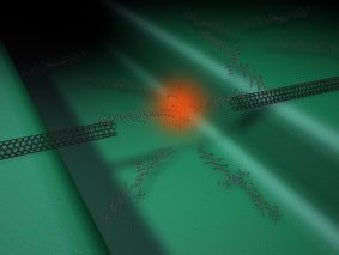
For the first time, scientists have observed a single molecule emitting light when sandwiched between broken segments of a carbon nanotube. The new device emitted just one photon for every 1 billion electrons, according to the study. The research could lead to development of optical electronics based on individual molecules. Or Tron costumes for the masses.
To build this Lite-Brite device, scientists from Germany, Switzerland and Poland created a tiny gap between two electrodes in a carbon nanotube and stuck a special molecule inside it. The gap was so small that it could only fit between one and three molecules, according to a report in PhysOrg. The rod-like molecule had electrical properties that enabled it to be trapped between the electrodes, completing the circuit.
When the scientists applied a voltage, they saw bright spots of electroluminescence, which is the emission of light when a current passes through an object. It’s the same phenomenon that provides the backlight on your wristwatch’s LCD display — and the body suits in “Tron” — but in this case, it was barely visible through a scanning electron microscope.
The light could be controlled by switching the voltage on and off, according to PhysOrg — proof that the molecule was where it should have been.
It’s important for the understanding of molecular electronics, which involves transporting electrical charges through molecules, according to Ralph Krupke, a researcher at Karlsruhe of Technology and DFG Center for Functional Nanostructures and a co-author of the paper describing the circuit. It was also a breakthrough for solid-state devices, because it integrates a
The paper is published in Nature Nanotechnology.
[PhysOrg]
The incredible innovations, like drone swarms and perpetual flight, bringing aviation into the world of tomorrow. Plus: today's greatest sci-fi writers predict the future, the science behind the summer's biggest blockbusters, a Doctor Who-themed DIY 'bot, the organs you can do without, and much more.


Online Content Director: Suzanne LaBarre | Email
Senior Editor: Paul Adams | Email
Associate Editor: Dan Nosowitz | Email
Assistant Editor: Colin Lecher | Email
Assistant Editor: Rose Pastore | Email
Contributing Writers:
Kelsey D. Atherton | Email
Francie Diep | Email
Shaunacy Ferro | Email
"because it integrates a..."
Smash up editing. Did you accidentally let go of the left mouse button when you copied this article prior to re-pasting it here?
LOL FAIL POST
Looks like there's a whole paragraph missing. Proof-reading, that lost art of journalism.
Now, back on topic. Combine this with OLED technology and lets get on with the micronizing of display technology!
You can get an idea of what was to be said next by reading this part of PhysOrg's article (I couldn't find the Nature article):
“In our view, the greatest significance is that we succeeded in forming a rigid solid-state device by integrating a bottom-up structure, the molecule, into a top-down structure, the CNT gap,” he said. “Thereby we had to control the critical dimensions and the molecule had to be tailored to enable light emission under voltage bias. Furthermore, from a molecular electronics point of view, it is the first time that the presence of the molecule in the gap is confirmed by its optical signature.”
WHAT A CLIFFHANGER!!!...
Also, SEMs (scanning electron microscopes) are observing emitted secondary electrons, not photons. You cannot observe or measure light in standard SEM. These measurements were made with a light-optics setup and an optical spectrometer. Please to be checking facts and proofreading in the future.
Can this tech be used for realistic holograms? Hummm?
Wow.
1 photon per billion electrons means that to get just 1 photon per second, we'd need to use 367,879,441 Amps, or almost 368 megaamps (MA). That's insane.
-IMP ;) :)
@Icemetalpunk, check your work. 1 amp is 6.25x10^18 electrons per second flowing around the circuit/component, not the roughly 3 electrons per amp as you suggest.