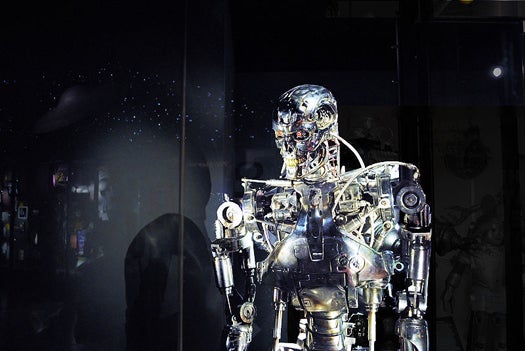
Robot Troops of the Future Robo-Soldier wants to execute (an efficient, well-calculated plan). Patrick Swint via Wikimedia

Modern warfare relies increasingly on robotics for intelligence gathering and increasingly for strike capabilities, but the decision-making capacity still rests solely in the hands of human commanders. But British defense company BAE systems is testing a way to turn over battlefield decisions over to robot troops as well.

ALADDIN (Autonomous Learning Agents for Decentralised Data and Information Networks) is BAE’s response to the overload of sensors and data now confronting battlefield commanders who now have UAV observations, soldier-based sensors, satellite data, and reams of other intelligence washing over them in such volumes that, as Air Force Lt. Gen. David A. Deptula puts it, they’ll be “swimming in sensors and drowning in data.” The system allows a network of robot soldiers to quickly collect and exchange information and then to bargain with each other to determine the best course of action and execute it.

The robots are armed to the teeth with algorithms employing a range of models – game theory, probabilistic modeling, optimization techniques – that let them predict outcomes and allocate battlefield resources far more quickly and efficiently than humans trying to process the same amount of data. All that should help troops – both robotic and otherwise – keep stay afloat in the data deluge.

But does it work? ALADDIN hasn’t seen any trigger time yet, but BAE and university researchers collaborating on the system have put it through simulated natural disasters (another potential application). Disasters, they theorize, are similar to warfare in their chaotic nature, and therefore the simulations are a good analog.

And in disasters the system operates well: Robots gather data on the various casualties in different areas, objectively assess where a limited number of ambulances can have the greatest possible impact, and execute a strategy quickly without egos or human emotions or errors clogging up the machinery. It’s like an auction for resources based on need, and while it may sound insensitive to auction off life-saving help to a bunch of machines, when this resource auction was eliminated from some simulations, some of the ambulances weren’t used at all because the system couldn’t figure out where to send them.

BAE is building what’s known as “flexible autonomy” into ALADDIN which will keep the higher decisions in the hands of humans (decisions like “go to war” and “don’t go to war,” for instance). And the idea of being able to crunch sensor data, raw intel, crowdsourced info from the Web, and other data sources to make good decisions quickly could prove invaluable. So while idea of robot armies with decision-making capabilities is terrifying to some, the allure of such high efficiency – be it in warfare or disaster response – is difficult to deny.

[The Economist]

22 Comments

it's the terminator!

Skynet...

How many people who are well versed in probabilities and game theory are highly successful in Las Vegas? Monaco? Macao? The vast majority can make some small, occasionally medium success; but it's well known that the odds still bite them in the butt in the end. Do we anticipate that this ALADDIN system would significantly improve on this? Allocation of resources in a disaster while holding the engineering data for every building in town is likely a good use for this tech, no question there. Automatically knowing how many casualties have been taken to every area hospital and clinic and that, but war is a significant order of magnitude beyond that. I've seen little in these last few years to make me believe for a second that computers are a match for multiple humans fighting for their lives and their loved ones. As support technology that can separate base data on logistics from trickery, and every stage up the ladder from there; I just do not think we are there yet.

Sure computers can beat us at chess, but that is a very far cry from the infinite variations of actual battle. I think they might me jumping the gun a bit. I'll wait another 5 or 10 years before I start crying Skynet.

This is not just a matter of impossible amounts of real time data. Our troops are much more dependent, logistically, than before the advent of all this wonderful tech 'designed to make war easier'. Each small sacrifice of hard won mass, or individual combat wisdom weakens U.S. Spend a year with a device that you use to see around corners; then try to live through three days of sustained combat without it and you will know first hand what I'm saying here.

@quasi44
Actually, if this were to be implemented in the near future, humans would be at both ends, ie, general command to attack a target region comes from a human, the robots do the calculations to give the soldiers the best plan, then it is actually executed by the human soldiers with possible automated or remote controlled back up.

And that last stage is where you have humans fighting with the fervor you were speaking of.

Mind, I'm inclined to initially employ them in disaster scenarios, where there is so little time to make a decision.

Stage one, the back seat driver:
"I reccomend this plan. Yes/next/quit?"
if yes, automate the orders implementing the plan
if next, then:
"I reccomend executing this secondary plan. Yes/next/quit?"
Repeat until yes or quit
if quit, program stops giving prompts, and continues an internal log of what its reccomendations would be.

stage two would be automated, with human oversite and overide options.

you could possibly insert steps between the stages, automating some things but not others.

My blog, randomness, some science. http://amborgeson.blogspot.com

So, now, we will in the near future have swarms of robot soldiers who can build themselves and also augment their abilities with human brains. Oh, and they also know how much pain to administer to humans.

Lovely.

You know, this is a great idea. We can just cut out the human grunts and the high command and instead just use robot soldiers and computerized generals. I've always wanted to start a robotics company named Cyberdyne.....

@ AdamB: Yes, I gathered the humans on both ends thing from the article. And from your 'some science' thing at the end of your post; I'd like to remind that ANY electrical circuit can be interrupted. Any signal interfered with. I can kill a 400,000 dollar Bentley with a magnet that they'd have to take the entire car apart to find; and I can plant it with the alarm on, in under 5 minutes. Easily. With plenty of time to spare. You think this, or any tech is superior to the sum of human creativity which created it, and dreams of things light years beyond it? Get Real. Give it a million petaflops of filled database on human thought and action; and I'd bet my life I could defeat it.

http://www.cyberdyne.jp/english/...cool how science fiction becomes science fact...the danger is AI escaping from its safeguards...just ask the military why it is researching how to prevent the terminator scenario from becoming reality

http://www.cyberdyne.jp/english/

Quasi44 - I think you're overestimating the scope of the project here, or maybe the scope of human innovation in a battle situation, one of the two. Hollywood is supporting you on both fronts, and the Terminator pic above doesn't help. But if you know the possible ways in which the combatants *can* respond and have a statistical picture of how they *might* respond, and can play out those scenarios rapidly enough, and you have a database of strategies that probably aren't going to change anytime soon for your own guys, this whole business seems about as simple as statistical modeling for an insurance company.

I don't think warfare is one of those areas where anyone much cares about your sincerity or creativity.

When machines replace human in war - war becomes meaningless. A game.

"My robot can beat your robot so there!"

Side thought: We need to figure out a way to remotely fry these damn spammers motherboards. Death by packet!

dtiuldulkdtu, yqw7, fgdfgvxcvx, ccdc351, and dsfdsfsd you people are dicks! How many people really visit your dumbass sites because of your lame assed advertising on here? I hope you end up in a Chinese labor camp where you belong. Anyhow, I agree too that no matter how good a computer you make it can be defeated. Computers operate within parameters, people do not.

I think the title of this article is misleading. There is no robot commander in the field, it is simply a computer that processes information and makes the best choice much faster and more efficiently that a human could. Like it was said, there is still a human on both sides of the computer. As for the defeat-ability of the computer, that can be said for anything. I could disable the $500,000 Bentley with a toothpick if i found the right place to jam it. Signals can be jammed, computers hacked, and weapons disabled, but thats all part of a war. We would still be devoting resources to stopping this stuff from happening. I be you couldnt disable the Bentley in 5 minutes with someone watching it could you? You would have to bypass that security. It could go on and on. For every encryption there is a decryption. Its all about staying one step ahead of the opposition.

Dear PopSci IT,

Please put a trigger on the database so that comments containing phrases like 'good news, there's fashionable' gets automatically deleted. i won't even care if you disallow comments that have 'http:' or 'www.' or '.com', etc... in the name. i know that means i can't post links, but i rarely do anyway. and it's a small price to pay to see far fewer spam comments. isn't it getting ridiculous? but hey... at least there's fashionable! lol

thanks :-)

there so v e r y *much* £4$h|0^@8[e, my friends.

AI is coming. We don't know if it will look like the terminator or snuggly pink bunnies who want to help us.

It may be snuggly pink terminators.

But it's coming.

For the near term, something like this would be valuable for seeing through some of the fog of war and diminishing a commander's worries about logistics. A noise filter to let the commander concentrate on killing bad guys.

I don't see near-term AI coming up with something like audacity or the ability to perceive subtle things that would indicate to a soldier that he was walking into an ambush and needed to stop and reassess. These are the things human leaders will probably be able to do better than machines for some time.

The machine might record a minute change in the background noise of insects or birds, but it wouldn't have the millions of years of evolution that instantaneously cause an animal to understand that it should be wary.

While humans are still dominant, will we fight wars with machines instead of soldiers? Not likely. "I crashed my car harder into yours than you crashed yours into mine. Neener, neener!"

Who cares?

It is possible that all of this will end up meaning more deaths in war when everyone has better and better machines.

People will still fight wars. You need to squish crunchies for anyone to care much.

@Dirk Mcbratney

Being a developer of software that does the sort of statistical modeling you suggest and a 24 year Army veteran and combat veteran, I think you are mistaken -- for the time being.

War is not as simple as determining which of some number of possible plays the enemy might run and defending against them. For one, defense is only half the battle -- less than half if you want to win. There is also offense. You cannot program audacity, for instance, into a statistical modeling program for an insurance company. Furthermore, combat is rarely two or three pieces on a board like it was in the 18th Century with rigid formations facing similar formations on the other side.

Often, there are no "likely" or "best" or "can or can't" solutions. Forces do not move in anything like a predetermined or predictable chess piece manner. War is fluid. The model is fluid. Feignts, ruses, entrapment, ambush, kill zones. And that's just the one dimension. Add air combat in there and you have a fluid battlefield in three dimensions. Surface ships, aircraft and submarines at sea.

There is a story, probably apocryphal, of a German General being debriefed after the war. When asked why the allies had won, he said "The reason the American Army does so well in wartime, is that war is chaos, and the American Army practices it on a daily basis."

Humorous. But there is some truth to it.

AI will get there. AI will surpass us. And AI will either destroy us, benefit us, or not give a crap about us.

But for now ALADDIN is simply a filter to cut down on information overload.

I'm not sure I would take combat orders from a box. A human has a chance of feeling that my life means a bit even if it's just signing a letter to my Next of Kin. A box might decide 70% casualty rate is acceptable to achieve an objective given ease of replacement. Cost analysis of the loss of a single fixed wing asset ( including training of a modern pilot, % of people capable, cost of maintenance, repair and or replacement) that can be taken out by 1 pissed off dude with a stinger? Or what 1000 ground pounders? Regardless of what some people would prefer to believe we've got names and families, most of us do anyways. Neat tool but if I'm gonna die in combat I want the person coming up with the plan to at least register I exist as opposed to being Supply Item - Marine, green, 1 ea.

FUBAR


140 years of Popular Science at your fingertips.

Innovation Challenges


Popular Science+ For iPad

Each issue has been completely reimagined for your iPad. See our amazing new vision for magazines that goes far beyond the printed page


Download Our App

Stay up to date on the latest news of the future of science and technology from your iPhone or Android phone with full articles, images and offline viewing


Follow Us On Twitter

Featuring every article from the magazine and website, plus links from around the Web. Also see our PopSci DIY feed


June 2012: Invent Your Own Anything

The 6th annual Invention Awards are here, from an inflatable tourniquet to a better lobster trap to spring-loaded hocket skates. This issue is all about the celebration of invention.

Plus: Making synthetic biology breakthroughs in a garage, building a constantly-moving ping-pong table, and a ridiculously overpowered barbecue.

circ-top-header.gif
circ-cover.gif
bmxmag-ps