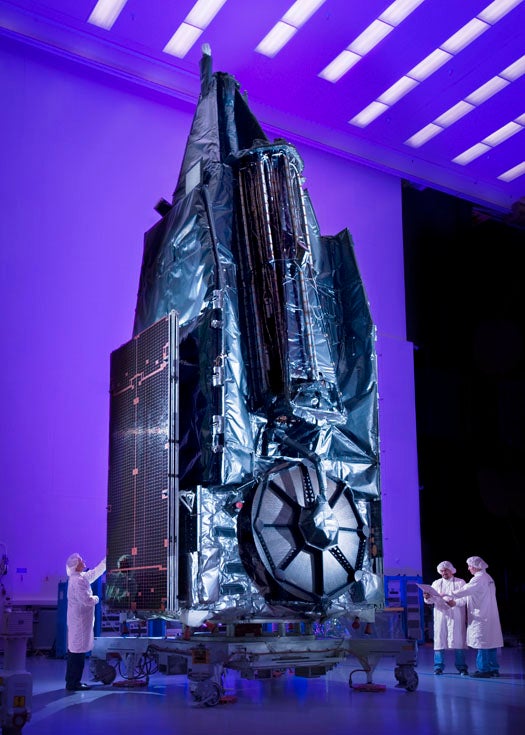
SkyTerra Under Construction at Boeing Boeing

Boeing has received the first signals from SkyTerra 1, a communications satellite it built for LightSquared that was hurled into orbit aboard a Proton rocket launched from Kazakhstan yesterday. The satellite, which will provide signal coverage where terrestrial towers can’t reach, is part of a new LightSquared 4G-LTE mobile broadband wireless system and boasts the largest commercial antenna reflector ever launched into space.

The mesh structure on SkyTerra 1 is an ultra-wide 72 feet across, and the increase in hardware up there should lead to space savings down here. The larger reflector will reduce the need to build bigger antennas and receivers into next-gen 4G devices, so a larger footprint in the sky translates into real estate savings in your pocket.

Boeing and Lightsquared will next initiate on-orbit maneuvers to move the 6-ton satellite into its geosynchronous orbit. It will be joined by SkyTerra 2 next year, and over the next 15 years will augment LightSquared’s ground coverage of North America, which should serve 90 percent of the U.S. population by 2015 under a deal inked with the FCC.

[BBC, Boeing]

23 Comments

I actually worked on that :) It's nice to see something I helped create get on POPSCI. My one moment of celebration ever on a Monday.

Now that is one big satellite...
Ivan Malagurski

Why are they wearing shower caps. LOL!

Waitwut?

The satellite communicates *directly* with 4G antennae? The next generation of cell phones will effectively become, through no virtue of their own, *satellite phones*? How does that even work? I don't even understand how effectively *putting the towers into orbit* does any damned good. Sure as hell doesn't reduce transmission distance and degradation, or provide a larger number of cheaper towers. And, I mean, 4G, WiMax, *real internet access*, directly from *space*? The last-mile service is *thousands of miles*?

Small wonder it's an unprecedentedly huge comsat.

God. The future is just so damned cool sometimes.

Obviously this is for SkyNet to link with all of Japans robots. THE END IS NEAR!! >.o

Aliens: hey is this that new pizza planet delivery express? I would like to order 275 of the gigantic 50 toppings.... make the toppings Grey goop berries, borma, rababa, totties, loogonese, etc!

The only way that will save the common person money is if we can get a cell phone that's not locked into a cell phone provider...and just try finding one that's not locked in. They will probably make having a unlocked cell phone against the law to own.

@WillSpaceGeek

Nice!

satalites are stupid, who needs 'em

I assume this is so you always have SOME coverage no matter where you are. I find it hard to believe this would as fast a tower. LTE is... Sprint?

So what about Sprint and it's "The Nation's First 4G Network" based on WiFi?

Are they about to have a "OMG, we just spent billions on crap!" moment?

Great! ... Now, if they'd put one under the ocean I could snorkle and SKYYPE, at the same time !

Seriously, tho, it seems like (1) It would require special phones with a much higher power client transmitter (in the phone/handset) and, (2) Seems like there would be MANY dead zones (lost signal) within canyons and behind mountains or, in the rain (like satellite TV), for instance.

Still, the Taliban should love this. OSAMA-SAT-4 !

Nice piece of tech. Expanded 4g coverage is awesome. 4g is much faster than 3g. Though i hope we find a cost effective solution to getting rid of all the junk in orbit. Scary to think that really small parts of things could ruin a very expensive satellite.

LTE = Long Term Evolution.

This is the same technology Verizon is using for their 4G network, which they will open to users at the start of 2011. Hmm...maybe they weren't kidding with all those commercials including antennas popping out of buildings and trash cans hahaha. But as always with Verizon, you can bet if they are "renting" coverage from these satellites they will pass that on to the consumer.

Sprint on the other hand uses WiMax for their 4G, which is provided by Clearwire...who is currently seeking (as of yet) non-existing funding. Interesting situation there because Sprint is the majority stakeholder in Clearwire. They (Clearwire/Sprint) are also talking about transitioning their 4G network to LTE because of its higher bandwidth and better signal penetration. Because of the extensive buildout of WiMax it will probably never go away completely, but it will certainly be the underdog to LTE.

> Seems like there would be MANY dead zones (lost signal) within canyons and behind mountains or, in the rain (like satellite TV)

My satellite TV works in the rain and snow. It's been more reliable (fewer and shorter outages) than my cable ever was.

Hey! Isn't that the Chrysler Building?

Looks like a giant pope hat.

Latency.


July 2013: The Future Of Flight

The incredible innovations, like drone swarms and perpetual flight, bringing aviation into the world of tomorrow. Plus: today's greatest sci-fi writers predict the future, the science behind the summer's biggest blockbusters, a Doctor Who-themed DIY 'bot, the organs you can do without, and much more.


Online Content Director: Suzanne LaBarre | Email
Senior Editor: Paul Adams | Email
Associate Editor: Dan Nosowitz | Email
Assistant Editor: Colin Lecher | Email
Assistant Editor: Rose Pastore | Email

Contributing Writers:

Kelsey D. Atherton | Email
Francie Diep | Email
Shaunacy Ferro | Email

circ-top-header.gif
circ-cover.gif