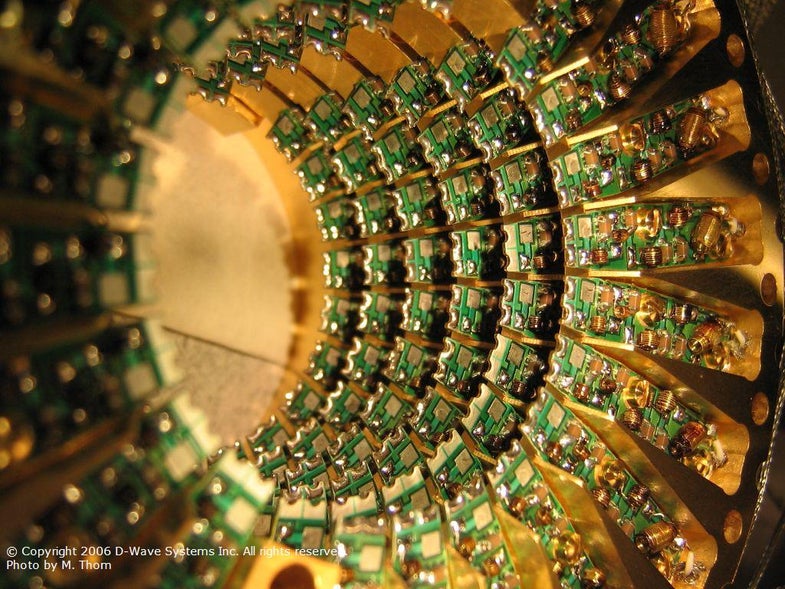
Ramped-up research efforts at IBM and other labs in the U.S. and Europe could lead to more powerful and more prevalent quantum computers in the near future.
IBM is breathing new life into a quantum computing research division at its Thomas J. Watson Research Center, reports New York Times. The computer giant has hired alumni from promising quantum computing programs at Yale and the University of California-Santa Barbara, both of which made quantum leaps in the past year using standard superconducting material.
Groups at both universities have been using rhenium or niobium on a semiconductor surface and cooling the system to absolute zero so that it exhibits quantum behavior. As the Times reports, the method relies on standard microelectronics manufacturing tech, which could make quantum computers easier and cheaper to make.
The Santa Barbara researchers told the Times they believe they can double the computational power of their quantum computers by next year.Quantum computing uses spooky action at a distance to conduct superfast calculations. Rather than using transistors to crunch the ones and zeroes of binary code, quantum computers store data as qubits, which can represent one and zero simultaneously. This superposition enables the computers to solve multiple problems at once, providing quick answers to tough questions. But observing a qubit strips it of this duality — you can only see one state at a time — so physicists must figure out how to extract data from a qubit without directly observing it. That’s where quantum entanglement comes in handy; two qubits can be connected by an invisible wave so that they share each other’s properties. You could then watch one qubit to see what its twin is computing.
None of this is simple, however; there are several competing methods for making the qubits, including laser-entangled ions, LED-powered entangled photons, and more. Google is working with a Canadian firm called D-Wave that has claimed 50-qubit computers, although skeptics have questioned that number. In most systems, the number of entangled qubits remains small, but Yale researchers believe they will increase in the next few years, the Times says.
Even better: with all this practice, physicists are getting a lot better at controlling quantum interactions. Their precision has increased a thousand-fold, one researcher said. That’s good news for anyone studying quantum mechanics.
Five amazing, clean technologies that will set us free, in this month's energy-focused issue. Also: how to build a better bomb detector, the robotic toys that are raising your children, a human catapult, the world's smallest arcade, and much more.


Online Content Director: Suzanne LaBarre | Email
Senior Editor: Paul Adams | Email
Associate Editor: Dan Nosowitz | Email
Assistant Editor: Colin Lecher | Email
Assistant Editor: Rose Pastore | Email
Contributing Writers:
Rebecca Boyle | Email
Kelsey D. Atherton | Email
Francie Diep | Email
Shaunacy Ferro | Email
i thought absolute zero has never been achieved?
it hasn't been, but i think what the author means is that the temperature is a fraction to absolute zero, or just really freaking cold, remember not everyone knows what their talking about and "absolute zero" sounds better than "a fraction of a degree away from absolute zero kelvin" though personally i think it depends on who your talking to.
You're correct calebscape808. Popsci often has inaccuracies in their articles. Best we could do is a few millionth of a degree above absolute zero.
Other than Peter Shor's quantam factoring algorythm what algorithms have been proven in a quantam computing environment?
So what you are saying is this will increase my FPS on my games? Also Is tdoes this mean I can put it in my computer?
"two qubits can be connected by an invisible wave so that they share each other’s properties"
Wrong there is no wave at all, entanglement is a consequence of quantum theory that implies instantanuous commucation between the entangled particules. A wave would be limited by the speed of ligth. Entanglement is really a strange phenomenum as it contradict the theory of relativity and the speed of ligth as the fastest communication medium.
CAN WE PLEASE DO SOMETHING ABOUT THE SPAM POSTS!!
quantum computing is still in very early development stages. We won't see actual quantum based computers for at least 15 to 20 years.
Programming will be much different for quantum based computers and C probably will be some primitive language by then.
For now just wait while transistors shrink and change to better meet our needs. Imagine transistors as small as a few picometers across
PopSci, please guys, your counter-spam measures don't work, howabout when we report a comment that comment is temporarily automatically removed until you guys vet the removal - that may be open to abuse but perhaps other folk here can suggest a better alternative to defeat the spam posts.
I agree with the posts above; the spam is getting rediculous. Reporting doesn't work, so we need some system in which we can remove spam ourselves, because it seems your not doing it Popsci. Maybe a simple system like Youtube? After a comment has been flagged by multiple people it is simply removed.
if you watch one qubit to observe the other via quantum entanglement and the other qubit is simultaneously 1 and 0, then what's the difference if you watch it's twin? Won't the twin also be simultaneously 1 and 0?
@poopshoop
The act of observing a qubit that is simultaneously a 1 and 0 will immediately make that qubit either a 1 or 0. This will then make the entangled quibit instantaneously become the others opposite. You can then know what the entangled quibt is without ever observing it.
"Wrong there is no wave at all, entanglement is a consequence of quantum theory that implies instantanuous commucation between the entangled particules. A wave would be limited by the speed of ligth. "
I'm glad someone is thinking about the exchange particle, but I have to disagree.
If we define the speed of light to be a limit, and we assume there is 'instantaneous communication', we have to conclude that our theories are incomplete.
It's like saying "all apples are red, this one is green, therefore it's not an apple".
It may be a wave.
Ram0n
What if there is no distance between entangled particles on the quantum level? We see the entanglement across what we perceive as space, yet there may be no space between the particles where they exist.
what if at the exact moment that you achieve lightspeed your effing with time so much that the travel is essentially instantaneous? that in reality there is no time quotient to quantum entanglement simply because it is the fastest that you can go without getting there before you leave?
human definitions superimposed on observable phenomenons, especially on quantum ones , limit our outcomes. Heres an experiment, let it observe itself, observing itself , observing itself until there are enough degrees of separation to be objective enough to determine its true state. Human consciousness affects quantum states. Its not spooky, its just not linear.
maybe toroidal wave entanglement will help?
There is also the seemingly absurd possibility that these particles, whether entangled or not, are cognizant of their respective "observed status". i.e. "The Double Slit Experiment". If this is the case, we soon will have to develop new relationships between and an understanding of the pieces that makeup our universe(s).