With the Space Shuttle program winding down, both NASA and several commercial ventures are developing next-gen rocket technology that will hurl the next iteration of space vehicles into the sky. But NASA acknowledges that rockets aren’t the only – or even the best – way to get into space.
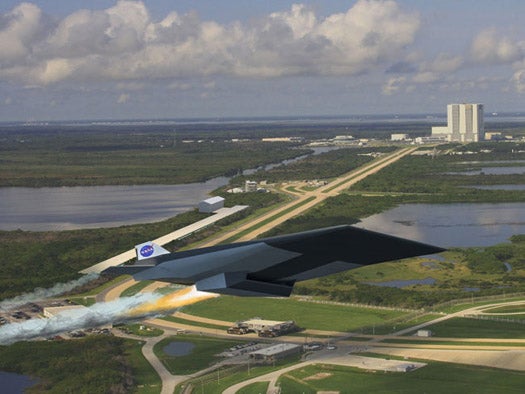
Engineers at the space agency’s Kennedy Space Center in Florida are exploring future space launch schemes that could see spacecraft flung into the heavens by a massive railgun or launched to the upper atmosphere aboard supersonic scramjets. Or, even cooler: both.
If space launches are anything, they’re expensive. As such, launch vehicles that are reusable (like the space shuttles) are key to keeping costs under control. One such scheme for reusable launch craft involves ferrying payloads to the upper limits of the atmosphere aboard scramjets, those air-compressing, high-speed jets with theoretical top speeds more than four times faster than the fastest air-breathing jet engines.
In such a scheme, a payload vehicle (holding, say, a satellite) would piggyback to high altitude aboard the scramjet, which in theory could reach near-orbital speeds. From the upper atmosphere, the payload vehicle would launch from the scramjet propelled by something akin to the second stage of a booster rocket, putting the satellite or even a manned vehicle into orbital space without the incredible thrust needed to launch it from the ground.But how does NASA plan to get the scramjet to the supersonic speeds necessary for sustained flight? Picture a huge railgun rising from the ground at Kennedy Space Center. Using an electrified track stretching for miles, the track would use a magnetic field (or perhaps gas propulsion, or even magnetic levitation – this stuff is all still very much on the drawing board) to accelerate scramjets to otherworldly speeds without expending the huge amounts of chemical energy needed to fire a rocket booster. Once a scramjet is moving fast enough, the jet engine would take over and propel it spaceward.
For now rockets are still NASA’s principle launch vehicles, so don’t expect any spacecraft-hurling railguns or regular hypersonic flights to the edge of space in the immediate future. But these technologies already exist in some nascent form or another. Both NASA and DARPA have been dabbling in scramjet technology for years, creating a vast body of knowledge and data for engineers to build upon. For their part, railguns have been around for nearly a century. All the technologies involved need further refinement, but none are out of reach.
Put another way: NASA is dreaming up massive railguns to launch hypersonic space vehicles into the atmosphere at blinding speeds. What's not to like?

The incredible innovations, like drone swarms and perpetual flight, bringing aviation into the world of tomorrow. Plus: today's greatest sci-fi writers predict the future, the science behind the summer's biggest blockbusters, a Doctor Who-themed DIY 'bot, the organs you can do without, and much more.


Online Content Director: Suzanne LaBarre | Email
Senior Editor: Paul Adams | Email
Associate Editor: Dan Nosowitz | Email
Assistant Editor: Colin Lecher | Email
Assistant Editor: Rose Pastore | Email
Contributing Writers:
Kelsey D. Atherton | Email
Francie Diep | Email
Shaunacy Ferro | Email
They just need to build a nuclear reactor and some HUEG capacitors and make a reinforced railgun. They just need a few days to soak up enough juice to get something to the edge of the atmosphere.
Why not a vacuum in a tube approach? Like the banks use to wisk around containers? With a vacuum a rail type gun could accelerate to even higher speeds and then exit into the atmosphere going make mach 10. Then the scramjet just maintains the speed.
A lightning bolt produces a vacuum, briefly. That is what causes the thunder. Maybe a controlled lightning bolt just ahead of the payload would create enough of a vacuum to reduce drag.
@gizmowix
The problem with a vaccum tube, which is normally a very good idea, is that you're not traversing a distance, but firing something out of it.
The Scram-jet operates by compressing the air that feeds into it by its own speed, and igniting fuel with it. Therefore it generates zero propulsion in a vaccum. If you read about scramjets, its also not easy to just lauch it from vacuum to atmosphere and have it immediately take off. Its an amazingly delicate balance that would be nigh impossible to activate in a split second.
Second is how you create a vaccum tube you can still shoot things out off. The tube must be entirly closed, so if you open the exit as the aircraft gets close, it will be buffeted by a random amount of air, very possibly setting it off balance. at those kinds of speeds, a little off balance means things break.
That being said, there is a compromise of sorts. You start in a vaccum tube and as the object accelerates, slowly let in air so that at the point you must open the firing end of the tube, the air pressure in and out is equal. This will give the partial benefit of reduced drag through much of the acceleration. However that wouldnn't give you nearly the same value as accelerating something through a complete vaccum, and probably isn't worth the cost.
Don't let such inspiring, humanity-transforming vision stay on the drawing board: fund it. No effort would be wasted as both technologies have multiple uses.
Why dont they just have one Giant one arm spinning thing( dont remember what its called) and spin it for a bit till it reaches maximum speed then release the payload at the right moment onto a railgun and then use the rail gun so the energy from both is being used and you dont need so much energy for the railgun
haven't they been assisting launches on aircraft carries ever since the first 1???? I also thought the DOD was in the processes of transforming our navy into a 100% electric system including magnetic launch systems instead of steam based. This is old news. I read that in popsci ten years ago.
@NOM
thunder is caused by the rapid expansion and contraction of air molecules briefly superheated by the lightning.
hmm... Seems like a long time will pass until this will actually be used by NASA. If at all, that is.
@new
Because things on spinning arms tend to spin, and setting spinning things on rails is generally a bad idea. Plus that sounds unnecessarily hard.
...My bad @wryip350.
Has anyone considered what the G-forces of launching from a railgun type device would be??
podbog,
I was thinking the same thing. It seems to me that only no-human payloads could be launched that way.
You guys are a bunch of twat heads.
This idea isn't a new one, NASA talked about rail launch, scamjets and gravity assist launches for decades. In the past how many time have you looked into Popular Science or Popular Mechanics magazine and saw some new rail launched system. My favorite is a gravity assist type first stage launch system like this one I designed 7 years ago,
http://shineinnovations.com/6312.html
With gravity assist accelerating down an incline like what you experiment on in first year of physics on a Galileo incline, the spacecraft and launch system could have about the maximum takeoff weight as a Airbus A380 with 650 metric tonne, over 1,400,000 pounds. The gradual acceleration pick up of speed down a side of a mountain with that much mass could launch a heavy lifting two stage wing rocket when it hits over 450 kph, 277 mph. The Space Shuttle uses 1/4 of its fuel by weight to get it up to 450 kph, this is fuel you don't need to carry with you. On a gravity assist we can use an optional rail system but we wouldn't need one if we use a similar landing gear structure as the A380 on the first stage accelerating platform. As a result we wouldn't have to take the heavy landing gear assembly up into orbit, a much lighter weight one would land the spaceplane because it's landing mass is much less than what it is when we take off, it isn't carrying all that fuel.
This is something we can do now, we don't have to wait another 100 years until the scramjets are perfected....
Ron Bennett
It would save a lot of fuel and help in the transition if they adapted this for commercial aircraft. Too much Fuel wasted on take off maybe we could save some money on airfare.
@riffmage:
Why bother conserving fuel, when they can just cram in more seats/saddles? ;)
thats a space elevator and yes we want to build that two
good idea, but the g forces would be a problem.
besides couldnt a gigantic blackbird-type vehicle release the scramjet vehicle?
bell x-1 worked like that, just multiply the carrier plane and the rocket planes speeds by 10
lnwolf41 Most people are equating a railgun weapon with a railgun launch system. Weapon system lauch a low mass at high velocity, on impact huge energy conversion.
Launch system you you start slow and build up speed.
0-60 mph in 5 seconds at 100 feet, or 0-60 mph in 1 minute at 1000 feet. same speed less G force. we have the land area availble but, we won't do it because it is too simple. the beuacrats would never understand it.
Why not start at a higher elevation??? Even a city like Denver would save thousands of pounds of fuel. A mountain launch would save more.
Otherwise why not use large rubber bands?
Just kidding about the rubber bands.
ARC RAILGUN, using lighting as a current to travel through and the rail gun to sustain that current, kind of like the aliens from War of the Worlds (Remake)
Exploring new space launch schemes is essential for mankind to advance toward outer space exploration. I dream with a more advanced space technology revolution.
www.youtube.com/watch?v=9ScAHXN_kAY
www.crossfirefusion.com/thruster
Inwolf: thatisthe problem w/politicians
jefro: how big would those bands be? ;P
I proposed to NASA a launch mechamism with an orbiting locomotive, which can be mostly solar powered. (As an entry for an idea competition they held last November, but I never heard any results or feedback from this.)
My idea: www.on-nor.net/orbitloc
I think we all know what happens at 88 Miles per hour anyway when their is a flux capacitor involved.