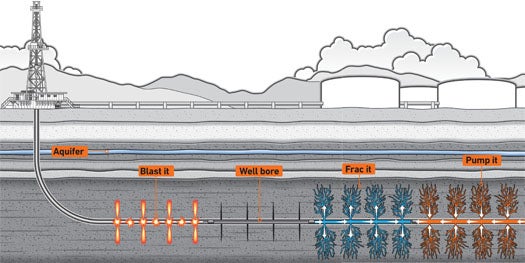
Need some natural gas? To generate more of it—and more income—energy companies are resorting to creative measures, eking out every last bit from the gas wells they drill. But environmentalists and public-health advocates warn that one such process, called hydraulic fracturing, or fracking, can also taint nearby water supplies. Advances in horizontal drilling technologies have allowed energy producers to reach gas packed in dense rock formations that happen to coexist with the sources of drinking water for a sizeable segment of the U.S. population. This fall, the Environmental Protection Agency is releasing a plan to study the health hazards of the practice.
1. BLAST IT
Once a well is drilled and a pipe is secured half a mile or more into the shale, well workers send a “perf” gun down into the pipe. The gun shoots small explosives that perforate the well casing and the rock along the well bore. When the well is complete, the natural gas will flow through these channels.
3. PUMP IT
Well workers stop the pumps. This loss of pressure draws the frac fluid and natural gas, which begins seeping out of the shale and into the bore of the well, up to the surface. In addition to containing natural gas, the frac fluid that emerges from the well is now replete with salt, heavy metals and naturally occurring radioactive materials—all of which pose health and pollution hazards. This spent fluid is stored on-site in pits or storage tanks until it’s hauled away to be pumped into deep injection wells, or to wastewater-treatment plants.
WHY FRAC?
It’s cheaper for an energy company to drill one well with multiple horizontal legs and frac the well than it is to drill many vertical wells and build infrastructure for each one. In Pennsylvania, some customers saw the results fracking could have on their utility bills, which dropped from $122 to $102 in one month.
WHAT'S THE DANGER IN FRACKING?
Each step has room for error. Trucks can spill chemicals, wells can blow out belowground, wastewater holding tanks can spring holes. Carcinogenic chemicals, including benzene, may leak from the well into an aquifer. A single well could contain enough benzene to contaminate 100 billion gallons of drinking water, according to drilling-company disclosures in New York State.
WHAT'S IN FRAC FLUID?
Tough to say. Gas drilling is exempt from the Safe Drinking Water Act, and companies are not required by the federal government to disclose the fracking chemicals in each well. Recent legislation in Wyoming now demands that information. We know that frac fluid is approximately 98.5 percent water, 1 percent sand and 0.5 percent other chemicals. According to Pennsylvania’s Department of Energy, these chemicals include potassium hydroxide and propylene glycol.
CAN IT BE MADE SAFER?
Maybe. Anthony Ingraffea, a civil and environmental engineer at Cornell University who has studied hydraulic fracturing since 1982, says our best bet lies in better ways to recycle the used frac fluid. Since 2009, the U.S. Department of Energy has awarded groups funds to research new techniques to treat this waste.
TCF: Units of a trillion cubic feet are used to measure resources in the ground, or annual national energy consumption. One tcf is enough natural gas to heat 15 million homes for one year, generate 100 billion kilowatt-hours of electricity, or fuel 12 million natural-gas-fired vehicles for one year.
Five amazing, clean technologies that will set us free, in this month's energy-focused issue. Also: how to build a better bomb detector, the robotic toys that are raising your children, a human catapult, the world's smallest arcade, and much more.


Online Content Director: Suzanne LaBarre | Email
Senior Editor: Paul Adams | Email
Associate Editor: Dan Nosowitz | Email
Assistant Editor: Colin Lecher | Email
Assistant Editor: Rose Pastore | Email
Contributing Writers:
Rebecca Boyle | Email
Kelsey D. Atherton | Email
Francie Diep | Email
Shaunacy Ferro | Email
The illustration accompanying the article should have had a notation "not to scale".
There is a mile of solid rock between the aquifer and the well bore.
A 'good' (i.e. successful) frac only extends 300' from the well bore.
For more information:
www.jlcny.org
FRAC! Cylons!
Someone had to say it! :)
I'm a petroleum engineer (who also worked as an environmental specialist for 4 years) and these concerns are baseless. As long as wells are properly completed the shale formation holding the gas is isolated from water aquifers, which are much more shallow and geologically isolated. Also, the whole reason hydraulic fracking became a widely used technology in O&G was to recover hydrocarbon resources from reservoirs (particularly shale plays) that were incredibly 'tight' (ie, low permeability). Natural gas flows more easily than viscous fluids like oil or even water. The only reasonable concern with this technology is that some companies might be irresponsible with the disposal of fracking fluid, but that is no reason to villainize the technology rather than the companies that ignore regulations. The United States is at a point where it needs to decrease it's reliability on imported energy resources more than ever before, and fracking is one very good way for us to recover trillions of cubic feet of gas that we weren't able to produce just a few years ago.
One aspect of fracking that the article doesn't mention is that each well requires the use of millions of gallons of fresh water. Is the natural gas produced a good trade off for such a precious resource?
Wylekyote writes: "The only reasonable concern with this technology is that some companies might be irresponsible with the disposal of fracking fluid..." This isn't correct in that it may not be the only reasonable concern about this technology, but even if it were, it's a good reason not to use this technology in the Marcellus Shale area. The fracking fluid is too dangerous and some people who work at these companies can be irresponsible.
Look up permeability. A material that has high permeability allows fluids (gases and liquids, including water) to the flow relatively easily. Shale is very compact and has a low permeability. Thats the whole reason that fracking shale formations is necessary (and why frack fluid simply doesn't escape in any quantity worthy of concern), it opens up more surface area in the reservoir that gas can flow through. When the gas starts flowing, the majority of fracking fluid is pushed out of the reservoir due to the increasing gas pressure and typically high temperature in these reservoirs. If there is still 'liquid loading" or "slugging", meaning the hydrostatic pressure caused by a liquid (either gas condensate that forms from the decreasing pressure as the gas comes up the tubing, or water vapor/frack fluid doing the same thing) in the tubing string blocks the flow of gas there are numerous methods used to remove the water. Having leftover frack fluid in your well isn't a good thing. And I probably should have mentioned this before, but a lot of oil reservoirs have "water injection" as a secondary recovery method after they slow down or stop flowing due to pressure loss. Since water is more dense than oil or gas, a ton (I'd almost say all that have even a halfway decent PE) companies reinject water in underneath oil and gas in reservoirs which forces the lighter O&G up the tubing to the surface. Honestly it's easier and typically more cost efficient (especially if you consider the fines they'd be facing for improper disposal) for these companies to do the right thing.
If you want to make a case against hydraulic fracking, why not whine about it's seismic effects near large faults. Its true that some fluid injections can act as lubricants along unstable faults and cause some seismic activity (or at least there's a huge correlation and the industry has been coincidentally drilling in areas that start having small quakes...not likely). However, the industry is already taking necessary precautions to prevent this from being a problem because they all know that they would eventually be held responsible and, believe it or not, most petroleum engineers and geologists actually have a conscience. This really isn't even an issue anymore, but you'd have an argument that's at least somewhat valid if you don't mind talking in the past tense.
The environmental effects from this process in Pennsylvania have been horrible. People who can't live in their homes anymore, or drink their well water. The fracking fluid ends up all over the place (whether its supposed to or not).
Look up Dimock, PA at some point. Tell me it's harmless when you can light the water out of the tap on fire...
Yes, these wells are way to deep to contaminate drinking water from the fracturing, but as for pollution I am very surprised at what the drilling industry gets away with in the US, but not in Canada. If I worked for the EPA or OSHA, I could make millions in fines. I have never seen an industry get away with so much. If people would just be careful it could all be OK.
Enammy, I would argue that the contamination in Pennsylvania is due to negligence in the set up of the casing. When a well is drilled, productive or not, fractured or not, the Commission of Environmental Quality (at least in Texas, TCEQ) demands the casing must be set from the surface, past any and all subterranean aquifers as means to isolate the product coming up the wellbore. Unfortunately, some of the companies did not follow procedure or the Pennsylvania equivalent of the TCEQ did not have clear guidelines to protect said aquifers.
CCGRUNT0331
I am no expert in the process, but I don't think it can be chalked up to anything other than deliberate negligence, considering both:
A) prevalence of the problem NYTimes has an interactive map called:
Toxic Contamination From Natural Gas Wells
The area provides drinking water for 16 million people...
B) The Energy Policy Act of 2005, which specifically included provisions to exempt the gas and oil industries from the Safe Drinking Water Act, passed shortly before the recent spate of drilling. In particular the bill exempts the fluids used in hydraulic fracturing.
If it was accidental negligence, I highly doubt the problem would be this widespread. If it was indeed believed that the aquifers would be protected there would be no need to include a provision exempting the industry.
I have a hard time reconciling these two facts as anything but an industry based push to protect themselves from interference or liability from disastrous environmental effects they were well aware of ahead of time.
Like buying Kerosene Fire insurance a week before your business gets mysteriously doused in Kerosene and burns down. Highly suspicious...