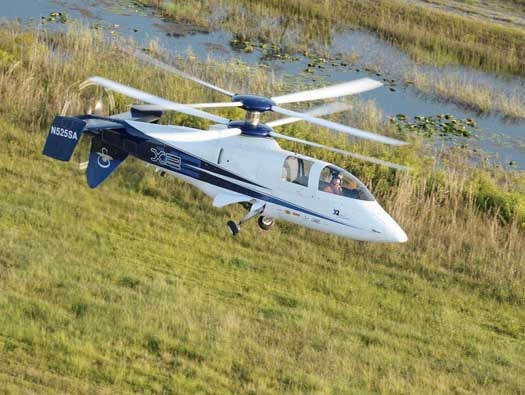
We were quite impressed with the Sikorsky X2 prototype when we featured it last year as a Best of What's New pick, but it's looking even better these days. The super-fast, dual-rotor helicopter is still in the prototype stage, but has already broken the rotorcraft speed record of 249 mph by reaching 258 miles per hour last week during a test flight.
Many helos top out around 200 miles per hour -- for a frame of reference, an Apache attack helicopter's top speed is listed as 176 miles per hour -- so the futuristic-looking X2 is setting the bar pretty high. Its dual-rotor, counter-rotating design creates increased stability for the pilot, allowing its six-blade, rear-facing propeller to push the aircraft to speeds that would make a traditional helo too unstable to keep on a straight heading.
Of course, this was just a test flight and the X2 isn't even close to done setting records. By the time the X2 completes testing, its designers think it can reach 288 miles per hour while still cruising comfortably.
Five amazing, clean technologies that will set us free, in this month's energy-focused issue. Also: how to build a better bomb detector, the robotic toys that are raising your children, a human catapult, the world's smallest arcade, and much more.


Online Content Director: Suzanne LaBarre | Email
Senior Editor: Paul Adams | Email
Associate Editor: Dan Nosowitz | Email
Assistant Editor: Colin Lecher | Email
Assistant Editor: Rose Pastore | Email
Contributing Writers:
Rebecca Boyle | Email
Kelsey D. Atherton | Email
Francie Diep | Email
Shaunacy Ferro | Email
I would like to see an air-screw type craft, just saying. On another note, this is AWESOME
Will this thing be allowed for personal piloting in the USA? If so, I found a reason to renew =D
Why isn't the military doing something with this?
The reason why this design will out-perform a single rotor helicopter is because it is immune from the retreating blade stall effect.
en.wikipedia.org/wiki/Retreating_blade_stall
If you weighed the thing down with the type of armor, weaponry, payload and fuel that the Apache carries, how would it stack up? I'd guess as a prototype it is pretty light on those types of things...
In the late 60s, lockheed built the Chyenne which had a pusher prop. The aircraft was noisey and had a ridge rotor system that falied in high speed testing killing the pilot.
Problem with rotorcraft flying at high speeds is they can not make turns without the rotor blades bending down which is what kill the lockheed test pilot.
@ Gizmowiz
The military tried something similar, to get helicopters to go faster, but the result was that the rotors ended up spinning too fast and breaking the sound barrier...resulting in LOTS of noise, instability and other phenomenon not conducive to stable flight (same reason propeller planes can only fly up to a certain speed).
The increase in speed isn't substantial enough to warrant their attention (IMO). Plus, this helicopter is like a sports car...all it is is a frame and engine...most military planes are loaded down with bombs, bullets, troops, other equipment needed for war. The Apache can't even takeoff with a full load of fuel AND weapons...it has to choose between full loadout of weapons and half tank of gas or half weapons and full tank of gas.
I bet this thing, loaded down with the same munitions as an Apache, wouldn't be able to get off the ground.
Let me clarify, the sound barrier thing with the blades is that the faster you go, the worse the performance of the blade. Helicopter blades can go supersonic, but mostly only the tips (from my understanding)...while the rest of the blade only moves at transonic speeds. Anyway...let me just say that there were too many problems then and they gave up.
I wonder how they solved that problem with this aircraft.
This could make most business jets a thing of the past w/ that kind of speed.
The limitation on a helicopter is that the advancing blade can't exceed the speed of sound. That could be overcome by making the blades passive, except when taking off or landing, and applying power from jets mounted on the sides.
fb36: "This could make most business jets a thing of the past w/ that kind of speed." not only are business jets exponentially faster (Citation X cruising at Mach .92, 607 mph), but they are also much more fuel efficient than helo's. Furthermore, fixed wing aircraft have a much better safety record and have lower maintenance/repair costs than rotarcraft.
One problem with a fast helicopter is that, as the blade goes forward, it exceeds sound speed, and the blade is resisted or even broken by the shock wave.
One solution might be variable pitch blades, that are streamlined as they move forward, but had a deep pitch when moving backward.
Another solution might by a gyrocopter, which has passively moving blades, and is powered by an engine on the sides of the craft. Possibly on landing and takeoff, there might be an engine on the rotors, which goes into neutral once airborne.
Possibly a blade could retract as the craft goes faster. As the tip approaches Mach I, it could telescope back and shorten the blade, then do the same again as the craft goes faster yet. At the end, the rotors might be a yard long as the craft itself approaches sound speed.