$18,000 and 20 hard drives = 5 trillion digits
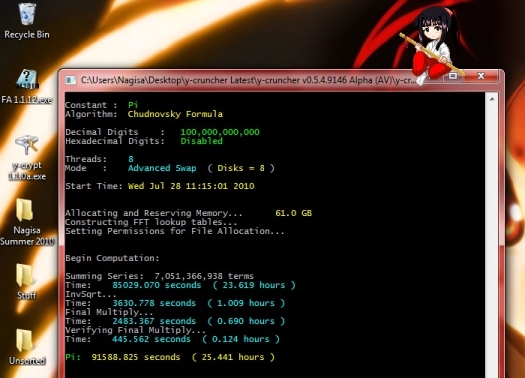
Calculating Pi at Home A screenshot from the software that set the new record via Alexander Yee

Shigeru Kondo spent some $18,000 to build a desktop Windows computer that, over the course of three months, shattered the world record for calculating pi. Running in the 54-year-old system engineer's home, where he lives with his wife and mother, the machine calculated pi to 5 trillion decimal places, nearly double the previous record of 2.7 trillion set by French programmer Fabrice Bellard late last year.

Kondo collaborated via email with Alexander Yee, an American computer science student, to do the calculation. Yee provided the software, called y-cruncher, which ran on Kondo's homemade machine under Windows Server 2008R2. The computer was built out of individually sourced parts, including Intel processors and 20 hard drives.

Kondo tells AFP that he was alone in his room at midnight when the 5-trillion mark was reached. His wife and mother were asleep and, when he told them, expressed "no particular feelings" about the monumental achievement.

[AFP]

30 Comments

ok its cool that they were able to reach that number but theres 1 thing i would really like to know. is that some other program being used with that little person on the cmd window? or is it just photoshop?

61GB of required memory. Damn. That's substantial for a "desktop" machine.

Most of that is probably just to run the girl perched on the window.

Obvious question not addressed in this article: Have any patterns/messages from the deity or extremely advanced extra-universal beings who engineered our universe emerged as the string is extended? I am waiting for this announcement.

Rocker, no need to bible bash... it's PI, a mathematical number, not a conspiracy, not the da vinci code.

It had to be an Otaku XD

Whats the speed record for calculating a billion digits on a cellphone?

@Rocker:

I heard somewhere that after so many characters a book or even string of numbers will develop patterns to spell words and so on...

I wonder, if you took a beach and determined exact points on individual grains of sand that would denote some character value based on orientation, could you see the future after you assembled the data and Google'd it's contents?

Do I smell a DIY Project...?

61GB ? Not really a desktop machine, at least not in 2010 :)

www.tendances-de-mode.com

@thefluffball

Rocker's comment had NOTHING to do with the bible, and everything to do with Carl Sagan's book Contact.

Get your nose out the bible and read a bit.... before making more ignorant comments :D

Actually, I think Rocker is referencing Darren Aronofsky's movie "pi" where the alphabetical equivalent of pi is the name of God.

But seriously... lighten up.

It doesn't say anywhere that the 61GB is all RAM, all HDD swap space, or both. Granted, you can upgrade from 1Gb to 32GB of RAM on a Dell Server for $1000, so double that certainly seems possible with $18k at your disposal.

If they are using 8 bits per character, the 5 trillion characters would take 4.7 TB of storage.

If they are going custom anyways, might as well be more efficient about storing numbers...? Using 10 bits, you could store any combination of three digits numbers, which would get you to 1.9 TB. You can do alittle better by using bigger blocks of number [blocks of 103 would save you another 6.25 GB, but that is near the limit]

i want the perched girl!!!

I was actually referencing an article I read somewhere several years ago (probably in Wired)about an actual, credible theoretical physicist (can't remember his name), who argued that it may be possible to create universes in the lab (may actually be possible for us soon). The laws of physics/mathematics in such universes could be deliberately engineered to include messaging from the creators in constants such as Pi.

Definitely didn't intend to Bible bash, although if you believe every word of the Bible to be literally true, you lose me.

You know every time his wife looked at that thing she wanted to kick the crap out of it. She was like "I cant believe he spent 18,000 on this thing if he wanted to know pie then he could have just hit the button on the dam calculator. There aint no new kicthen button however so we sure as hell could have used the money on that instead and take that dam girl off!

Its purpose is to bassically learn if you can find an infinit number, which has all kinds of meaning if you do because it gives you an idea of say the universe. infinitly small implies infinitly big.

And its not so much Pi as it is the fact that a couple people did this with junk rather than state of the art computers.

Makes you think of the untapped potential of technology. Perhaps our emotions are just really long strings of numbers that show a patern.

Maybe it will help to open doors to new inventions or understandings.

Do you people have no philisophical thoughts. All you negative people, what have you done?

N E Ways, i think its cool. no matter how borring.

61 GB isn't much anymore, when I consider I had to create a dedicated 30Gig temp file just to play BluRay discs in Open Source.

@ Rocker and DevlinT: Also, in Carl Sagan's novel CONTACT the architects of the universe had hidden coded messages inside the value of Pi. This plotline was eliminated from the film version of contact.

However, it is not possible to set the value of Pi. Pi is simple the ratio of a circle's circumference to its diameter in euclidean (flat) space. This will be true everywhere, even in universes like ours where space is not exactly euclidean.

One more comment: I have heard that pi is believed to have the property of "normality" which I understand means that all number sequences occur in its decimal expansion. In fact, no matter which base is chosen to represent the value of pi, any given sequence of digits must occur infinitely many times within it.

So this means that *any message* you look for in pi does occur within pi somewhere -- a fact which makes Carl Sagan's story seem less interesting.

Probably too late in the game for anybody to read this, but I have a question. How does anybody know that these increasingly long values of pi are correct?

Does anybody really know what pi it is, does anybody really care?

Can you email me Pi? I'd like to have a look.

@ford2go

Google it.
"π (sometimes written pi) is a mathematical constant whose value is the ratio of any circle's circumference to its diameter in Euclidean(flat happy high school geometry) space; this is the same value as the ratio of a circle's area to the square of its radius."

@johnt

I'm well aware of what pi is. My question is how anyone knows that these calculations are accurate out to this unreal number of digits. Who would know if the algotithm stared to break down at say 3.2 trillion digits.

@BuschChris
Infinitely small does not necessarily imply infinitely large. Certain functions can extend to +Infinity, but then have a finite limit on the negative side of the graph.

@Ford2Go
They used the Chudnovsky Formula, which is based off of a Reimann Sum to find digits in the number of pi. Just because of the theorems of calculus relating to Reimann Sums, I'm assuming there weren't any mistakes. I think that's actually a safe assumption to make.

But this is really cool. I've been wanting to do something along these lines of finding digits of Pi myself... just never had the extra money to throw at it. Cool though!

...and if they reach the end, what then?

Pi to 5 trillion digits... h.m.m.m....

Who checks his math?

How does one know that it isn't a random number generator after the first trillion or so?

What does one do with a 5 trillion digit number?

Does calculating the radius of a circle to a 100,000th of an electron - really get us anywhere?

>>>>>>>>>>>>>>

At any rate, congratulations Mr. Kondo.
Condolences Mrs. Kondo.

This is a major victory for obsessive compulsives the world over. Finally, some one has come up with a practical use for being able to memorize phonebooks.

I can’t wait for Mr. Kondo to have his work published in its 10,000 volume matched book set.

Only weights 2 tons in paperback.

And, it’s due out on Kindle – shortly after pigs fly.

Spoiler alert: don’t flip to the final 100,000,000 digits – it’ll ruin the surprise ending.

>>>>>>>>>>>>>>>>>

Not to trivialize Mr. Kondo’s accomplishment – here, - but, what “I” find amazing is that WinWoes in any of it’s bloat-code infestations could run long enough to calculate a 5 trillion digit number without locking up – or, coughing up blood into the dreaded “blue screen of death.”

I guess that Mr. Kondo knows for sure - now, that all the DRAM works and all the sectors are good on his hard-drives.

I hope he remembered to “Save As.”

Next week - he divides by zero...

Wow I am speechless, now this is what you call a super computer! Think about the advancements in years to come!

http://camcorderscenter.com/

The last 2 number of pi just have to be 42 its the answer to life and everything else

@dzinerfusion

There are computers from dell that match the performance if you upgrade everything(I mean everything to the top level).
Except the dell one doesn't have the hard drive space.

dell.com (large enterprise)


June 2013: American Energy Independence

Five amazing, clean technologies that will set us free, in this month's energy-focused issue. Also: how to build a better bomb detector, the robotic toys that are raising your children, a human catapult, the world's smallest arcade, and much more.


Online Content Director: Suzanne LaBarre | Email
Senior Editor: Paul Adams | Email
Associate Editor: Dan Nosowitz | Email
Assistant Editor: Colin Lecher | Email
Assistant Editor: Rose Pastore | Email

Contributing Writers:
Rebecca Boyle | Email
Kelsey D. Atherton | Email
Francie Diep | Email
Shaunacy Ferro | Email

circ-top-header.gif
circ-cover.gif