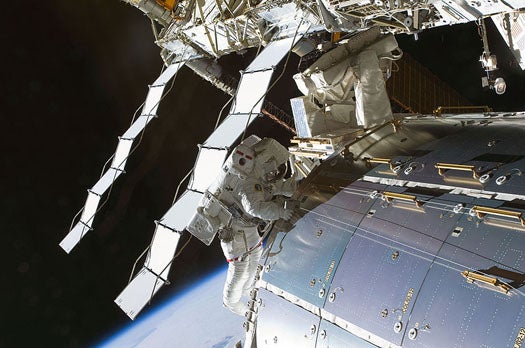
Hanging Out on The ISS's Exterior Astronaut Nicole Stott works on the exterior of the Columbus Laboratory module of the ISS.

Bacteria taken from the scrumptiously named fishing village of Beer on Britain's south coast have proven themselves some of the hardiest organisms on Earth -- or in space for that matter. Bacteria found in rocks taken from the cliffs at Beer have survived a grueling year-and-a-half exposure to space conditions on the exterior of the ISS and returned home alive, becoming the longest-lived photosynthesizing microbes to survive in space.

The bacteria were sent to the ISS as part of an experiment to identify potentially helpful microbes that could be used in life-support systems or bio-mining operations on future moon or Mars missions. The researchers didn't select the bacteria specifically, but rather sent whole chunks of bacteria-laden rock from the cliffs to the station, where they were installed in boxes on the exterior of the ISS's Columbus Laboratory.

Out there, the bacteria were exposed to everything from the wild temperature swings between day and night, cosmic radiation, extreme exposure to ultraviolet light, and the effects of the vacuum of space. For most living cells that's a deadly cocktail, but while some bacteria in the rock died as they were pounded on by the harsh space environment, a colony of bugs known as OU-20 (they were sent up by the UK's Open University) resembling the cyanobacteria genus Gloeocapsa survived.

It's not exactly clear how they did it, but the survivors of the grueling 553-day trial are now back here on Earth for study. Researchers hope such hardy bugs could help future planetary exploration missions extract minerals from rocks or recycle waste on remote planets, allowing something like a permanent moon or Mars base to operate self-sufficiently.

[BBC]

7 Comments

Is this the beginning of a comic book? Who accidently leaks these into their ham sandwich and gains super human rock munching powers? Or better yet, super waste recycling powers?

If this is true then any chance of finding 'undiscovered and new' life on other planets is doomed because there is no way to totally completely sterilize a vehicle going to other planets. The first one there is likely to contaminate the planet and ruin the experiment (of finding new life). Just goes to show you Mars is already probably ruined for good to test for the presence of true Martian life.

Even if you sterilze a vehicle before takeoff it has to shoot through hundreds of miles of atmosphere and it's likely tiny dust components live with bacteria on them will hitch a ride. So forget space exploration it's a waste of time unless ships are shot into space from an orbiting space port and the explorer ships are sterilized in space itself. Otherwise bacteria hitching a ride will just contaminate every place we visit.

Even if you sterilize a vehicle before takeoff it has to shoot through hundreds of miles of atmosphere and it's likely tiny dust components live with bacteria on them will hitch a ride. So forget space exploration it's a waste of time unless ships are shot into space from an orbiting space port and the explorer ships are sterilized in space itself. Otherwise bacteria hitching a ride will just contaminate every place we visit.

So no reason to visit other places unless we can insure were not seeding it with foreign bacteria? That's a bit extreme.

Also, it said this ONE strand of bacteria survived amongst many. So unless they plan on building space vehicles in the south of England out of rocks I think we’ve got good chances.

This does, however, bode well for making future world easier to colonize. The ability to produce biologic material on a hostile world is critical to colonization, as biologic recycling in a closed system will never be 100% efficient. A programed bacteria that produces biologic mass on a hostile world which can be collected, composted, and used as biomass would be a great boon.

Furthermore, those with dreams of terraforming understand that planets are big. All of human industry today barely impacts the planet. Intentional terriforming through mechanical means is functionally impossible. Seeding a planet with bacteria, however, can really put a planet to work. Even today on Earth, most of the planetarially signifigant chemical reactions are performed by bacteria (decomposition/digestion, methan production, etc).

Sure. No pop-bottle-glasses-wearing Dexter of a scientist would ever figure out that he hadn't found extra-terrestrial life on Mars if he ran into mycobacterium tuberculosis in one of his samples -- right gizmowiz?

"Wow! The Martians must all have died of an independently evolved form of tuberculosis!"

I have some suspicion, gizmowiz, that while the entire spacecraft might be as difficult to sterilize as my son's old bedroom (even years later, I know that there is a roving pack of feral sneakers running around in there), the robotic arm and containment/reaction vessel would get some special attention. Furthermore, I find it unlikely that anyone would deliberately put a sample of cyanobacteria in a tea bag and hang it from the side of the vehicle with a kicker charge to disburse it evenly all around the area just to foul up the experiment.

Also, since the crew of Apollo 12 brought back a camera from Surveyor 3 and it was discovered that some streptococcal bacteria -- pre-launch, likely from a sneeze -- had survived, I think the standards for sterile, clean-room standard equipment preparation conditions have been tightened up a wee bit.

As for bad Sci-Fi movie plots, this sounds more like "The Green Slime", but in this case it's something brought up from Earth rather than some fluorescent green poo an astronaut stepped on while putting demo charges on an asteroid.


June 2013: American Energy Independence

Five amazing, clean technologies that will set us free, in this month's energy-focused issue. Also: how to build a better bomb detector, the robotic toys that are raising your children, a human catapult, the world's smallest arcade, and much more.


Online Content Director: Suzanne LaBarre | Email
Senior Editor: Paul Adams | Email
Associate Editor: Dan Nosowitz | Email
Assistant Editor: Colin Lecher | Email
Assistant Editor: Rose Pastore | Email

Contributing Writers:
Rebecca Boyle | Email
Kelsey D. Atherton | Email
Francie Diep | Email
Shaunacy Ferro | Email

circ-top-header.gif
circ-cover.gif
bmxmag-ps