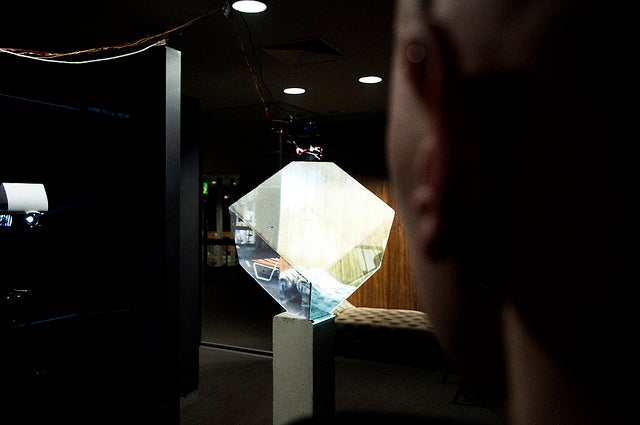
Cloaking device: on!

The amazing disappearing concrete block Markus Kison/Flickr

Clever augmented reality applications are becoming the natural byproducts of our modern computers--computers that are tiny, have eyes and other location-aware sensors, and are able to place a synthetic layer of information on our view of the world around us.

The latest is this "invisible" block of solid concrete dreamed up by artists Daniel Franke and Markus Kison. So how does it work?


When a viewer approaches the fixed concrete block mounted at an angle on a pedestal in the middle of a gallery, a rotating cameras on top picks up his/her face and calculates the viewer's exact line of sight. Custom software (written with the visually-oriented openFrameworks platform) then computes the exact angle and composition of the scene being blocked by the cube and projects it onto the face of the concrete. So, if you're aligned properly, you see right "through" the block at the uninterrupted forms of the chair and bench on the other side.

The project is called "Durchsehen, Exp. 01 (augmented perspective)" and was displayed at a gallery in Berlin this year.

[Designer's Page 1 and 2 via CoDesign]

15 Comments

very cool, emagine if the could be aplied on mass effect

yep first post baby :0

Interesting.

Maybe this will help make omni-tools more likely...

This is a great subject, and a subtle change in how Popsci is reporting. This article actually explains how it works. Well done.

It is amazing method to present our reality actually. But I think that if we will want to be more view of image, it should be very diffcult finish.

Camera, meet projector. Projector, meet concrete block. Human, meet...hey! Where did that concrete block go?!

On a related note, what the heck does your comment mean, Anson Leung?

-IMP ;) :)

Barley invisible. You'd have to be brain dead not to be able to tell it's not there.

Maybe Roadrunner could order one from Acme and use it on Wiley.

Too bad it'll only work for one viewer at a time.

Cool, but hardly an innovation considering the extreme limitations.

Similar tech could be used to render a surgeons hands invisible. The front of the gloves could have several cameras and the back of the gloves would display what the cameras see. It seems like I read an article about that at some point in time.

I remember reading PopSci a while back and them having an article on real invisibility, using fiber optics or something like that, so people could see through you. I didn't work too well, but it's still really cool.

so that means we can invisible tanks!

Really cool application and as others said there could be even more interesting uses for the technology. This definitely goes beyond the type of augmented reality apps that we see today. The current crop of AR advertising, marketing, and gaming programs are useful and "sticky" to varying degrees. My company, Atomic Greetings creates augmented reality greeting cards that allow people to send personal and private video messages inside the card. By all accounts people find our product useful, fun, and sticky.

If everyone follows these guidelines augmented reality will be mainstream very quickly.

Stan Timek
Atomic Greetings
http://atomicgreetings.com

Augmented reality greeting cards done right, with video!

we can 'invisible' tanks. we can 'invisible' anything we want, but it goes against the rule of the geneva convention. thou shalt not blind thine enemies :D
@kgbstoli: this couldn't make anything invisible. it is augmented reality. you would have to be wearing what we used to call 'V.R. goggles' to see the concrete block as 'invisible'
we aren't cloaking tanks OR concrete blocks. just making a window where a wall was.. but only if you're looking at the computer's video output, which is in a head-mounted display to best experience the augmentation of your reality.

@jeditalian, I suppose stealth technology is against the Geneva Convention then?

Also, I think you missed something there. No goggles required. The technology could potentially be improved to a point where an unsuspecting viewer would not detect the concrete block perhaps until they got very close to it.

how about using very thin fiber-optic cables, wave-generators and extremely small computers, perhaps numbering in the thousands to weave a fabric that can analyze light waves striking an enclosed object (a human wearing the suit) and can re-generate "back-ground" objects on the surface of that material for 360 degree viewer perspectives? is this feasible? comments.


June 2013: American Energy Independence

Five amazing, clean technologies that will set us free, in this month's energy-focused issue. Also: how to build a better bomb detector, the robotic toys that are raising your children, a human catapult, the world's smallest arcade, and much more.


Online Content Director: Suzanne LaBarre | Email
Senior Editor: Paul Adams | Email
Associate Editor: Dan Nosowitz | Email
Assistant Editor: Colin Lecher | Email
Assistant Editor: Rose Pastore | Email

Contributing Writers:

Kelsey D. Atherton | Email
Francie Diep | Email
Shaunacy Ferro | Email

circ-top-header.gif
circ-cover.gif
bmxmag-ps