NASA: Fixing what Yeager broke

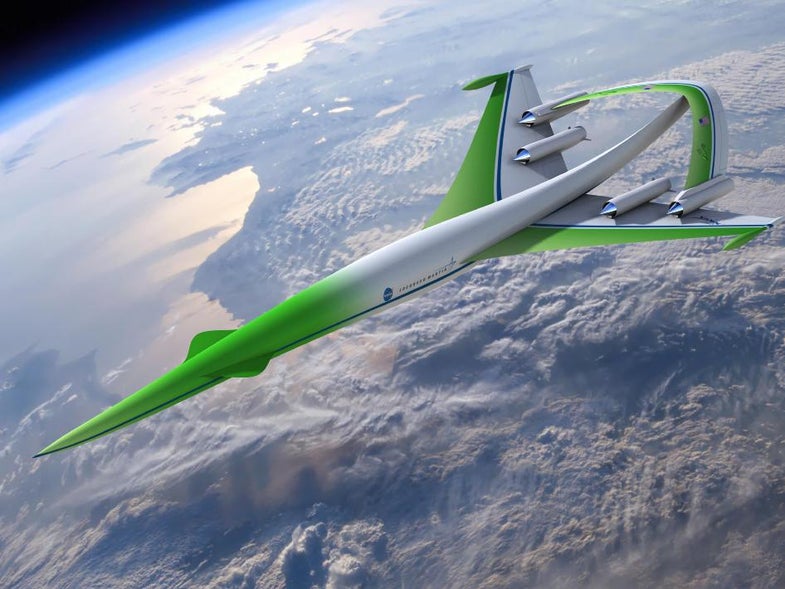
A Boomless Sonic Jet Lockheed Martin Corp. designed this supersonic aircraft, which aims to reduce the potentially damaging sonic booms that prevented the Concorde from being flown over land in the U.S. NASA

True to its aeronautic roots, NASA is evaluating a new generation of supersonic airplane designs to see whether they can reduce sonic-boom levels.

Boeing and Lockheed Martin have submitted futuristic concepts that look similar to the Concorde, but aim to muffle the annoying and potentially damaging sonic boom problem.

Airplanes flying faster than sound create a cone of pressurized air molecules that extends to the ground, as NASA explains. The shockwave is noisy, but it can also cause structural damage, and in the Concorde's case, the U.S. wasn't having it. The supersonic jet never flew over land in the U.S.; sonic flights are restricted to military and research aircraft.

The new designs could make over-land travel possible, however, by using special engine or tail designs that reduce the shockwave effect.

The Lockheed design uses an inverted parabolic shape over a V-shaped engine array. The parabola would control air flow in a way that would lessen the shockwave, NASA says. It also has improved range, payload and environmentally friendly designs.

The Boeing concept, below, also uses a V-shaped twinned tail section, and like the Lockheed jet, it also places the engines on top of the wings. The Concorde, like nearly all current commercial aircraft, put the engines beneath the wings.

As Wired's Autopia blog notes, the design takes advantage of the wings as a natural sound barrier.

The planes are still a long way from takeoff -- NASA anticipates the aircraft could enter service by 2030 or 2035.

Boeing Boomless Jet: Boeing's concept places the engines on top of the wings, adding an extra sound barrier.  NASA via Wired

[Autopia]

29 Comments

I would love to see this put to commercial use, but Congress has banned super-sonic commercial flights over land, regardless of the size of the boom.

Even with the ban lifted, who would invest? A start-up would face massive barriers to entry. An established carrier would worry about taking passengers away from their highly profitable first-class fares. You might argue that it might be adopted to take fares from other airlines, but the shakey financial history of the Concorde shows how risky this investment is. Until the ban on super-sonic over land is lifted, this won't do much to improve our lives.

Still, it's pretty cool.

If you think about it, how much did it cost to start the airline industry as we know it today? Probably more, because airports and infrastructure had to be built as well, whereas this would only cost what the airplane cost itself. I think it would be good, but I can't see how it could be environmentally friendly if it is as big as it appears and burns enough fuel to go supersonic.

I would love to be able to fly across the country in under two hours.

Make it so.

if you look right under the title what do you see?
NASA: Fixing what Yeager broke
LMAO
any way what a great idea because the only reason airliners arnt supersonic is because every time one flys over you there be a sonic boom.
i get enough of those all ready from random expermental aircraft from classified. but all the other airliners come over my house once 10 mins that would get really annoying.

but may be i can make them in to some sort of extemelyy loud clock?

I would love to be able to fly back home in under 20 hours!!! but alas... it doesn't really matter because even the 20 hour flight costs me an arm and a leg.

Those planes fall right in line with the prediction of the future as told by anime...

Considering Concorde's sonic boom was only banned cause Boeing failed miserably with the SSX and Pan Am were gonna buy a foreign aircraft so the US invented a law just to stop the sale, they could just drop the petty law now Concorde is dead.

It's not like the US doesn't have military planes breaking the sound barrier every day over the country!

Boeing's design looks suspiciously like the Normandy from Mass Effect.

I live near Windsor in England which Concorde used to fly over now and then. It was noisier than other aircraft but hardly deafenning. In fact it just kind of made you proud of what can be acomplished. Assuming they would be an alternative to current planes and not a replacement I think a few overland flights wouldn't really be an issue. Even if all carrier aircraft were eventually replaced with supersonic ones I imagine we'd just get used to it. I expect when they first started using the planes that fly over my house every 20 minutes or so people complained they would be "defeaning" nobody even notices them and I'm sure we could get used to supersonic aircraft too. Man up people, its just noise.

I have several thoughts I'd like to share. First, I think Rebecca got it at least partially incorrect (or her editors) as the Lockheed Martin caption mentions "sonic booms that prevented the Concorde from being flown over land in the U.S."

I know for a fact that the Concorde made appearances in Oshkosh, WI. The important detail is that it flew over the US sub-sonically, yet it did fly over the US.

Advances in engine design have significantly reduced the sound of modern jet engines. This is somewhat dictated by noise ordinances.

The Concorde had roughly 100 seats. When I saw it in person, it was substantially smaller than what I had imagined. I am unaware of the intended specifications of these new designs, but they most probably won't be the size of an Airbus 380 because of design limitations inherent to any supersonic aircraft--structural integrity, pressure vessel, heat due to friction.

Yet other comments have a good point about cost--how will existing carriers fund an SST or even HST aircraft at this point in history? Perhaps we could use another round of stimulus funds.

I can't wait for the future to come, i mean supersonic jets, floating ecotopias, ecotropolises, it will be awesome.
My problem is that we keep talking about this stuff, but we never do it. If we keep this up, we will never see the future, so stop talking and start doing.

@kaliberbeats Yes the military does have aircraft flying over the US at super sonic but they are not always flying at that speed and generally speaking don't unless over a range. The other reason that they may have that law is that it seems the civilian industry lends itself to a lack of integrity on inspecting and repairing the aircraft. Whereas when I told people in the service that it was an unserviceable aircraft the military didn't try to have someone else reinspect and call it good. Instead it forced the hand to get the proper repair. Something that eludes profit chasing industries. Why because if someone that does the job I did costs profit on large scale the civilian industries have someone else fudge the inspection to keep profits rolling. As has been brought up in many civilian accidents.

Please bear in mind that this statement is made based mainly on my integrity, and work ethic. I can't speak to every situation or persons level of integrity. I can only say that the planes I was assigned typically were able to out perform other peoples planes over time... the time it took me to get the planes to my standards.

Fuel ... It's all about fuel! A 727 is faster than a 757 but is sucks more fuel for less payload. The Concorde was retired because it was a fuel hog ... which is why it cost so much to fly on it. Right now it's more about packing more people on than going faster.

@ Alastes
NASA is getting ready for the Krogan attack.... lol

There are military aircraft that break the sound barrier -- but this is restricted to relatively unpopulated areas. Besides, it's expensive and they don't do it a lot.

The Concorde is a technical marvel, but it produces a bigger sonic boom than most fighters. ( The Boeing proposal would have been louder still). Also, it would produce it continuously over a standard commercial route if not for the ban. Sonic booms are loud. Whoever said that they live near an airport doesn't realize that they probably throttle down before they get there.

Then there are the economics. 100 passengers in a fuel sucking aircraft is not an ideal plan. Not to mention that the Concorde is probably a fairly high maintenance aircraft. I doubt that it would have survived even if the ban had never been enacted.

ITS SOOO BEAUTIFUL!!! I MAKES ME WANT TO JUST... UNNNMMM UGGGHHH... AHHHHH!!!

so good

In the late 60's Lockheed had the world's best SST design but it could not be manufactured as there was not enough titanium machining capability. Lockheed had the SR71 titanium experience to know. Computer controls were too slow, the tires would melt, the wings were too hot upon landing, etc.

Boeing's swing wing was awarded the government contract. It was a failure on paper and in all tests so Boeing switched to the fixed wing Lockheed design that had lost the competition.

On it's best design day, it could fly three quarters of the way from New York to Paris before landing in the big pond with the required passenger loading. So is this "supersonic" design below the temperatures for aluminum aircraft (a la Concord) or is this one another Mack higher like an SST in titanium or exotic materials?

AWESOME!!!!

I never understood why an advancing civilization would go backwards in commercial avaition.

Another gee-whiz concept that will fly no further than the covers of Popular Science magazine, along with aerocars in every garage and jetpacks. (Okay there ARE aerocars and jetpacks. I just haven't seen any zooming overhead, lately) It will always cost way more to fly the same distance faster. That's why the Concorde was used by mainly by the likes of millionaire businessmen and supermodels. Maybe it's simply better to not be in such a hurry in the first place? Supersonic travelers remind me of Larry Ellison, who having beaten his fellow yachtsmen in a race, proceeded to buzz the runners-up in his private jet.

Give me biofuel-burning, subsonic travel that I can afford, anytime. Better yet, a planetary Maglev train system running inside vacuum tunnels; now that's a magazine cover that ought to become reality.

Another concept that won't become a reality until I'm good and dead. Yeah it starts out at 2030, then it will be pushed back to 2050, 2080, 2085, etc. We talk about this advancement of the human race and how the future will be (think of those 2057 television episodes that aired). Unfortunately to me it seems as if in the year 2057 and so on the world will be pretty much the same as it is today just with slicker cell phones if that.

Phoghat

from Elmhurst, NY

Pi * R^2? Pi are round, cornbread are squared

Current fuel prices are stratospheric, what will they be in 15 or 20 years? The airlines are dying because of it. Not to mention the the waste of organics these will generate.
I'd love to have these as much as anyone, but I don't think it will be able to pass a reality check

"Never flew over land in the US"? Where did you come up with that?? Aside from my recollection of it landing once at Cleveland Hopkins International Airport in Cleveland, OH, while double-checking that memory I found this in a wiki article:

"The U.S. Congress had just banned Concorde landings in the US, mainly due to citizen protest over sonic booms, preventing launch on the coveted transatlantic routes. However, the U.S. Secretary of Transportation, William Coleman, gave special permission for Concorde service to Washington Dulles International Airport, and Air France and British Airways simultaneously began service to Dulles on 24 May 1976".

It maybe never flew supersonic over US soil, but it did fly over land in the US.

"...there is an expanding frontier of ignorance...things must be learned only to be unlearned again or, more likely, to be corrected." - Richard Feynman

Back in the day NASA did a lot of R&D heavy lifting that was eventually passed on to the commercial sector. This could be a move back in that direction.

Granted, the laws that are on the books preclude commercial supersonic flights over the US based on flight performance of the state of technology 40 years ago.
If NASA develops a design that sponsors acceptable parameters, the laws can be modified.

First, they have to advance the design past the original US SST.
Second, they have to build one.
Third, they have to see if the real one performs half as well as the simulated one in their computer.

Theoretically, mitigating the boom is pretty easy.
Altitude is your friend, the higher the better. If possible, go trans-atmospheric. The thicker the atmosphere – the better it propagates the sonic boom wave. If you’re skimming thru thin air, there’s noticeably less coupling to the ground… The down side, you have to pack an on board oxidizer for the fuel for more conventional engines.

If you want to bite the bullet and go for a scramjet, then you have to pay a penalty for flying multiple engines, the scramjet to cruise at hypersonic speeds - and, another engine to get up to speed where the scramjet will light off.

The problems arise when moving from theory to reality.
The really cool hypersonic designs rely on “and – then a miracle happens” pieces parts.
You just can’t go down to “Hypersonic Engines – R – Us” and pick out your power plant in your favorite designer color.
A Lot of what NASA wants to exploit are laboratory curiosities – based on a couple of proof of concept proto-types… Nothing I would want powering an aircraft that I would put my mother on.

That’s probably the point…
Pull a pie in the sky design out of a computer… Dump gawd awful amounts of money at contractors to implement the miracle parts. Then see if they all integration into a stable survivable craft.
At least with today’s technology, they won’t have to risk a flight crew to test fly the thing.
They can do all the test flights over water with fly by wifi.
Everything’s better with Bluetooth.

The only thing standing between NASA and the shiny new Hypersonic plane is a few billion dollars.

I thought that sonic booms were only made by aircraft flying at (or near) the speed of sound. If the aircraft flies significantly faster say 1.5 times speed of sound it does not produce a boom. The boom would then be only over a short area as the plane went transonic.

PEOPLE!!! Did you guys even read the @#%$ TITLE?! The whole point of the concept plane is to get RID of the boom! Jeez!

Along with nuclear... this will be our future...
sonic boom or no sonic boom (preferably without)

I hope they fly on biofuel by then.

The Concorde was banned because it was not American - if it was then they would have not cared about a sonic boom... Pan Am would have had loads of them (New York to LA in 2 Hours, yes please!) and they would have made millions. Because the money was going to leave American hands - and american companies would have been shut down due to not having them they put in a silly law. It had more to do with industry then the American people - dont be fooled otherwise.

With regards to these, they will be about soon - but i doubt anyone other than the mega rich will get to fly on one.

also - it really looks like the Normandy from Mass Effect, either genius or someone needs to be fired!


138 years of Popular Science at your fingertips.

Innovation Challenges


Popular Science+ For iPad

Each issue has been completely reimagined for your iPad. See our amazing new vision for magazines that goes far beyond the printed page


Download Our App

Stay up to date on the latest news of the future of science and technology from your iPhone or Android phone with full articles, images and offline viewing


Follow Us On Twitter

Featuring every article from the magazine and website, plus links from around the Web. Also see our PopSci DIY feed


February 2012: The Future of Fun

Science is reinventing play, from extreme sports to gamification to ridiculous roller coasters to the playgrounds of tomorrow, and this issue is chock full of fun. Also, on a less fun note: Did global warming destroy my hometown?


circ-top-header.gif
circ-cover.gif