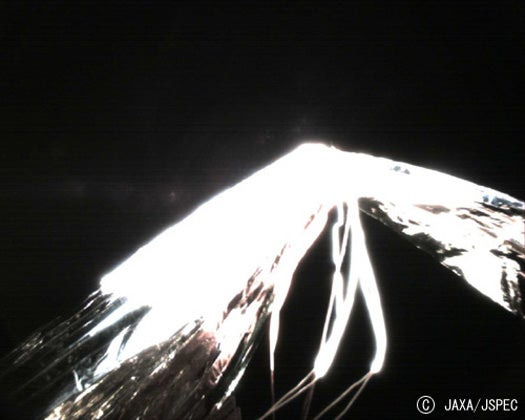
IKAROS Unfurls Its Solar Sail JAXA

It’s sink or sail time for Japan’s IKAROS spacecraft, and according to initial reports from JAXA the unfurling of the first solar sail deployed for actual deep space travel went off without a hitch.

But the successful sail deployment isn’t a guarantee of success. IKAROS (Interplanetary Kite-craft Accelerated by Radiation Of the Sun) still has to get moving, and mission handlers say in their blog posts today that it will be a few weeks before we know if the sail is really working the way it is supposed to.

How is it supposed to work? The sail is made of aluminized plastic that’s a mere 0.0003 inches thick and covered in thin-film solar cells. When photons from the sun strike the sail, they bounce off and impart their forward momentum to the sail, which tows a small spacecraft. Photons are quite small but they are also abundant, so while it takes a while to get moving, that momentum builds up over time.

Since it’s powered by the sun, solar sail craft require no propellant or other power source, which make them a leading candidate for long-distance, interstellar space travel. And because the sail collects photovoltaic electricity as well, future spacecraft could be augmented with an engine that also runs off the suns energy.

Of course, none of this works if the ultra-thin sail doesn’t deploy properly. JAXA was able to coax their sail into unfurling by rotating the spacecraft rapidly, spinning the sail out with centrifugal force.

IKAROS is more or less a proof of concept, so the craft isn’t designed to do anything beyond proving the technology can actually carry the craft out of Earth orbit and toward the solar system beyond. But JAXA has a second solar sail mission slated for later this year in which the spacecraft will integrate ion propulsion engines with a 164-foot solar sail. That spacecraft will attempt to reach Jupiter and the Trojan asteroids by cruising on sunshine.

[Wired Science, JAXA]

19 Comments

How will this work if THERE IS NO WIND IN SPACE!!!!

really... they explained how it worked in the article ... read it

I can't tell if you are being serious so..I'll assume not and lol along with you. lol gasp!

Personally I'm amused that they launched a proof of concept, and already have the other mission almost ready to go before this even returns any data.

I'm guessing they're confident the idea is solid... unless of course this ends up being a dis-proof of concept in which case they may want to re-think the second launch :-)

I think I see a...

************/|
***********/-|
**********/--|
*********/---|
********/----|
*******/-----|
******/------|
________|_______
\------Failboat--------/

I think I see a...

************/|
***********/-|
**********/--|
*********/---|
********/----|
*******/-----|
******/------|
________|_______
\------Failboat--------/

Of course there is wind in space, it's called solar wind!

i wonder what happens if the sail rips since its so thin

i think its amazing how these agencies give their projects acronyms that also turn out to be fitting names.

I.K.A.R.O.S => Icarus, that's cool

^I think there has to be a closet english major on every engineering team to come up with these as a requirement.

The irony in using I.K.A.R.O.S is that Icarus failed. Hopefully this does not as it is a promising venture.

--GTO--

Solar wind is the photonic emissions from a star that shoot out in mulitple directions. Such energy can be harnessed by devices such as the IKAROS unit. Now we can only hope that the IKAROS does not end up just like Icarus, but if it does, perhaps they will learn and move on. I think it's great that someone is actually risking something in the name of science.

and what about Micrometeoroid's? aren't they slowly rip the sail? I don't think this has any future for space filght.

Icarus failed by flying too close to the sun - this thing will be going in the opposite direction.

the best thing about science is that even when an experiment fails, we learn something. sometimes more interesting, suprising, and important things than if the experiment had succeeded.

Now we just hope no sand sized particle scrapes the sail if it starts moving. It'll be sad if we hit a speed of 3km/h just to fail because of space debris.

Well luckily it's not American dollars paying for this venture... although I wish it was. America's days are numbered if we get our @$$ handed to us by the rest of the world in the space race.

...or medical science, or environmental science...

... oh wait... WE ARE...

It may just be me but doesn't this sail sound alot like the debris that came down in Roswell NM years ago? It was metallic and looked alot like a supposed weather ballon?? I am just saying thats what I though of immediately.

I dont undstant why they would,if they know the myth, name the project Icarus.Perhaps this IKAROS's undoing will be that it flew to fare away from the sun.

To: 7biologist7 They will exploit a phenomenon called radiation pressure.The radiation pressure comes from the solar wind.The solarwind is radiation
from the sun.

internet tv

Live long and prosper friends.

“Interstellar” travel keeps being mentioned with this technology. I may just be confused here, but wouldn’t there be an increasing amount of photons approaching from the opposite direction (or from any other direction for that matter) when it approaches another star system. And wouldn’t these apposing photons either destroy the sail, or at least “blow” the sail in another direction?


140 years of Popular Science at your fingertips.

Innovation Challenges


Popular Science+ For iPad

Each issue has been completely reimagined for your iPad. See our amazing new vision for magazines that goes far beyond the printed page


Download Our App

Stay up to date on the latest news of the future of science and technology from your iPhone or Android phone with full articles, images and offline viewing


Follow Us On Twitter

Featuring every article from the magazine and website, plus links from around the Web. Also see our PopSci DIY feed


June 2012: Invent Your Own Anything

The 6th annual Invention Awards are here, from an inflatable tourniquet to a better lobster trap to spring-loaded hocket skates. This issue is all about the celebration of invention.

Plus: Making synthetic biology breakthroughs in a garage, building a constantly-moving ping-pong table, and a ridiculously overpowered barbecue.

circ-top-header.gif
circ-cover.gif
bmxmag-ps