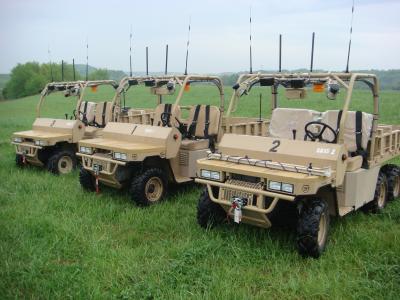
VT's Ground Unmanned Support Surrogates (GUSS) The autonomous navigation technology in each GUSS was developed as part of Virginia Tech's 2006 and 2007 DARPA Urban Challenge vehicle. Virginia Tech

Technology developed by Virginia Tech for DARPA's Urban Challengein 2006 and 2007 is heading off to war, joining the U.S. Marines and troops from 13 other nations at in Hawaii for the Rim of the Pacific (RIMPAC) war games next month. Aiding platoons of marines as they participate in the Naval Laboratory's experimentation that accompanes RIMPAC, VT's Ground Unmanned Support Surrogates (GUSS) will autonomously help grunts haul supplies, transport wounded, and carry out other platoon support tasks.

Four of the unmanned vehicles will join the 100 aircraft, 34 ships, five subs, and 20,000 personnel participating in RIMPAC. The off-road vehicles -- which somewhat resemble hardier versions of those John Deere Gators used to haul injured players from NFL fields -- can move 1,800 pounds at 5 miles per hour, about the pace of troops moving on foot.

But it's not the vehicles themselves that are the crux of this system; the autonomous navigation system that VT's Urban Challenge team developed for the Urban Challenge is getting its first big real world test at RIMPAC. The system earned third place in the 2007 autonomous vehicle race, completing DARPA's 60-mile course in less than six hours all by itself. That system has been greatly improved over the course of three years, but it faces new challenges on the battlefield as it will have to negotiate tricky terrain, seamlessly switch between autonomous and remote control modes, and deal with rapidly changing mission objectives.

Developed in conjunction with TORC, a private company founded by alums of VT's robotics program, the GUSSs are controlled via an interface known as WaySight that allows marines to command the vehicle in several modes. Using a one-pound handheld controller, marines can take remote control of the vehicles, give their autonomous nav systems new routes or objectives, or simply tell them to follow autonomously at a safe distance.

GUSS development and testing is part of an ongoing contract between VT and Navy researchers, so a successful test run could see these kind of autonomous pack mules move closer to becoming regular fixtures on future battlefields.

[Eurekalert]

10 Comments

... until the enemy hacks your controller/GUSS link and drives all your supplies off a cliff.

pretty sure they would prefer to hack our predator drones first

The already have hacked our predator drones. . .They didn't take control, but it seems like insurgents were able to stream the same video feed as our military without much difficulty or expensive technology. I believe the article was on PopSci awhile back actually.

hacking the videos so they can watch their comrades die isnt as big of a deal as taking control

Thanks for picking up the story! Just to clarify, TORC worked closely with Virginia Tech and the Marine Corps Warfighting Laboratory in the development of the GUSS systems. TORC's full product line was integrated on the vehicles (in addition to the WaySight being the primary operator control unit) - from drive-by-wire conversion, emergency stop systems, power distribution modules and the autonomous navigation system, which is a custom version of our AutonoNav product.

See more pictures and video of GUSS at www.torctech.com/media/guss/

Hey your missing doors I see a new no door lawsuit coming down the road. If this wise arsed comment saves you a lawsuit, and a troop an arm your welcome.

awesome; now camoflage them to look like fully armoured humvees, & send out in road patrols,that way they'd be taken out by road side bombs;& less personal killed or maimed
you could use golf carts, similarly camoflaged,& remotely controlled, then there could be couple out front, or every second vehicle a drone;
or sent down narrow streets to check for insurgents,or used as launch vehicles for drones;
lots of possibilities for search & rescue also

I like how we are using preexisting equipment to build these autonomous vehicles. As for the decoy vehicles that lousephyr mentions, that makes a lot of sense. Hundreds just driving around. Hey if putting up decoy cop cars helps slow down traffic on our streets, I wonder what decoy tanks would do to a war zone.

Let's hope the insurgents don't think to use anything like the pair of 10x50 binoculars I paid 15 bucks for.

The GUSS vehicle looks a lot like the LASSO developed by VSE Corporation, but it seems to fall short of some of the LASSO's unique off-road capabilities - http://www.youtube.com/watch?v=Eff7M9EZYPc. LASSO was built from a blank slate as well, not developed by beefing up an existing product. It's top speed is 25mph and carries 3000lbs of payload. Even the look of the GUSS robot is eerily similar to the LASSO and LASSO's been in development since 2005.


June 2013: American Energy Independence

Five amazing, clean technologies that will set us free, in this month's energy-focused issue. Also: how to build a better bomb detector, the robotic toys that are raising your children, a human catapult, the world's smallest arcade, and much more.


Online Content Director: Suzanne LaBarre | Email
Senior Editor: Paul Adams | Email
Associate Editor: Dan Nosowitz | Email
Assistant Editor: Colin Lecher | Email
Assistant Editor: Rose Pastore | Email

Contributing Writers:
Rebecca Boyle | Email
Kelsey D. Atherton | Email
Francie Diep | Email
Shaunacy Ferro | Email

circ-top-header.gif
circ-cover.gif
bmxmag-ps