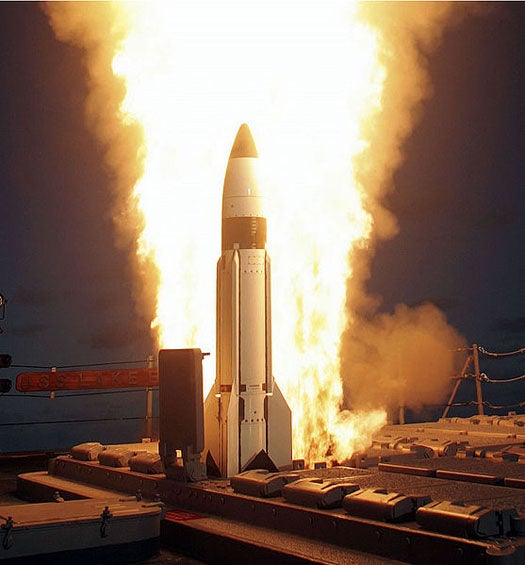
The SM-3 Interceptor A 2005 test launch lifts off from the deck of a Navy Aegis cruiser. U.S. Navy

The Obama administration has worked tirelessly towards nuke reductions in recent months, signing an arms control treaty with Russia and ratcheting up the rhetoric -- and the promises of further sanctions -- towards Iran. But at the center of President Obama's arms reduction campaign is an antimissile defense rocket known as the SM-3, and depending on who you ask the interceptor is either "proven and effective," or an absolute failure 80 percent of the time.

Two physicists from MIT and Cornell published a new analysis of the SM-3 in the May issue of Arms Control Today critiquing 10 tests of the SM-3 conducted between 2002 and 2009. The Missile Defense Agency and the Pentagon have hailed these tests as successes, with the interceptors nailing their targets 84 percent of the time. But MIT's Dr. Thomas Postol and Cornell's Dr. George Lewis claim that success rate is closer to 20 percent.

At issue is whether or not the SM-3 is actually capable of destroying the warhead aboard an ICBM as opposed to simply destroying the launch vehicle. The interceptor contains what's known as an exoatmospheric kill vehicle, which uses an onboard telescope to look across space for telltale signs of an incoming rocket. Once the target is acquired, the kill vehicle slams into it, destroying it via impact.

Postol and Lewis argue that missiles -- particularly ICBMs -- are big vehicles, with their warheads being but small parts of the whole. Though the SM-3 indeed makes contact with incoming threats with regular frequency, it only struck the warhead directly in tests twice out of ten tries. That means the warhead could still be loose in the atmosphere, free to fall wherever gravity takes it. And, as Postol points out to the NYT, if we merely nudge a missile headed for Wall Street off course enough to hit Brooklyn, we can't call that a success.

The Pentagon claims that in tests their mock warheads were destroyed in the breakup of the launch vehicle, regardless of whether the SM-3 scored a direct hit to the warhead of simply impacted the carrier vehicle. But Postol and Lewis argue that mock warheads are far more fragile than actual nukes, which are designed to withstand the heat and stresses of space flight.

As such, the difference of a few inches could be the difference between a kill for the SM-3 and a nuclear strike for the enemy. Those are an important few inches, not just for the future of the SM-3 but for Obama's nuclear policy. The SM-3 is at the core of his nuclear agenda regarding Russia, Israel, and Iran, not to mention his rationale for cutting America's nuclear arsenal.

[New York Times]

10 Comments

Aegis is all well and good, but the number of ships needed to knock out a missile in the launch stage from Iran alone is more than we actually have. So even if we had a suitably effective ICBM-killer - which we don't - covering all possible launch vectors would be impossible. Current missile defense approaches are just a waste of taxpayer dollars, so at least Obama is spending less on them than Bush did.

Deterrence and defence are two different things. You can deter a sane nuclear armed enemy by the knowledge that you can do more harm to him than he to you. This is just a numb ers game. If you have 10 for every 1 nuke the enemy has, you succeed in this. If you have 5 for every 1 and you can knock down 50% of those, the potential damage ratio remains the same and so does the deterrence ability.

But while deterrence works on a large political machine with a lot to protect, it won't work against a small groupp of madmen who simply don't care if their country is wiped off the map as long as they take out the enemy at the same time - even if you have 10,000 nukes for every one of theirs.

This is where missile defense is critical.The nature of the enemy has changed. Nuclear and missile technology can't be kept out of the hands of rogue nation-states forever. In time, they will figure it all out. If the defense system is flawed, then it needs more work. But even flawed, some defense along with deterrence is better than deterrence alone.

If that's all we have right now it's better than nothing.

I was a gunners mate missile tech in 90-94 on an old cruiser with 70's tech. We used terrier SM2 missiles and I'd have to say 80% of the time or better we could nail anything out of the sky within 60 miles. Today's SM3's would better this by a lot. Understand this too, if your thinking accuracy, there are different types of payloads these missiles carry. Continuous rods(think shotgun blast before target)and even low yield nukes(can neither confirm or deny the presence) to name a few. VLS systems can also fire more than a dozen missiles in rapid succession, tracking them all to the targets. It's a pretty impressive system, heck it has even shot down low earth orbit targets(satellites) Of course there will be better down the road, but for now the US has the best. -Go Navy!-

That's great! Just launch 5 each time and you will have 100% success! Yay!

Wylie Coyote Physics

http://www.wired.com/dangerroom/2010/05/pentagon-missile-defense-critics-use-wile-e-coyote-physics/

@ almondtlent
5 shots with 20% each is 67%.
That said, I think that missiles can't efficiently be shot down by other missiles... at least not as efficiently as the Boeing 747 with the laser, can't remember the name. If they would just give that a bit more funding and this a little less...

With all this progress in ABM tech, one can't help but wonder if it will inspire anti-ABM measures. What if MIRV descent phase strategy was augmented with a booster dividing into multiple small launchers for the independent warheads? In other words, a big booster launches the warheads, but at a high altitude (where an ABM would take notice), the main booster splits into multiple small boosters. The ABM would have to choose a target, a smaller target, perhaps even a decoy!

well. the only way to solve this is to shoot 100 into the sky and hope that the twenty percent holds up, and if it dosent we can also use obamas ears for protection

By the one and only.........

HatisBig

@scramjetter
Decoys do indeed exist and the SM-3 does have to and is quite capable of discrimination between targets. It incorporates an amazing amount of ingenuity, science and quality but the discrimination algorithms are quite dependable.

@Dustin2127
The SM-3 in my opinion is actually much more applicable and effective than the airborne laser could ever be. The AL is a boost phase only weapon due to what it targets, meaning you need a jumbo jet (only size plane that can carry necessary equipment as of now) close enough to the ICBM pretty much while it is being launched. Even over a span of several hundred miles this is not only (again, in my opinion) unsafe in wartime but also impractical as you would be a massive target especially with a 747's radar cross section. It already takes a crazy amount of engineering to keep an F-22 underweight just considering the radar system so I don't see it getting mounted on a Raptor any time soon. Keep an eye out for the UAV called Avenger though over the next few years =)

All, keep in mind the cross-sectional size of a .50 cal bullet vs the size of a human arm or leg. Now at the speed that tiny little bullet is going, it can usually remove an entire limb from a person just from its kinetic energy. Consider the same scenario now with a larger, heaver and ridiculously faster bullet; I have complete faith in the kill vehicle having seen what it can do firsthand. Also, kill assessments are performed after launch events to determine what remains of the target. Even if the government is embellishing the test results as a deterrent, the above scenario still applies. The SM-3 success rate is drastically over 20%

In the end though 'kfreels' is correct. Any war is a numbers game and the adversary's will to destroy themselves in an effort to kill you must be taken into account. That being said, our ballistic defense efforts coupled with those of our allies yields a drastically improved result than without. And that's what it's all about, saving lives.


June 2013: American Energy Independence

Five amazing, clean technologies that will set us free, in this month's energy-focused issue. Also: how to build a better bomb detector, the robotic toys that are raising your children, a human catapult, the world's smallest arcade, and much more.


Online Content Director: Suzanne LaBarre | Email
Senior Editor: Paul Adams | Email
Associate Editor: Dan Nosowitz | Email
Assistant Editor: Colin Lecher | Email
Assistant Editor: Rose Pastore | Email

Contributing Writers:
Rebecca Boyle | Email
Kelsey D. Atherton | Email
Francie Diep | Email
Shaunacy Ferro | Email

circ-top-header.gif
circ-cover.gif