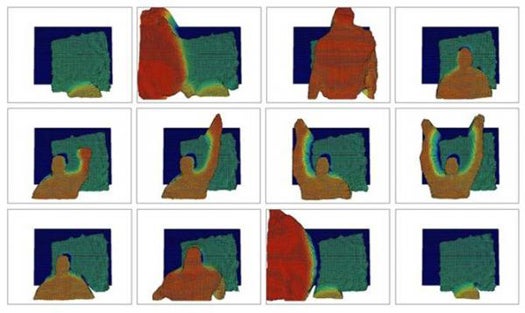
With existing camera technology, capturing 3-D images as the biological eye does is difficult and time consuming; basic stereoscopy requires two images to create a single 3-D frame, which means that to shoot 3-D video you need at least two cameras rolling on the same subject at the same time (even the high-tech gear behind Avatar required two different lenses). But engineers at Fondazione Bruno Kessler (FBK) in Italy have created a single camera that can capture the third dimension, using laser detection and creative use of CMOS technology.
And that's not all: The camera's sensor also records the smallest pixel currently in the field, a mere ten millionths of a meter (roughly one tenth the size of a human hair). Add it all up, and it's one pretty sweet piece of machinery, with the ability to capture not only the highest quality of detail in images, but to produce a depth of vision you can only get by adding the third dimension.
The camera employs a sophisticated range-finding technique to add depth to its frames, bathing its subjects in ultra-short laser light pulses (ultra-short being just a few billionths of a second) that bounce off the subjects much like radar. A complementary metal oxide semiconductor (CMOS) micro-sensor picks up the laser bursts as they return to the camera, measuring each pixel's distance from the camera. From that data, the camera can place each pixel in space, adding a third dimension to its vision.While the obvious film-making implications of such a device conjure James-Cameron-esque fantasies, the applications are far wider. The researchers envision the camera sensor assisting the elderly and disabled, its reliable eye for spatial arrangements keeping watch for dangerous situations that could cause falls or other accidents. Security cameras fitted with such a sensor could be greatly improved with a third dimension enhancing their ability to follow a subject in a crowd. The same tech could aid smarter guidance systems that could give turn by turn instructions to a person as they navigate the corridors of unfamiliar buildings.
We're more interested in video games. A 3-D camera could not only "see" a player moving in 3-D, but could add a third axis of sophistication to those movements by "seeing" when a player moves forward or backward in space. This kind of technology could lead to a true peripheral-free era of gaming where players need nothing more than their consoles and their own bodily movements to achieve a seriously sophisticated gaming experience.
138 years of Popular Science at your fingertips.
Each issue has been completely reimagined for your iPad. See our amazing new vision for magazines that goes far beyond the printed page
Stay up to date on the latest news of the future of science and technology from your iPhone or Android phone with full articles, images and offline viewing
Featuring every article from the magazine and website, plus links from around the Web. Also see our PopSci DIY feed
Science is reinventing play, from extreme sports to gamification to ridiculous roller coasters to the playgrounds of tomorrow, and this issue is chock full of fun. Also, on a less fun note: Did global warming destroy my hometown?
So what's new?
Hi. I'm an electrical engineer and mathematics student in Israel and my final project involves the use of a 3D camera to create a system that will basically control your TV according to your hand gestures (no remote... nice stuff). What you have described sounds very much like the CMOS chip canesta produces.Check it out yourselves on canesta web site or google "Canesta101.pdf"
Again I ask, what's new?
Well since you must ask twice, I will answer you!
Second paragraph and I quote.
"The camera's sensor also records the smallest pixel currently in the field, a mere ten millionths of a meter (roughly one tenth the size of a human hair). Add it all up"
from Los Angeles, CA
uri--
I'm happy to see your comment, and wish we all could read such comments from students worldwide-- Greece, Saudi Arabia, Iran, Mongolia, Bosnia... language can be a barrier, but so can ideologies. I do hope we can overcome such differences.
One of the most fascinating developments in 3-D is stereograms... there are lots of them-- they're just pictures, not movies, but they don't require any glasses or other special equipment. There are a lot of them online.
Commonsense correction:
I was worried when Avatar was the first comparison noted for binocular vision. It really ought to be noted here that this camera does exactly what the human eye does *not* do, which is in turn exactly the opposite of what the article implies, gaging distance. The human eye does not do that. That's why it uses ... two lenses. *Frazzled*
In any case, this technique would be useless for videography, because ... the human eye doesn't work that way, so there's no sensible way to translate this into something that humans could appreciate.
With that said - holy hell! Robot surveying, digital scanning of 3-D objects, and who knows what else just got a hell of a lot easier, because this information that's useless to human eyes would be hella useful to computer ones.
@dirk, this could actualy be used for the stereoscopic video used in films. All that you would need to do is to overlay the video as a texture on the 3D model. Then render in stereo. Works exactly the same as what James Cameron did for avatar, rendering a model from two unique points.
HALO Nerd ;D
I don't think it works that way. You'd have a three-dimensional map of a scene from a single perspective. While human beings may be rather unused to seeing social problems from two perspectives at once, it's rather fundamental to our sense of sight. = ) A very complex algorithm *could* compute the information from a camera like that above into 3D material that the human eye could compute, but it wouldn't be seamless.
For illustration: hold your finger in front of your nose and close one eye at a time. Your brain uses more information than is presented by a single lens, regardless of this extra rangefinding component.
The 3D output of *this* device - which would be genuinely three-dimensional, unlike the information recorded by your eyes or contained in a stereoscopic film, which presents just two channels of two-dimensional data - would be something more like a still image from a single perspective that could be rotated somewhat like a relief. Faces invisible to the camera's perspective would simply not be recorded. In the above example, the opposite side of your finger would simply be an open black space.
The most 3D media that this technology could produce would look something more like the offerings of a Viewmaster - distinctions of layers, a foreground, background, etc., but not a full sense of a 3D environment.
Again, though, the applications in robotics, surveying, etc. are limitless.