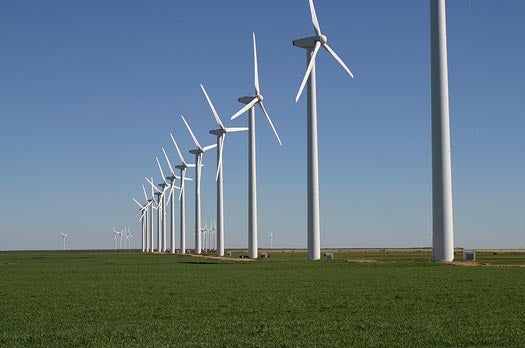
Wind Power Wind power is green as can be, but incredibly inconsistent. A new gravel-battery storage scheme could cheaply store excess power when the wind is strong to supplement wind turbines when the gusts die down.

Wind and solar are such promising technologies for the hydrocarbon-free energy sources of tomorrow, but intermittent, inconsistent output renders them unfeasible as anything other than secondary power sources. But UK firm Isentropic thinks it may have solved the problem as it pertains to wind power; all we need to stabilize the energy flow from turbines are giant batteries made out of gravel.

The battery consists of two large silos filled with crushed rock. Electricity generated by the turbine heats and pressurizes argon gas and feeds it into the first silo. The gravel is heated to more than 900 degrees as the hot, pressurized argon passes through, though by the time the argon leaves the chamber it has cooled to ambient temperature.

The argon is then fed into the second silo where it returns to normal atmospheric pressure, initiating a cooling effect that chills the gas and rock to -256 degrees. Thus, the electricity is stored as a temperature difference between the two chambers. If the wind ceases to blow, the process is reversed, feeding the cold gas back into silo number one, powering a generator as it makes the transition back to hot from cold.

The process isn't a perfect closed energy loop, but Isentropic claims a complete trip through the cycle retains up to 80 percent of the original electricity. Even better, gravel is cheap; the cost per kilowatt-hour falls somewhere between $10 and $55, depending on the costs of other materials. Isentropic also claims the batteries are highly durable; according to the company's founder, a 164-foot tall silo with an equal diameter would retain half its energy even if left untouched for three years.

All that sounds pretty good, but Isentropic has yet to fully prove out the idea. The vast temperature differences generated by the argon sound quite drastic, and the director of the UK Energy Research Centre points out, gravel isn't the ideal material to have inside of machine with moving parts. As such, Isentropic is designing a pilot plant that could store 16 megawatt-hours in two silos just 23 feet tall by 23 feet in diameter. That's enough to cover a pretty big neighborhood during a long, windless stretch. The company is also in talks with an unnamed utility to build a larger demonstration facility.

[Guardian, Isentropic]

13 Comments

hypnometal

from New York, NY

Sounds promising - let's hope it works! :-D

Un put de 70m adancime in care se coboara si se urca un cub de 10m latura de fier ( ~ 7500 kg/m³) poate stoca sub forma de energie potentiala in jur de 1500 kwh.
EP = m*g*h = 7500*10*10*10*9.8*70 = 5145000000 J
1kwh = 3600000J
EP = 5145/3.6 ~= 1429 kwh ~ 1.4Mwh

100 de astfel de unitati pot stoca 140Mwh. Suficient pentru a stoca energia generata de un parc de turbine eoliene.

SOLAR THERMAL STORAGE uses salts that melt at high temp to dramatically reduce size and weight of the storage medium (by using the latent heat of fusion).

Perhaps something similar could be done with the argon ... heat a salt that melts just below 900 degrees and a liquid that freezes just above -256 degrees.

The energy to change 1 degree between liquid and solid (in either direction) can be hundreds of times more than heating and cooling the solid or the liquid, reducing the size and weight proportionally.

How is $50/kWh "cheap"? Am I missing something here?

yosifcuervo

I was thinking the same thing. I hope they meant megawatt or gigawatt. Even megawatt would be about 3x what I pay now.

Li-ion batteries cost ~ $1,000/kWh and last maybe 3,000 deep cycles ... that's 33 cents per kWh per cycle ... EXPENSIVE !!!

At $50/kWh and say 10,000 cycles that's 1/2 cent per kWh per cyle ... CHEAP !!!

egmarshall

Thanks for clearing that up.

"How is $50/kWh "cheap"? Am I missing something here?"

It is a cost of electric storage, not a cost of electricity. And it is really cheap.

or you know, you could just go to the scrap dealer, find lots of batteries, and make your on power storage. or if you really want to be green, replace your lights with candles, your fridge with an underground ice box, and throw away any "useless" entertainment electronics, like cellphones. Hooray for primitive living!

@stiuengleza =

"A shaft of 70m deep in that climb and descend an iron cube of side 10m (~ 7500 kg / m³) can be stored as potential energy around 1500 kwh.
PE = m * g * h = 7500 * 10 * 10 * 10 * 9.8 * 70 = 5145000000 J
1kwh = 3600000J
PE = 5145/3.6 = 1429 kwh ~ ~ 1.4Mwh

100 such units can store 140Mwh. Enough to store energy generated by a wind turbine park."

Romanian - translated by google translate

What I don't understand is why we are not utilizing the excess power to use for hydrogen generation,and compression storage it's a no brainer. It's like a green card lottery.

Hydrogen is a no-brainer, but only in the derogative sense(it takes a lack of brains to propose hydrogen as storage).

25% round trip efficiency, expensive electrolysers, expensive fuel cells.

ajohnson1986

from Sioux Falls, South Dakota

not to mention the fact that its not easy containing the smallest stabil molecule out there. And besides that hydrogen is flamable and burns clear so if you have a leak you don't even know it until your pants start on fire.


138 years of Popular Science at your fingertips.

Innovation Challenges


Popular Science+ For iPad

Each issue has been completely reimagined for your iPad. See our amazing new vision for magazines that goes far beyond the printed page


Download Our App

Stay up to date on the latest news of the future of science and technology from your iPhone or Android phone with full articles, images and offline viewing


Follow Us On Twitter

Featuring every article from the magazine and website, plus links from around the Web. Also see our PopSci DIY feed


February 2012: The Future of Fun

Science is reinventing play, from extreme sports to gamification to ridiculous roller coasters to the playgrounds of tomorrow, and this issue is chock full of fun. Also, on a less fun note: Did global warming destroy my hometown?


circ-top-header.gif
circ-cover.gif
bmxmag-ps