Should silicon stay or go?

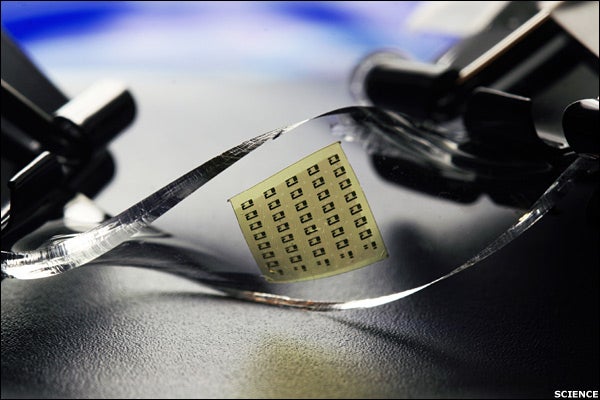
Flexible Silicon More flexible circuits can help silicon stay relevant in the future of computing Science/University of Illinois at Urbana-Champaign

After a breathless race through the '80s and '90s, desktop computer clock speeds have spent the last decade languishing around the 3 gigahertz mark. That stagnation in processing speeds has prompted scientists to debate whether it's time to move beyond semiconductors -- and what better place to debate than in the journal Science? Ars Technica gives a top-down overview of several future paths laid out in the journal's latest issue by researchers such as Thomas Theis and Paul Solomon of IBM.

The main issue comes from voltages being forced to scale down as ever-tinier transistors are developed. That can lead to heat and power use problems, as well as slower switching and clock speeds. Chips have typically compensated by favoring size and power over speed, but scientists suggest several possible new approaches.

Some argue that clock speed is overrated, and that most interesting future innovations will come from smaller, flexible electronics built into smartphones, medical implants or even Star Trek-style clothing. Silicon ribbons can already do this to some extent, as long as people can live with their lesser power compared to a typical multi-layer silicon microchip. Extremely simple and small chips could also do the trick without requiring serious reengineering.

The IBM researchers tout the idea of finding a new transistor switch that can amplify small voltage changes. One promising approach which could achieve that goal is "interband tunnel FET," which allows small voltage changes to maintain the necessary on-and-off states. But it only works with carbon nanotubes as opposed to silicon. Another approach would add a device that gives even small voltages an all-or-nothing impact -- something that should allow for switching in less than a picosecond (one trillionth of a second), but in reality takes 70 to 90 picoseconds.

The last two ideas would move away from the old reliable silicon for semiconductors, and instead look toward transition metal oxide that combine oxygen with materials such as titanium and the rare earth element lanthanum. But there are so many transition metals and oxide combinations that researchers need a better way to predict the effect of any combos, lest they engage on a wild goose chase. We've also looked previously at studies aimed at using carbon-based graphene as a silicon replacement.

Material challenges aside, there's reason for optimism. Silicon Valley hasn't done too badly historically when it comes to cultivating a culture for innovation, and even the Pentagon's DARPA has singled out the semiconductor industry as a model for others.

[via Ars Technica]

18 Comments

Eu zic ca e timpul sa renuntati la limba engleza. Este o limba depasita pentru vorbit cu animale.

We need to move to the next stage in CPU's as they have not kept up with RAM speed and are the bottleneck.
Certainly for CPU intensive applications such as hands-free speech recognition ( talkingdesktop.com ) CPU's seem to be holding back advancement. Dual-core and Vista/Windows 7 have really helped speech recognition but more speed would be welcome.

I remember reading that the bottleneck isn't neccessarily the material used. Its the way the cpu handles the commands. We currently use a cpu command system that was developed in the mid 80's. Unfortunatly though, it would require a lot of research. If any current manufacturer decided to take up the task, it would be likely that they would be spending a couple years developing it and it would probably bankrupt them in the process allowing their competition to take over. Not something a business is likely to undertake unless its a new one.

@ divid

Leave your rants on another site. That is all.

Processor speed is not everything. My laptop is slower than my desktop, but the laptop has a core2, and generally seems to perform better.

There will continue to be changes, but it's probably going to become a more complex situation with changes in software being a large part of it.

Until, of course, we get to that mythical quantum computer (I'm not holding my breath...)

and divid, I was going to post something nasty in Romaninan, but why bother. I don't know why you're so angry, but this site is a poor place to express it.

Maybe this can help?

https://www.popsci.com/science/article/2010-03/computer-processes-faster-speed-light

Obviously, the binary system of the old light switch:
On Off, On Off, has to change.
And of course, light is faster than electrical impulses.
Much of our electric circuits are two dimensional.
If, .. if I were to explain the next generation of
logic circuits right here, some IBM engineer would just run
the idea back to his lab and 10 years later, make 1 gazillion
dollars with Bill Gates Jr., and I wouldn't even get a
honorable mention. I could draw it out on a napkin for a
couple Cornell scientists, but that would be an expensive
napkin. nah, I just sit here and drink my coffee. Crays are
fast enough anyway.

@divid.. LOL,
You should learn English or Chinese if you want to join the 21th century.
my parents used to speak Romanian, about 40 years ago.
Romania is..how to say.. a bit backwards..?
See you in 200 years, maybe Romania will earn the right to spread its language by then.

back in ~ 1998-2000, my science teacher said cpus should move from Silicon to Arsenic and something about Indium and Germanium. did that ever happen? it was something about going a stairstep down and to the right on the periodic table to find similar properties but better for something. actually i think he was saying switch from silicon to Arsenic and from Germanium to
Antimony. and then we figure out quantum computing while we are screwing around with Tellurium/Polonium radioactive cpus.
okay maybe not that last part but i think different combos need to be studied, like Bismuth+Tellurium sandwiched between Copper = Thermoelectric Module/Peltier.
blah. mor cores mor heat. use dolphin brain instead. liquid cooled.

he was talking about using indium antimonide (InSb) and indium gallium arsenide (InGaAs) way back then between 500Mhz and 1Ghz.
he was saying they are dangerous elements, but we wouldnt be eating them, and they would make computing faster.
indiumsamplesblog.com/indium-overview-world-supply-and-applications/

In regards to a "wild goose chase" concerning material challenges, I was under the impression that when a clinical approach or scientific method were applied to such discovery endeavors, advances in knowledge occur...all science begins as a "wild goose chase" of sorts, no? Seems to this civilian crackpot that material science investments are rather worth it in the long run...

@omadawn Stiu deja engleza. Nu e nevoie sa invat.
romana == engleza. Inteleg ca pe voi nu va intereseaza limba romana dar asta nu ma opreste ca eu sa o folosesc. Cu putin efort si voi puteti intelege.
Ce spun are legatura cu articolul fiindca ma ajuta la programarea procesoarelor.
Numai bine

"We need to move to the next stage in CPU's as they have not kept up with RAM speed and are the bottleneck."

You're WAY wrong on this one. SDRAM clocks used to be the same as CPU clocks in the 1980's. If you had a 33 MHz CPU you'd have some RAM operating at 33 MHz.CPUs left DRAM in the dust 20 years ago and haven't looked back; memory cells never made it much above 200 MHz.

When you buy a stick of RAM today that supposedly operates at a frequency of 1600 MHz, what you're really buying is memory cells operating at 200 MHz that are then multiplexed so that 8 bits of output are crammed into a 1 bit line switching at a 1600 MHz clock.

The move from SDRAM to DDR represents a failure of RAM to keep up with CPU clocks by a factor of 2. The move from DDR1 to DDR2 represents another factor of 2. The move from DDR2 to DDR3 represents yet another factor of 2. That's a factor of 8 discrepancy so far.

Multiplexing gets you the bandwidth, but it doesn't get you the latency. A memory request takes 500-1000 clock cycles if you have to go out to RAM on a modern CPU.

It is just as much wrong to call DDR-3 memory 1600 MHz as it is to call a quad core operating at 2 GHz an 8 GHz chip.

The computational resources of a modern CPU is less than 1 watt, there's a few watts more in communicating off-chip and so on but most of it consists essentially in trying to hide the horrifying latency of RAM. These HUGE L2 and L3 caches exist to increase the odds of finding the value of whatever memory is being read without having to go out and actually read memory. Out-of-order execution exists to keep the chip busy while waiting for cache or RAM to finish reading. There exists a vast machinery to speculatively prefetch memory you might need to read in the next thousand clocks; any kind of regular pattern of reading and writing will quickly be identified and memory prefetched. There even exists explicit instructions to let programmers and compilers instruct the CPU what memory it should prefetch and whether that memory is temporal or non-temporal to control cache pollution.

If you don't believe me look at GPUs. Here the memory latency almost doesn't matter because the problem is of a kind where it is generally so predictable what memory you will require that you can always read it well in advance; all you care about is bandwidth. That's why GPUs consist of several hundred cores with very little else than raw computational power.

Well knowing that they have found a cheap way to make diamonds, 5$ a carot or less, (which they are still trying to keep under wraps so people will continue to purchase them) And knowing diamonds are one of the most highly conductive materials on the planet one could only wonder, knowing that diamond processors could run at speeds that would melt silicone, why, besides the diamond market, are they not producing diamond processor's As is said since ancient times this valuable Crystal is the most powerful thing on the planet. However I do believe we won't see it for some time, either they will keep the tech for themselves, or the diamond market will have to flop before they do it..... or there is a serious cooling issue, which i don't see as a problem... any input is gladly reviewed I am an engineer and see many possiblities this just seems common sense to me....

Brian.O because that's undesirable.

Diamond semi-conductors allow you to run at high clock-frequencies that silicon is prohibited from by heat dissipation issues, but you don't actually want to do that.

Every time you double the clock frequency you get ~twice the performance(assuming no memory bottle neck) but you also consume ~8 times as much dynamic power.

What would you rather have, a single core processor operating at 32 GHz processor or a 4096 core processors operating at 2 GHz; they would consume roughly the same amount of power(an obscene amount, in both cases).

Diamond semiconductors might useful for 3d chips where heat issues stem not from obnoxious power consumption but from cramming too much stuff into a tiny 3d-volume rather than over a large 2d surface.

Diamond semi-conductors are also useful for the exact same subset GaAs is used for; e.g. radar systems, radio-frequency components of cellphones and communication satellites.

The stupid, brute-force single core paradigm has already gone WAY too far in the direction of sacrificing transistors and power for tiny incremental gains in single-threaded performance.

Processors are fine, just waiting on better SSD and for the prices to become lower. All in all I can still play WOW. Go get pwnd.

We definately need to update the CPU industry. These old silicon technologies have been here for over 30 years! This is techonology people we need new innovations. This special carbon tube technology could be the best new thing out. Even though they are underclocked then most CPUs now there needs to be a change and we can build on it.
This might be the best technology to date!

@soylent
-----------
Every time you double the clock frequency you get ~twice the performance(assuming no memory bottle neck) but you also consume ~8 times as much dynamic power.
-----------

it'd be even worse :D

----------------
The stupid, brute-force single core paradigm has already gone WAY too far in the direction of sacrificing transistors and power for tiny incremental gains in single-threaded performance.
----------------

multi-core Ideology is about to've been far from Ideal: narrow FSB crowds threads to access the external devices, but broad one makes RAM density lower. + needless to mention, multithreading synchronization kills performance as well: 2N CPU's could give no more 10% Increasing of Processing Power respectively to N ones at determined N. in short, if N -> inf, IPP -> 0%.

however, problem to speed-up processors ain't about to save Power: shrinkage makes watts per m2 too high to withstand + heating has no smooth distribution over whole chip's area. on the other hand, if we take power consumption down, then cpu becomes more vulnerable 4 electromagnetic noises.


June 2013: American Energy Independence

Five amazing, clean technologies that will set us free, in this month's energy-focused issue. Also: how to build a better bomb detector, the robotic toys that are raising your children, a human catapult, the world's smallest arcade, and much more.


Online Content Director: Suzanne LaBarre | Email
Senior Editor: Paul Adams | Email
Associate Editor: Dan Nosowitz | Email
Assistant Editor: Colin Lecher | Email
Assistant Editor: Rose Pastore | Email

Contributing Writers:

Kelsey D. Atherton | Email
Francie Diep | Email
Shaunacy Ferro | Email

circ-top-header.gif
circ-cover.gif