Nanoelectromechanical Sensor Can Instantly Detect Pathogens And Toxins
Tests for toxins or pathogens generally rely on chemical reactions. But a team of researchers at Cornell University have created...
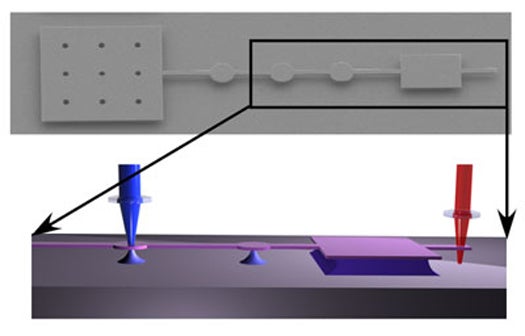
Tests for toxins or pathogens generally rely on chemical reactions. But a team of researchers at Cornell University have created a sensor that detects the presence of chemicals based on the mechanical disruption of a nanoscale system. The device can instantly detect as little as a single molecule of a substance.
The nanomachine takes the general shape of a diving board, a form called a cantilever. At one end of the cantilever sits a nanoelectromechanical oscillator; at the other end, a laser. When the laser strikes the oscillator, the whole cantilever vibrates at a specific frequency. If a particle lands on the cantilever, the frequency changes in a predictable way, revealing the identity of the particle.
An array of these sensors could analyze blood for the presence of viruses, or water for the presence of pollution. The super-high resolution of the device would allow for more accurate, and earlier, warnings than ever before possible.