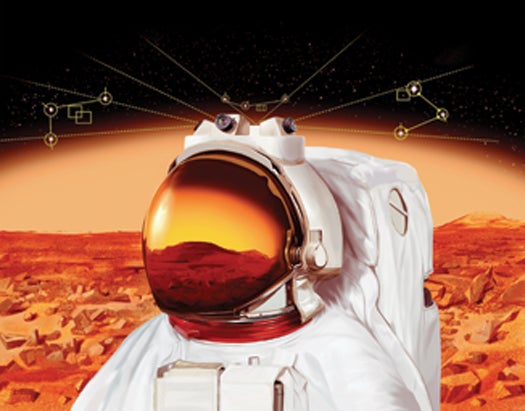
It will probably take another decade to perfect the sophisticated rocket and life-support technology needed to put a human on Mars. But once we’re there, NASA may use centuries-old technology to keep us from getting lost during a stroll.
Apollo crews never left sight of their capsule, but explorers will be expected to roam farther on the Red Planet. Mars, however, like the moon, lacks a strong magnetic field to point a compass needle north. This conundrum inspired Richard Speck, the founder of space-tech company Micro-Space, to design a camera system that tracks celestial bodies for personal navigation cues. It uses the same principle as the sextant, the sun-mapping tool invented in 1731 for sailors to plot their course.Four die-size cameras sit on an astronaut’s helmet so that each points in one of the cardinal directions. The cameras gauge the position of any two celestial objects—including the sun, Earth and stars—and the helmet’s computer provides instant location information to within a quarter of a mile and projects it on a head-up display. The beauty of the system, Speck says, is that unlike a GPS network, it requires no satellites, no transmitters—barely any setup at all. “You could just start exploring,” he says.
Speck recently began making prototypes, funded by a $100,000 award from NASA’s Small Business Innovation Research program. He thinks the military might also have use for the tool here on Earth. Scrambling troops’ GPS signals is Espionage 101, but there’s not much enemies can do to block the sun and stars.
Five amazing, clean technologies that will set us free, in this month's energy-focused issue. Also: how to build a better bomb detector, the robotic toys that are raising your children, a human catapult, the world's smallest arcade, and much more.


Online Content Director: Suzanne LaBarre | Email
Senior Editor: Paul Adams | Email
Associate Editor: Dan Nosowitz | Email
Assistant Editor: Colin Lecher | Email
Assistant Editor: Rose Pastore | Email
Contributing Writers:
Rebecca Boyle | Email
Kelsey D. Atherton | Email
Francie Diep | Email
Shaunacy Ferro | Email
Well, kind of a no-brainer, except for those who have learned no history (which is nearly everyone under 30, but I think that might still be a minority).
Interesting to note that PopSci is concerned about war on Mars and we're not even there yet. Makes a lot of sense to stay on Terra until the concept of war has been replaced with negotiation. Going all the way to Mars in order to fight battles seems a bit... g-d-f silly and wasteful of life and a lot of technology and money. Visiting other planets should be a privilege reserved for peaceful types. How does THAT sound for a Plan??? (Anyone who says we need to be prepared to fight Martians watches too much of the wrong sort of television.)
Before terra-forming Mars, we need to try terra-RE-forming little old Terra, wouldn't we all agree?
I think you missed "here on Earth"- there was no mention of war on other planets...
@popular scientist, maybe that would be true for the US education system, but they do still mention the sextant in Canadian history classes.
It isn't a no-brainer. As someone who uses a sextant, I feel sure it will not work.
A sextant is useless without a level horizon unless it incorporates an artificial horizon. With no liquid water on Mars there are no level horizons. I doubt if an accurate artificial horizon could be built into a helmet, but I could be wrong on that.
To find the angle between two celestial objects tells you nothing about where you are on your planet. The only useful measurements are altitudes above the horizon, which is why you need to know, very accurately, where the true horizon is.
And you need to measure those altitudes to an accuracy of something like a quarter of a minute of arc. So each camera would need a resolution of at least 200 megapixels, as well as the artificial horizon being accurate to better than a quarter of an arc-minute. I don't think so.
Surely a much better solution would be to use accellerometers to calculate how far you've walked from your starting point.