The future of wireless: illumination as information
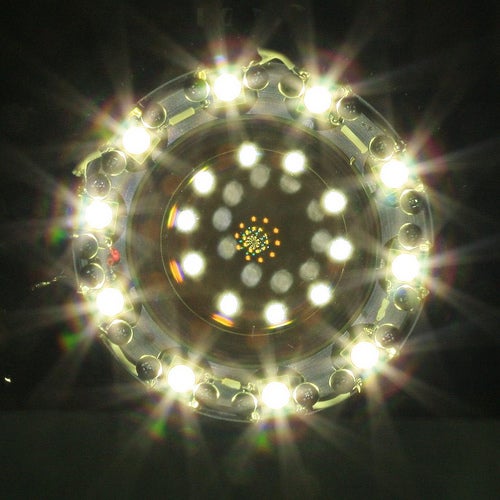
Wireless Web Via LED Light German researchers have figure out how to broadcast wireless Internet via a visual-spectrum signal through commercial LEDs. Velo Steve via Flickr

A bright idea coming out of Germany's Fraunhofer Institute could change the way we connect to the Internet in the future, as well as drive the nascent market for interior LED lighting. Researchers there have found a way to encode a visible-frequency wireless signal in the light coming from lamps and fixtures, turning the light that surrounds us into a high-speed broadband source.

That's not to say there's anything particularly wrong with radio-frequency wi-fi, but its limited bandwidth restricts it to a certain spectrum within an already crowded field of signals. It also leaks through walls -- a benefit for signal pirates but a detriment for those who want a signal that is both secure and free of interference.

Visible-frequency wireless works by flickering all the lights in a room ever so slightly -- so slightly, in fact, that the human eye could never detect it. Incandescent and fluorescent bulbs can't flicker fast enough, so the scheme does require LED lighting, but the connection doesn't require any kind of specialized fixture, just commercial LEDs. And, though standard LEDs also have a limited bandwidth, the researchers were able to expand that bandwidth drastically by filtering out all but the blue light.

In the lab the Fraunhofer team has downloaded data at a rate of 230 megabits per second, a record for visible wireless using commercial LEDs and comparable to high-end radio wireless connections. With a better modulation signal the team thinks they can double that data speed. Meaning that in the future, in-room only secure, super-fast wireless connections may be just a flip of the switch away.

[Science Daily]

17 Comments

that would be awesome. i would like to be bombarded with visual data transmission, but my internet connection isn't disrupted by the sun, tv, or strobe lights, so i think i'll just stick wth my $15 wireless router, until fiber comes to my area, in which case i will upgrade from b/g to N or whatver new wifi protocol they have invented on that day so very distant in the future.
i would recommend a windowless room if you are going to try using led transmitted internet, because i have noticed IR remotes have trouble communicating in bright sunlight.

I wonder if this would be cancer causing if someone entered a room with multiple devices.

CANCER?

When was the last time light in the visible specrum gave anyone cancer. Using regular commercial LEDs that do not produce radiation above UV or below infrared will not do anything but hurt your eyeballs if you stare into it maybe...

*blank stare*

@knucklesammich: if you already have wifi in your house (and chances are that you do since you're reading popsci), then in theory, it seems this invention would not be adding anything new to your wavelength environment. In any case, looking forward to market testing. Thanks, Simone, www.tendances-de-mode.com/en/news

Would that work out out-door? We'll see.

Sometimes my lights aren't on...

Light holds the future for virtually all electronics.

Sure, you can receive data, but don't you need to receive AND send packets to use the internet? Some sort of other connection would be needed as well. Not to mention, all of the problems above.

This will be so pimp with a disco ball in a club with laser!

Light Fi at the bar! Sweet!

fluff I think you've hit on if it's bigger weaknesses.

You'd either have to have an array of optical sensors in your rooms to detect your computer's leds, or else you'd need a hybrid optical/rf system

Also,you have to have a light source in every room that you want this service, and each one has to connect somehow to the internet. Not to mention that you have to place your computer so that it has a good line of sight to the LED source ("Honey, you're blocking my access to allsports.com!")

Cool tech, but the application may be a little tricky.

It's very interesting, I did however have a slight idea about how the wireless aspect of this works because I saw it on an article on www.bestwirelesssurroundsoundsystem.com and was facinated when I heard about it.

This will be so pimp with a disco ball in a club with laser!

Light Fi at the bar! Sweet! http://www.tamders.com/ | http://www.mekanize.net/ | http://www.durust.net/ | http://www.aindir.com/

Popsci you have done it again. This article is clearly exciting. Clearly art and technology combined. What more can be said...other than lets go for it. I can see this being a hit in the household where all of those e-boxes are just an eyesore.

www.ldj-lights.co.uk

Without question this is a fantastic shift in the use of energy, however, would it not be feasible to use solar energy as a source of lighting thus reducing our reliance on our reducing fossil fuel.

www.lumalighting.co.uk

This is brilliant concept, but I here this is really in the research phrase and we should not be getting too excited as there are many other methods and engineering designs that may surpass this idea. At least we are doing our best to reduced the visiable signs of our computing work space. It will eventually just merge into the living room background.

www.litecraftcommercial.co.uk

Now this is clever! To combine to important aspects of our work and play with lighting and computing in one is brilliant and it will reduce energy and dual production costs. This can be viewed as a positive action for monitoring our energy consumption through smart applications.

Regards,
John
www.broadband-expert.co.uk

Very interesting concept indeed. The demand for broadband access is only going to grow further, so research into areas and technology that will help to supplement and expand on the current infrastructure can only be a good thing.

Mike @ www.mobilebroadband.net


138 years of Popular Science at your fingertips.

Innovation Challenges


Popular Science+ For iPad

Each issue has been completely reimagined for your iPad. See our amazing new vision for magazines that goes far beyond the printed page


Download Our App

Stay up to date on the latest news of the future of science and technology from your iPhone or Android phone with full articles, images and offline viewing


Follow Us On Twitter

Featuring every article from the magazine and website, plus links from around the Web. Also see our PopSci DIY feed


February 2012: The Future of Fun

Science is reinventing play, from extreme sports to gamification to ridiculous roller coasters to the playgrounds of tomorrow, and this issue is chock full of fun. Also, on a less fun note: Did global warming destroy my hometown?


circ-top-header.gif
circ-cover.gif
bmxmag-ps