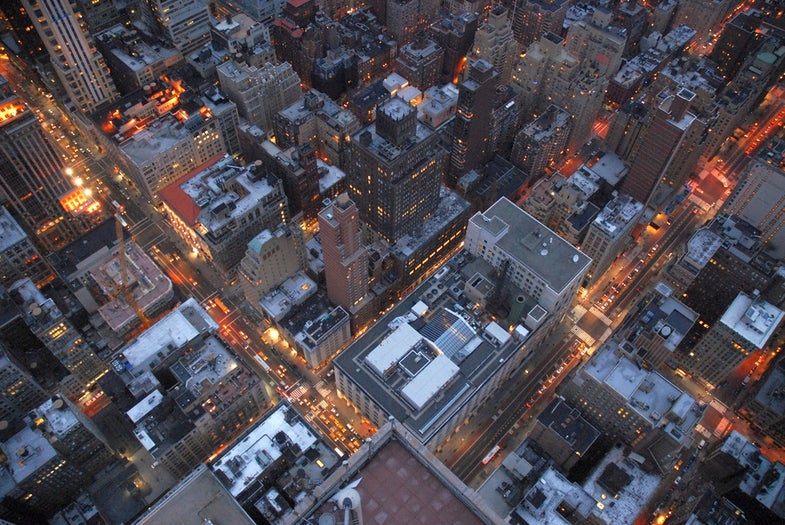
Tracking from Above It's difficult to use radar in urban environments because of all the structures that get in the way. But by bouncing highly sensitive radar off of buildings' facades, DARPA hopes to lock onto individual vehicles from UAVs and track them through urban streets even when buildings block line of sight. Zemlinki

Radar is great for tracking objects in the wide-open sky or even at sea, but when you try to take it to street level you run into some obstacles -- literally. Radar requires a good line of sight, and obstructions like buildings or terrain features can render radar useless. But now, using a handful of unmanned aircraft and technology that allows them to intelligently reflect radar off buildings, DARPA is developing a system that should be able to track individual vehicles even as they dart between skyscrapers and other structures.

Dubbed Multipath Exploitation Radar, the system works by using buildings as mirrors, bouncing radar off of surfaces to "see" around corners and keep tabs on vehicles even without direct line of sight. First the MER system uses LIDAR -- optical surveying tech that is already packed on many aircraft -- to create a 3-D map of a city. That model of the city allows the system to calculate which reflective angles can best keep an eye on a particular vehicle even when it is obscured by a structure.

Using Ku-band radar, the MER is sensitive to even slight differences between similar vehicles, ensuring that the target car isn't lost in the mix of traffic even when the signals are bouncing off of buildings. That's a key component of MER that can't fail if the system is to work in crowded urban environments. And it will have to; DARPA thinks that once a LIDAR model of a city is made, MER can cover a swath of terrain more than 600 square miles in size.

But MER has some obstacles of its own to overcome before it starts seeing through buildings. The key challenge is maintaining a lock on the target as the radar re-orients itself from line-of-sight to reflection and back, perhaps multiple times very rapidly as a car speeds through urban streets. In the meantime, the ever-ambitious DARPA is looking into developiong an algorithm that would allow MER to track several vehicles in different areas at once.

[New Scientist]

6 Comments

Isn't there already a UAV system in Britain that tracks down suspects as well? It seems like the U.S. is a step behind but trying to get a step ahead by tracking vehicles as well.

In my understanding, the UAV the brits use are flown manually and have cameras to track the suspect. This system appears to be autonomous once the target is identified and uses radar.

So not really behind, no.

Yeah. It's not like the US and Britain can't have similar UAVs. The Brits, as dontcallmechief said, uses a camera and is manually flown. This craft, as the article says, will use radar. Trying to track multiple cars simutaneously will definately be a feet though.

whats innovative is not the UAV
but the radar itself capable of accurately bouncing signals of different materials and different angels from considerable height to track a small target in a sea of like targets
and constantly changing those parameters

personally
i don't think its really possible with today's tech
but we'll wait and see

I don't know flash.killer, i see it able to do one target but i don't see it being able to do multiple with current tech.


138 years of Popular Science at your fingertips.

Innovation Challenges


Popular Science+ For iPad

Each issue has been completely reimagined for your iPad. See our amazing new vision for magazines that goes far beyond the printed page


Download Our App

Stay up to date on the latest news of the future of science and technology from your iPhone or Android phone with full articles, images and offline viewing


Follow Us On Twitter

Featuring every article from the magazine and website, plus links from around the Web. Also see our PopSci DIY feed


February 2012: The Future of Fun

Science is reinventing play, from extreme sports to gamification to ridiculous roller coasters to the playgrounds of tomorrow, and this issue is chock full of fun. Also, on a less fun note: Did global warming destroy my hometown?


circ-top-header.gif
circ-cover.gif
bmxmag-ps