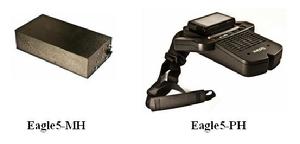
As if aerial robots and bionic limbs didn't make the Army seem futuristic enough, it looks like another hallmark of sci-fi, X-ray vision, will ship off to Afghanistan later this year. The device in question is the TiaLinx Eagle Scanner, which uses radio waves to see through the ground, walls, and other kinds of cover.
Eagle Scanners:  via TiaLinx
Like the earlier discovery that Wi-Fi signals provide X-ray vision, the Eagle Scanners measure how radio waves bounce around, and move through, different objects. By measuring the various densities of the materials its radio waves pass through, these hand-held scanners can look through concrete as if it were glass.

The models deploying with the troops to Afghanistan can see up to 20 feet behind an eight-inch-thick concrete wall, and identify whether or not there are any people on the other side. The sensor can also detect whether a seemingly uniform wall or road contains any hidden compartments. Plus, the device can communicate wireless, and send images back to HQ immediately.

For the soldiers lucky enough to snag one of these sensors, the two most obvious uses are searching for IEDs and monitoring houses during raids. Plus, with the disaster in Haiti fresh in everyone's mind, there's no doubt these sensors will one day find their way to rescue personnel combing through rubble in search of survivors.

[Danger Room]

10 Comments

That's awesome. Tech like this can save more lives in Iraq and Afganistan. No need to blindly storm into a room wondering if it'll be your last. Are there materials this tech doesn't see through? If there is, I hope no one posts it as the baddies will surely implement counter measures against it.

Yeah and if you connect it to the side of a rifle you get a heart beat sensor like in CODMW2.

Fascinating! If you follow the links, you find they are using ultrawideband radar. The same technology can also be used to trasmit 100's of Gigabits/second wirelessly over short ranges. Pretty cool technology. Between this and terahertz cameras, say good bye to privacy. And by the way, you can block it by wearing a tin-foil hat. ;)

Wow, I definitely agree that this technology can save many lives

Wow, thats some prety scary stuff. Wonder who is using them right here at home!

Jess
www.web-privacy.cz.tc

How many kills do I need with the heartbeat sensor to get the X-ray vision??

Seriously though...I LOVE TECHNOLOGY

www.freebord.com/ride <-- Snowboard the Streets!

Robert1234: Yeah, and the cops will be watching your daughter getting it on with her boyfriend too, right thru your walls!

Back during Desert Storm, a General mentioned that they did not bother bombing some Iraqi aircraft bunkers because they knew they were empty. The AWACS type aircraft has obviously had this technology for some time. Now we get a man portable version. Cool stuff, but I hope there are some laws against it's misuse by overly zealous police or even corporate spies.

@Yeah Right I absolutely agree with you on the aluminum foil hats. I found out that if you shape them punk style with spikes looking upwards, you have a much better chance of jamming alien detectors and in some cases even causing damage to them. I always use it at home...

www.hungriabonita.com/budapeste - An awesome trip

You can shield against these systems by painting your walls with iron-laced paint. Check out Magically Magnetic Paint online (lyt.com), they sell the stuff pretty cheap.

And by the way, there are already several systems like this that are near deployment or already deployed, such as CELLDAR.


138 years of Popular Science at your fingertips.

Innovation Challenges


Popular Science+ For iPad

Each issue has been completely reimagined for your iPad. See our amazing new vision for magazines that goes far beyond the printed page


Download Our App

Stay up to date on the latest news of the future of science and technology from your iPhone or Android phone with full articles, images and offline viewing


Follow Us On Twitter

Featuring every article from the magazine and website, plus links from around the Web. Also see our PopSci DIY feed


February 2012: The Future of Fun

Science is reinventing play, from extreme sports to gamification to ridiculous roller coasters to the playgrounds of tomorrow, and this issue is chock full of fun. Also, on a less fun note: Did global warming destroy my hometown?


circ-top-header.gif
circ-cover.gif