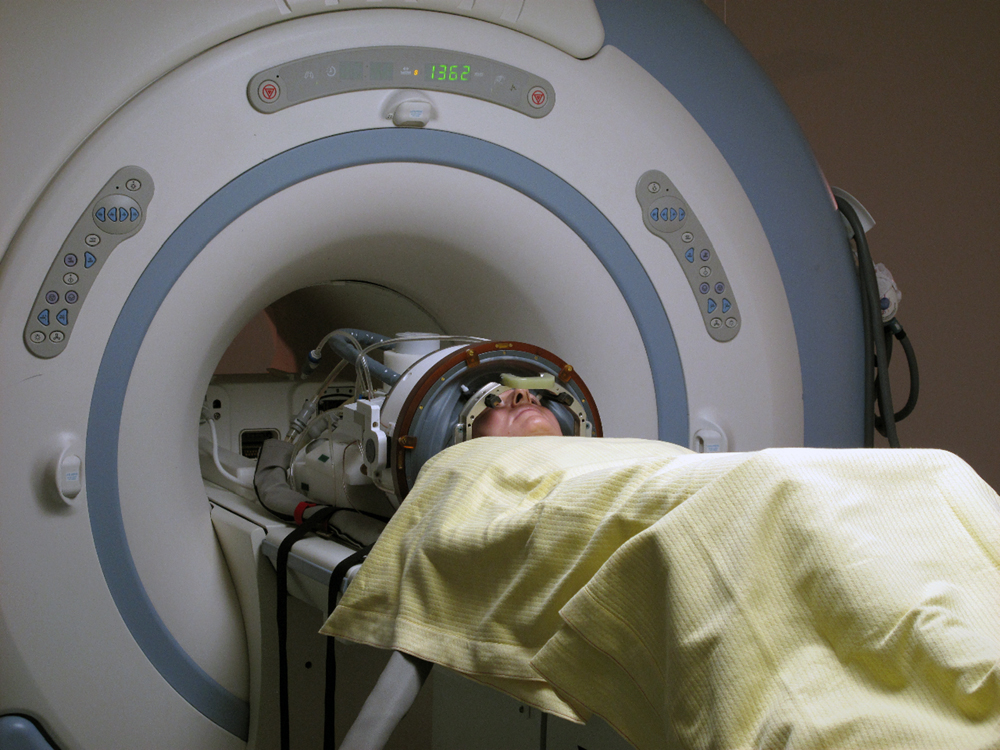
ExAblate 4000 MR-guided High-Intensity Focused Ultrasound Insightec

Physicians usually rely on surgery or drugs to bust blood clots in the brain that might otherwise cause a stroke, but sound waves might provide a third noninvasive choice. U.S. researchers have begun testing an Israeli ultrasound device to see whether it may prove accurate enough to break up a clot without causing collateral damage in the brain, Technology Review reports.

Strokes represent the third most common cause of death in the U.S., and occur when a blood clot prevents blood from reaching the brain. Only drugs or surgical intervention can remove the clots in time to prevent serious brain damage or death, but fewer than 10 percent of patients usually fit the requirements to undergo those procedures.

The company InSightec has created a focused ultrasound device that looks like a helmet, studded with over 1,000 ultrasound transducers. Each of the transducers can focus an individual beam into the brain of the helmet-wearer and converge on a spot just four millimeters wide--enough accuracy to dissolve a blood clot within less than a minute.

Thilo Hoelscher, a neurologist at the University of California at San Diego, has already led a team in testing the InSightec device on blood clots in animals and in the skulls of human cadavers. Now they must figure out how to dissipate unwanted heating in the skull, as well as find a good way of pinpointing blood clots for precision targeting of the ultrasound beams.

We previously got a look at the InSightec device and its use in destroying diseased brain tissue. But this latest application will push the envelope of the machine's precision even more, and perhaps help modern medicine tackle an even greater health threat. The U.S. researchers hope to begin busting blood clots in human trials by 2011.

[via Technology Review]

6 Comments

I wonder if this has any application for DVT (Deep Vein Thrombosis) in other parts of the body? For example, could a blood-clot in a leg or arm be "sound-beamed"? I am aware of chemicals to do this (Warfarin, Coumodin, and Heparin), but sometimes they do not work. Also, even if this does work, would there be a possibility of pieces of the clot going into the bloodstream, therefore the heart, lungs or brain?

Yes,excellent question.Hopefully,the clot dissolves instead of breaking up..

Chris

the isrealis come up with some good tech

Hi BeanyBoy,

I work with InSightec. I can tell you that the ExAblate is able to focus ultrasound waves in various parts of the body, but has only been tested to ablate clots in preclinical studies. The same technology is currently approved to treat tumors within a woman’s uterus, and clinical trials are underway to investigate its safety and effectiveness in treating conditions such as the pain caused by bone metastases, multiple myeloma, prostate cancer, and breast cancer. The brain system is also being evaluated for treating functional brain disorders and brain tumors.

Thanks for the interest!

usaser

ultra sound amplification by stimulated emission of ....somethign with an are related to sound.

An ultrasound device designed to produce highly focused sound waves might one day be used to break up stroke-causing blood clots in the brain without surgery or drugs. Thilo Hoelscher, a neurologist at the University of California at San Diego, is attacking the clots with a device developed by Israeli ultrasound technology company InSightec.

Today, only two proven methods are in use to bust clots. A drug called tissue plasminogen activator (tPA) dissolves clots, but it can only be given to certain patients, and it usually must be administered within three hours of the stroke itself. Alternatively, some clots can be physically retrieved through a blood vessel, but few hospitals practice this technique. Overall, perhaps fewer than 10 percent of all patients are candidates for either of these interventions.

==> www.thebrainhealth.com/stroke-on-left-side-of-brain.html


June 2013: American Energy Independence

Five amazing, clean technologies that will set us free, in this month's energy-focused issue. Also: how to build a better bomb detector, the robotic toys that are raising your children, a human catapult, the world's smallest arcade, and much more.


Online Content Director: Suzanne LaBarre | Email
Senior Editor: Paul Adams | Email
Associate Editor: Dan Nosowitz | Email
Assistant Editor: Colin Lecher | Email
Assistant Editor: Rose Pastore | Email

Contributing Writers:
Rebecca Boyle | Email
Kelsey D. Atherton | Email
Francie Diep | Email
Shaunacy Ferro | Email

circ-top-header.gif
circ-cover.gif