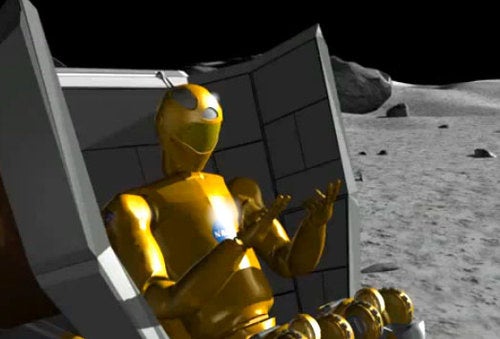
NASA can put humanoids on the Moon in just 1000 days. They would be controlled by scientists on Earth using motion capture suits, giving them the feeling of being on the lunar surface. I'd pay to use one.


Back in the Lunar exploration days, scientists had to tell astronauts what to do up there, and how to identify interesting things during the limited time they had. For Apollo 15, the first mission that carried the Lunar Rover, astronauts were trained in field work by Caltech geologist Leon Silver.
Geology Training:
That helped them to move faster and look at the ground with a critical science eye, knowing what they were looking for. The result: Their findings and samples were a lot more valuable to scientist back on Earth, confirming theories that weren't confirmed till then.

Now imagine these NASA C-3POs roaming our satellite, controlled by all kind of scientists using telepresence suits down here, all looking for interesting things using high definition visors, and able to move just like they would move on planet Earth. It won't work for Mars, but with a communication delay of only three seconds, it will work beautifully on the Moon.

The 1000-day mark is quite plausible, since the mission would be a lot simpler than a human-based one. It will also be quite cheaper than the real thing. First, you don't have to care about life support systems, which will make spacecraft manufacturing a lot less complex. The whole system would also weight a lot less, reducing the need for the development of a huge rocket, and again reducing the costs.

What about the human factor I'm always defending? Well, we know that, sadly, we're not going to get astronauts anywhere any time soon, so this is definitely the best alternative. It won't be as inspiring as humans going back to the Moon or establishing a semi-permanent colony, but it could have an extremely positive effect on science.

Whoever did this at NASA should put together an actual budget as soon as possible. And while you are at it, make it possible for regular people to use one, maybe at the Johnson Space Center or some selected museums through the world. That will definitely inspire people.

Gizmodo is the world’s most fun technology website, focused on gadgets and how they make our lives better, worse, and more absurd.

24 Comments

Once we get them to the moon, couldn't we also use cargo ships to begin to construct a more complex lunar base with the advantage of workers needing no life support? Also, how are these things powered? do you have to return to base to be recharged by the solar cells? If you could keep them charged indefinitely, these 'avatars' would prove to be completely invaluable in lunar exploration, construction, development ect. If anyone could answer the power question I would be extremely grateful.

I like your idea Dustin. If all they had to do was make sure to be back to the lander after two or three hours of work to recharge, that would be wonderful. Only having to human rate one trip after everything is already there and set up would be so much more cost effective than having humans do it all with multiple trips.

Thats probably a much smarter route in establishing a permanent station there.

Furthering the charging concept keep in mind that the moon almost always has sunlight on the 'light' side. There's no reason, in my mind, that the avatars couldn't be constantly solar powered. With the reduction in gravity even a steel constructed avatar would have significantly reduced power consumption. But I think they could probably even use some plastics in the construction for the same reason, less impact by gravity means less stress on the structure. This assumes, of course, that they make it there in one piece.

Of course, without a 14 day battery, you'd not be able to do much during lunar night, unless they put it at one of the poles, which is the logical position for a base anyway. But to dig a little deeper, a good system might be an interchangeable lower body, tank treads for tougher terrain, and the like. Of course, seeing NASA's budget, I doubt they could do this in a decade, let alone 1000 days. The way I see it, let a private company launch a mission with say... a half dozen of these aboard, say, a purchased Delta IV heavy lifter, and sell tickets for "an afternoon on the moon" to raise capital. I imagine people wouldn't pay _quite_ as much for this as they would for a trip to low earth orbit, but that'd open up the industry to a broader swath of humanity than before, to quote popsci. Imagine it, if a scientist with a fair amount of capital wanted to explore.. say.. a crater on the moon, all he or she would have to do is book an hour with the tank tread modded avatar. I don't think it's 200k material, I'm thinking depending on demand, it will be somewhere lower, around 10-100k depending on demand/usefulness. And of course they'd be useful when... let's say NASA wants to book tickets to the moon via... SpaceX, for 100 million a person or so, they'd be able to construct their base ahead of the astronauts as I above stated. All while raising capital for future launches. Anyway, the main point is that this is not NASA's domain. They're probably going to be axed completely at some point, or reduced to something more resembling a research facility that uses private companies to launch space missions.

NASA should just be our government public research and development department. The area of the government that uses tax dollars to look for ways to make life better through technology. It doesn't need to be space at all.

I got an idea they should have a charging station for that little avatar.

Charging Station will be charged by Solar Panels

I could never understand why NASA has taken this long to have a robot program for space exploration. Humans don't belong in space. Humans can't live in space. I'm more inspired by a robot program with missions to every planet and every moon then sending a bunch of dudes and a female teacher into space. Humans will never colonize a moon or planet. We are stuck on this rock. Deal with it.

@New Rock

So your basically talking about a civilian branch of DARPA?

The concept is certainly bold but the 1000 day goal seems a tad too optomistic. I am also wondering if a humanoid robot is the right platform for this sort of project. Yes it would mean more of a conection between the "Avatar" and it's controller on earth and a humanoid robot would be able to function better on the moon with it's low gravity than on earth. But wouldn't it be cheaper and more attainable to send a tracked vehicle to the moon, possibly with humanoid torso arms and head? That way more ground could be covered in a shorter time and the robot could bring all the equipment and instruments that it needs with it. The humanoid "avatar" idea is certainly innovative and undeniably cool but perhaps the designer has watched a certain movie a few to many times?

Or you could just keep the Humanoid idea and send up a couple of moon roving mustangs :D (gotta ride in style)

Hmmm...

Robots that work tirelessly, don't need to be paid, don't call in sick, and will tear their arm off if you tell them to.

What could POSSIBLY go wrong?

@scifiguy Your description of a humanoid torso, arms, and head describes NASA's first attempt at a humanoid robot, and I think they've only gotten that far on the second generation. Popsci did a piece on the robot a couple weeks ago, but I don't remember what it was called.

Personally, with all these gears and joints, I would be very worried about the lunar regolith that was such an issue during the Apollo missions since the solar radiation makes it very statically charged, sticking to everything.

its a surrogate

A 3 second lag time is still significant. It doesn't stop you from tripping over a rock and falling, possibly damaging your robot. So a certain amount of autonomy may be required.

@bjkilby There is no "light side". The Moon is tidally locked with Earth, so that the same side always faces us. Since it takes one month to orbit, one lunar day is one month. So any solar power systems need to cope with a 14 day-long night.

Just don't get the Koreans to design the docking mechanism for the charging station.

The idea of robots paving the way for colonization has been around for quite a while. The first place I saw it presented was in Issac Asimov's Foundation/I, Robot mixture, where robots went forth and colonized planets, making them habitable for the human colonists that would eventually follow.

Vicarious extra-terrestrial experiences are also not new. The Mars rovers acomplish well enough what wants to be done here. The difference is that now we have the technology to make dexteric, humanoid robots that could be directly controlled.

The main idea, as Dustin originally pointed out, is to land a charging station with the initial robots. I would imagine a nuclear reactor would first acompany them, along with fuel cells and supplies to deploy a solar farm. Maybe two solar farms, connected by superconducting wire (remeber, cold is already there) because of the solar visibility from one side of the moon is predictably reliable, but still inconstant.

Once you have a renewable power source in place, you can start adding things like drilling stations and even habitats, allowing for potential refueling of ion-drives and eventually human bases.

Lets face it, constructing a lunar base by hand would be extreamly costly and dangerous, even with prefabricated structures. Using directly-controlled humanoid robots will remove a lot of the barriers to constructing something in so hostile an environment. Perhaps the only silver-lining of the budget cut is the additional necessity that always spawns innovation.

So now even NASA is trying to outsource their work. How many more American jobs do we need to lose before we realize that outsourcing is bad for the country?

"The whole system would also weight a lot less...". Shouldn't that be " 'wait' a lot less"?

These same robots could be used to setup a base before humans arrive.

I would not send a biped robot mostly due to reliability issues a tracked or wheeled design would be better and would allow them to make the 1000 day deadline.

Is it just me, or do the Robonaut's motions at one point closely resemble the abominable snowman in Rudolph The Red Nosed Reindeer?

I like your idea Dustin. If all they had to do was make sure to be back to the lander after two or three hours of work to recharge, that would be wonderful. Only having to human rate one trip after everything is already there and set up would be so much more cost effective than having humans do it all with multiple trips. http://www.tamders.com/ | http://www.mekanize.net/ | http://www.durust.net/ | http://www.aindir.com/


June 2013: American Energy Independence

Five amazing, clean technologies that will set us free, in this month's energy-focused issue. Also: how to build a better bomb detector, the robotic toys that are raising your children, a human catapult, the world's smallest arcade, and much more.


Online Content Director: Suzanne LaBarre | Email
Senior Editor: Paul Adams | Email
Associate Editor: Dan Nosowitz | Email
Assistant Editor: Colin Lecher | Email
Assistant Editor: Rose Pastore | Email

Contributing Writers:

Kelsey D. Atherton | Email
Francie Diep | Email
Shaunacy Ferro | Email

circ-top-header.gif
circ-cover.gif