The BMW Oracle Racing team’s boat--with an enormous wing for a sail--could win it all at the America’s Cup race this month
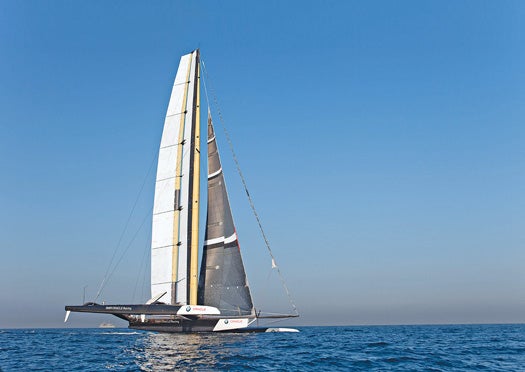
Smart Sailing Electronic sensors feed 26,000 data points every second—such as the wind speed, pitch of the waves, and stress on the boat—to a computer to calculate the optimum wing-sail configuration. Courtesy Gilles Martin-Raget/BMW ORACLE Racing

This year, the rules have all but disappeared for competitors in the world’s oldest international trophy competition, the America’s Cup sailing race. Motorized sails are fine, the single-hull rule is out, and in the case of the BMW Oracle Racing team’s boat, even sails are optional. Instead, the largest wing ever constructed could catch enough wind to make the yacht the fastest yet.

Conventional fabric sails are unreliable. “Wind speed and direction change by the second,” says Mike Drummond, the design director for the BMW Oracle Racing team. “The crew must constantly maneuver the mainsail to maintain maximum speed.” A sail’s leading edge often ripples, particularly when tacking into the wind, increasing drag and causing the sail to lose the airfoil shape that helps propel the boat. In contrast, it takes just one sailor a few clicks on a computer to immediately swing the 190-foot-tall carbon-fiber-and-Kevlar wing into position, where it will hold its shape regardless of conditions. With the wing, Drummond says the 90-foot trimaran can sail up to 5 percent, or about one knot, faster.

In the months leading up to the February 8 race day, Drummond’s team noticed a few drawbacks to the new design. In strong winds, where sailors would normally shrink a soft sail, the one-size wing can grab too much wind and destabilize the boat. And in choppy waters, the extra weight can cause the craft to pitch front to back. “Still, overall, it’s obvious that the boat goes faster,” Drummond says. “We used to measure performance gains in hundredths of a knot. Now we measure it in tenths of a knot or more.”

WING

The 7,700-pound wing includes a single piece that rotates around the mast and eight flaps that catch or shed wind in different directions for thrust. Engineers claim that the wing—80 percent longer than a Boeing 747’s—can achieve twice the power of a soft mainsail.

MAST

Fiber-optic sensors in the mast and hull reflect light differently when stretched. A computer converts these changes into stress loads in real time to predict material failures and alert the crew if strong winds could snap the mast.

SAIL

A camera system photographs the soft sail, analyzes its shape and height, and compares the measurements with past performance data to suggest the optimal setup.


15 Comments

Well, what's the point of racing then? It takes skill out of the competition. It just becomes a matter of which competitor has the better technology. Kinda lame really. The America's Cup deserves better...

correct me if I'm wrong, but any race that involves equipment beyond the human body is going to be primarily about the technology at the highest levels of competition. I can assure you that the boats in the last race before the rules were changed were a far cry from the boats in the first race.

Personaly, I think things like this are great. they spur innovation in materials and engeneering. it may take time, but such pioneering does tend to work its way into everyday life eventualy, and we are all better off for it.

another thought; by doing away with strict rules, the competition is opened up to new and creative ideas, like using a giant wing instead of a sail. competition has always spurred humanity to innovate and evolve the way we do things. It's a big part of what sets us apart from animals.

I was gonna say the same thing ABREMMS. The competition might stir up some innovative technology on sail boats that we have never seen. A little healthy competition never hurt anyone. If it were up to people like FROSTTTY we would still b living in the dark ages.

Having better equipment (carbon fibre, titanium alloys, etc..) is one thing, having a computer to control it and make decisions for you is another.
I'm all for better helmets, lighter bicycles, faster engines, etc... but when you put the equipment in the hands of a computer, then it's just "the best programmer wins".

regarding the computer system, from how i understand the article people still steer the ship, the computer just makes minor adjustments to make the most of the wind, not unlike the fly-by-fire systems used in modern jet fighters. no one doubts the skill involved in flying a jet, but thanks to the computer making small adjustments here and there, the plane is able to perform much better than it otherwise would.

even if it is a case of who has the best programmer, how is that any less of a competition? you still have skilled humans raising the bar ever higher.

Not really what this race was about. It was about the human spirit, now it will be about which boat has the most tech, and who can push buttons fast enough.

.. .-.. --- ...- . - . -.-. ....
Finally, outdated rules are changed. No one would enter a boat from the 1800’s or 1930’s etc. Outdated rules and laws hold up Technology and freedom. “Change comes slow in America”, Just look at our justice system, it goes back to the Middle ages or further! We need to speed things up so, fore example, in space we can get out of our front yard and get to the nearest star. Thank you Americas Cup for letting us all think freely.

So fuel costs for shipping are rather high, I wonder if wind powered container ships might come back in fashion, I have already seen one use a kite.

Funny how one would complain of the use of a computer while using one.

In fact, the America’s Cup has been a technology fight for many years now. Back when it was still limited to 12 Metre yachts, the cost of just developing a single hull was well over $1,000,000. Now, they have just really opened the rules.

I find it a bit sad that they have eliminated the “people power” principle, though. It used to be that all the power had to be supplied by the crew themselves. Some exceptions crept in with the use of computers (they have been on the yachts for years), but the tactics and sail handling skills were still human.

Now it appears that only tactics are going to be left in the human realm. It will become no different, fundamentally, than motor racing – and that is a shame for the worlds most visible, if not premier, yacht race.

I agree with Abremm. And in response to seamountie, innovation wise, you would want the most premier yacht race push the bounds of technology, because it will have the most profound effect on the industry.

This does not change the rules of smaller races that can enforce more traditional sets of rules, encouraging the spirit and triumph of human skill as others of you speak of.

This is not, and will never be, the only yacht race out there. It is the most well known, and the fruits that it bears should be the most rewarding.

The art of sailing is very romantic - the high seas, man against the ocean, the ropes, the wheel, the shouting commands to the crew. Not so much anymore. I wonder if this technology could be adapted for cargo ships. Biiiiiig sail obviously but would be interesting to see how we could harness the wind once again for doing something other than moving rich people around the ocean for a few days.

I agree with BeanyBoy... What's the point of having a sailing competition if a computer is sailing??? I can understand using better equipment to give an edge to the sailors, but, really, a computer who's sailing has nothing to do with sailing skill... I can even understand a computer analyzing data and telling the sailors information about the stress and everything, or even using a giant wing as a sail, but a computer that sails is about the skill of the computer programmer, not the skill of the sailing team...

The Interested Science Student Who Wants To Know More...

I like seeing innovation AND human-power-only competitions, isn't that the whole idea behind having different classes or types of races? Who knows that this won't in some way help drive wind generators to become more affordable and efficient? The world is competing for oil and gas, indeed we're fighting resource wars as we speak, anything that will help prevent wars for energy is a very very good think, imo. So bring on the wings, bring on the computers, and bring on the only thing that makes either of them accomplish anything at all, bring on the human minds.


138 years of Popular Science at your fingertips.

Innovation Challenges


Popular Science+ For iPad

Each issue has been completely reimagined for your iPad. See our amazing new vision for magazines that goes far beyond the printed page


Download Our App

Stay up to date on the latest news of the future of science and technology from your iPhone or Android phone with full articles, images and offline viewing


Follow Us On Twitter

Featuring every article from the magazine and website, plus links from around the Web. Also see our PopSci DIY feed


February 2012: The Future of Fun

Science is reinventing play, from extreme sports to gamification to ridiculous roller coasters to the playgrounds of tomorrow, and this issue is chock full of fun. Also, on a less fun note: Did global warming destroy my hometown?


circ-top-header.gif
circ-cover.gif
bmxmag-ps