Internet in the Ether Brian Kaas Design

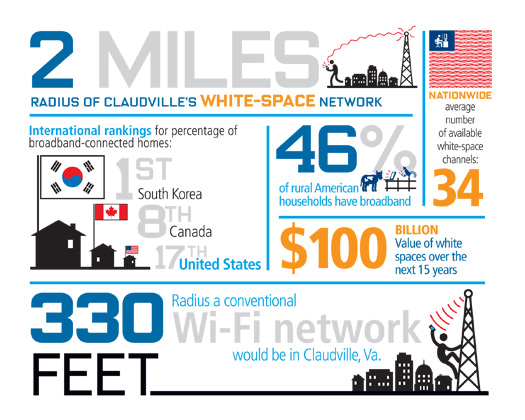
When TV went digital, Verizon, AT&T and other cellphone carriers shelled out a combined $19 billion for some of the freed-up airwaves, known as white spaces. Now wireless company Spectrum Bridge is using the parts that are still unclaimed to deliver high-speed Internet from its broadcast tower to your laptop computer.

As soon as next month, the Federal Communications Commission is expected to allow commercial white-space Internet, which could help hook up the 54 percent of rural homes without broadband. These white-space channels use lower frequencies than Wi-Fi, so they can pass through physical obstacles easier and travel farther. Last October, Spectrum activated the first white-space network, in Claudville, Virginia, under an experimental FCC license. The town’s hilly landscape and abundant trees made conventional wireless near-impossible, so the company set up an Internet-connected radio transmitter at the town’s edge and gave the school, business district and a few homes modem-like radio receivers. “They’ve been trying to get connected to the outside world for the better part of this century,” says Jeff Schmidt, Spectrum’s director of engineering.

Because wireless mics and news cameras can also use white-space channels, Spectrum’s system chooses among unused channels listed by the FCC. If all goes well in Claudville, the company plans to test the tech in the more crowded airwaves of cities this year.

20 Comments

If the old analog tv signals can be used for broadband internet access, this proves the public has been lied to about the reason for the switch to digital.

The only reason I can think of for the tv networks to not fight this is that they plan to transmit their services over the internet eventually anyway.

How does the government have the authority to force them to abandon all the infrastructure they had built all these years and convert to a less perfect system. And don't say the digital system is not less perfect, it gets more interference and needs line of site for the most part. If they can stream video over the net to you over the same system tv signals were sent through they could have simply converted to that and had PC boxes rather than converter boxes.

I see a new fleecing of the public coming. We will soon all have to buy a new Internet Ready TV to get those channels. They sold converter boxes and soon when they switch to internet transmission they will sell the Internet ready TVs and boxes. Which will all cost us more as we will have to pay for the service directly or the broadcasters will have to pay AT&T or whoever owns the wireless towers.

Can you say SCAM!

Have you looked at TVs lately? Many of them already have ethernet or wi-fi connections so you can watch internet TV. So with the average amount of time it takes for this sort of tech to roll out most of us will already have TVs capable of receiving the information.
Not only that but apparently you haven't been watching the white-space debate. The FCC first turned down the idea when it was presented by several IP companies such as google and microsoft. It was only after repeated attempts by them to prove that it wouldn't interfere with the current license holder's spectrum have they tentatively started testing.

I wonder what "The Internet" looks like on an old analog TV. Pretty fussy I'm sure but maybe a little more organized than the static we're used to looking at.

I can't wait, I will be able to watch internet porn on my big screen.

For those who haven't tried it, computer monitors are much higher resolution than televisions. The text on this site would be very hard to read on even a 720p television let alone anything else. Using old tv's for "internet" is silly at best since only videos and images would be viewable.

Also... S-video? VGA? HDMI? It's not hard to watch anything on a tv. I regularly watch Hulu on my tv via VGA from a laptop.

Digital tv is not going away, old analog tv abandoned some of their frequencies we need to use these for wireless internet. It will not go to places like at&t but to local isp's. There is no scam and digital tv is not going away we are just getting more use out of the same space, well we will once the fcc frees up the white space.

I'm not sure if people here are just being flippant or if you seriously believe what you are saying.

Just to correct the record, TV stations were required to use the new spectrum so the stations could broadcast both the old analog signal and the new digital signal. Additionally, using the old spectrum for internet does not mean you can use your old TV to "watch" the internet.

Maybe I'm just being too serious, and not getting the joke. But I don't think so.

I guess im just not getting it... who cares if most homes dont have broadband.. alot of people have internet other ways. Is cable considered broadband? We dont have a one set answer here in the us. So the little ranking thing that shows us in 17th or what ever. Also that is going off % it looks like. So as far as people we have alot more on broad band anyway. Plus our country spands a very large area. we have 6 times the people in canada. I guess my point is who really cares about this? the other % that dont have it most likely dont want it or cant afford it, and both will be true even after this role out.

Every person on the North American continent should have broadband access, in fact every single person in the world should have it, and it should be cheap or free. It's probably going to take another 50 years for this to happen, but hopefully not.

No one seems to have asked, so I will.

So we're about to be able to receive internet over previously analog TV frequencies... what about upload? How will our machines send queries? TV transmissions, the old kind, were one-way communications.

Only the frequency is the same. Nothing else. Not the format, anything else. Just want to restate that. Since it's a digital signal, it'll also have the same range as digital TV, or a little less (because dropped packets are a bigger deal for internet use than for video streaming.) The bell-shaped range curve of analog TV was unique to analog transmission.

There are no televisions involved. = ) Just a modem with rabbit ears.

It's a matter of the service that makes this a good thing or an indifferent one. Presumably, with this arrangement the service could be relatively inexpensive, like buying a $100 antenna modem and a $20/month service plan. For folks like my parents, living in rural Kansas, that would mean a free upgrade to broadband instead of being damned to dialup on decaying rural phone lines. But even if the infrastructure is cheaper, companies could still charge what they charge for the same *service* now - something like $60/month or more.

If the business model and the overhead can be managed to make this relatively inexpensive, then you get two things out of the deal: a broadband outreach program to the rural poor in a couple of years, and potentially a cheap alternative to 3G within a few years more. (God ... that means netbooks with 3-foot antennae, though. Eek.)

Oh - the other bit. Upload is required for queries, so without up, there's no down. Presumably, they've accounted for that, yeah? I imagine you'd either have something that looks very much like a TV station antenna working as a transponder, going both ways, sending out very big signals and picking up very weak ones.

Now ... this doesn't jive, though. The antenna doesn't know where your computer is. That means the pulse is *immense* compared to Wifi. I don't know how that can possibly work - what would the real bandwidth possibilities be on a single, really big antenna? And since anyone in a two mile radius can run a packet sniffer on your surfing, erm ... better make sure your bank supports SSH connections. = )

First of all they wont use the same transmitters and the coverage area will be dependent on loads of factors. There will almost certainly be multiple access points at each site arranged in sectors. Your home will have a directional antenna aimed right at the access point, no rabbit ears. All communications is encrypted and is much more secure than wifi. You can expect data rates between 15 mbps to 60 mbps per sector.

Here are some facts, to help clear things up.
Digital signals can carry more information on a single frequency than analog can. this is due to modulating the signal (phase, and amplitude). We can also send two signals that do not interact with each other on the same frequency as long as they are perpendicular to each other (horizontal, vertical). So in general switching from analog to digital means that we can make more efficient use o the frequencies that exist since there are a finite number of frequencies available.
Also all frequencies travel at the same speed, however higher frequencies can carry more information in the same period of time because there is less distance between each successive wave crest. The downside to higher frequencies is that they cannot travel through things as easily (walls, rain), and the processing of them requires more power (amplification before demodulation).
Lastly the United states does not make all its own decision on how spectrum is utilized. The International Telecommunications Union (ITU) sets global standards for how wireless frequency bands can be used. These regulations are then administered and further regulated by the FCC in the United States.
Also the Sending out of signals from ones home is easily possible wirelessly. There are satellite internet providers that allow you to communicate from your home with at satellite 36,000km away with only a simple small satellite dish (must have a transponder, TV dishes do not have this). And if you were using much lower frequencies you would not need line o sight to transmit (as the technology in this article would be using). It doesn't matter that you are far away, a very weak signal can be picket up and amplified billions of times over.

Who cares?? I care! You know how frustrating it is to pay for a satellite ISP? $100 for 1.5Mbs with 2000ms latency that makes the service feel comparable to that of dialup!! You think that's ok? 50%... 50%! of rural homes without broadband! Knock on this dude's skull. Hell yes we need the white space. The reason so much white space is freed up with the introduction of digital is digital takes up a much less wider spectrum than analog did. Have you ever noticed digital channels with sister channels (i.e. 13-1, 13-2, 13-3)? We're going digital because it is a much much more efficient way of using the spectrum. The analog channels that were only able to hold 1-13 signals can now hold 30+ using that same spectrum.

If you read the article first before commenting! The article simply said that they are re-using the old analog TV FREQUENCY, not the old analog TV towers, not the old analog TV transmitters. In other words, the technology, the tower equipments, as well as the "modem" equipments in your home will be very different from your old analog TV.

For those questioning the technology, perhaps you can think of the cell-phone technology, where it is a two way communication, with a bunch of towers to accommodate the link-up and link-down. No, I am not saying the technology will be exactly like the cell-phone model, but I am giving you an example of how things can be done, and it is already around you, all you need to do is just look.

If you read the article first before commenting! The article simply said that they are re-using the old analog TV FREQUENCY, not the old analog TV towers, not the old analog TV transmitters. In other words, the technology, the tower equipments, as well as the "modem" equipments in your home will be very different from your old analog TV.

For those questioning the technology, perhaps you can think of the cell-phone technology, where it is a two way communication, with a bunch of towers to accommodate the link-up and link-down. No, I am not saying the technology will be exactly like the cell-phone model, but I am giving you an example of how things can be done, and it is already around you, all you need to do is just look...

Dallas
http://burnwiigames.org/

First off as the previous poster put...READ THE THING BEFORE COMMENTING. They not once said your tv will be the thing getting internet from it. They simply put that they will be able to wirelessly send internet signals to more locations that broadband wasnt previously able to get. IE, People that live in the country where cable lines havnt yet been laid for internet to reach them or people who live too far from a repeater box so they are unable to get a line to thier house without having to pay someone to run it which kind of makes getting the internet too expensive for the average person.

The signal sent out by the towers WILL NOT go to your tv. As the post stated it will be sent out to special MODEMS that will be able to pick up the signal such as a Cable modem or dsl modem currently does. So your old 50 inch projection tvs do not turn into a internet machine unless it has the proper hook-ups for it.

And for those who need further explanation on the difference in digital signals and analog picture this.

Analog signals are very basic as in they are pretty much just on and off. only two points are accessable on them.

Digital signals can be represented by a wavy line that can be accessed from multiple points of the frequency instead of the previous off/on spots.
The digital signal is ultimately more effective at handling a signal

Hopefully this helped at least once person.

Fantastic news for those who reside in areas that do not receive good connections. To be able to look at improvements that increase the amount of available internet use in hard to connect locations is another challenge that appears to have been solved. I have lived in the mountains and know the frustration of not having a good communication connection. I am a fan of white space and Spectrum.

www.broadband-expert.co.uk

Whenever I hear talk about public airwaves being put to new use I always start looking over my shoulder. It seems that every single time airwaves come up for auction it’s the public (who allegedly owns them) that gets the raw end of the deal. How is it that a publicly owned utility, can be sold and the public sees none of the proceeds and is then charged to use what it once owned? I guess I’m spitting in the wind, but I still think it’s a shame.

Regards,
Paul
http://www.connetu.com/


138 years of Popular Science at your fingertips.

Innovation Challenges


Popular Science+ For iPad

Each issue has been completely reimagined for your iPad. See our amazing new vision for magazines that goes far beyond the printed page


Download Our App

Stay up to date on the latest news of the future of science and technology from your iPhone or Android phone with full articles, images and offline viewing


Follow Us On Twitter

Featuring every article from the magazine and website, plus links from around the Web. Also see our PopSci DIY feed


February 2012: The Future of Fun

Science is reinventing play, from extreme sports to gamification to ridiculous roller coasters to the playgrounds of tomorrow, and this issue is chock full of fun. Also, on a less fun note: Did global warming destroy my hometown?


circ-top-header.gif
circ-cover.gif
bmxmag-ps