
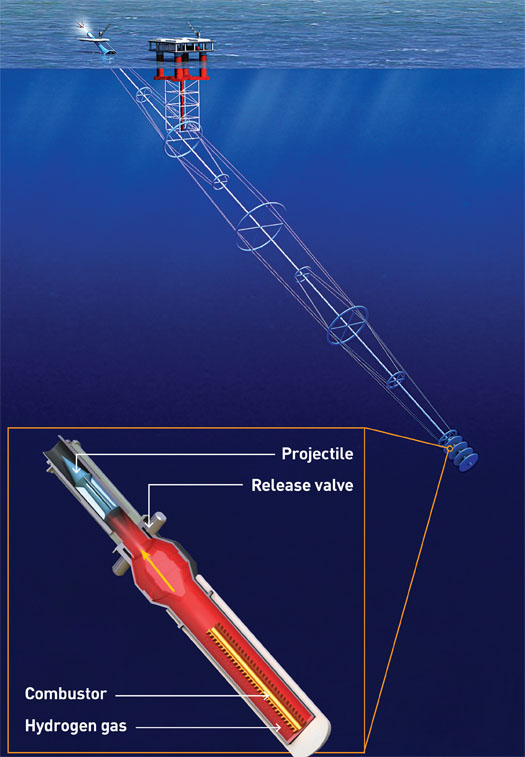
John Hunter wants to shoot stuff into space with a 3,600-foot gun. And he’s dead serious—he’s done the math. Making deliveries to an orbital outpost on a rocket costs $5,000 per pound, but using a space gun would cost just $250 per pound.
Building colossal guns has been Hunter’s pet project since 1992, when, while a physicist at Lawrence Livermore National Laboratory, he first fired a 425-foot gun he built to test-launch hypersonic engines. Its methane-driven piston compressed hydrogen gas, which then expanded up the barrel to shoot a projectile. Mechanical firing can fail, however, so when Hunter’s company, Quicklaunch, released its plans last fall, it swapped the piston for a combustor that burns natural gas. Heat the hydrogen in a confined space and it should build up enough pressure to send a half-ton payload into the sky at 13,000 mph.
Hunter wants to operate the gun, the “Quicklauncher,” in the ocean near the equator, where the Earth’s fast rotation will help slingshot objects into space. A floating cannon—dipping 1,600 feet below sea level and steadied by a ballast system—would let operators swivel it for different orbits. Next month, Hunter will test a functional, 10-foot prototype in a water tank. He says a full-size launcher could be ready in seven years, provided the company can round up the $500 million. Despite the upfront cost, Hunter says he has drawn interest from investors because his reusable gun saves so much cash in the long haul. Just don’t ever expect a ride in the thing: The gun produces 5,000 Gs, so it’s only for fuel tanks and ruggedized satellites. “A person shot out of it would probably get compressed to half their size,” Hunter says. “It’d be over real quick.”
STEP 1: HEAT IT
The gun combusts natural gas in a heat exchanger within a
chamber of hydrogen gas, heating the hydrogen to 2,600˚F and causing a 500 percent increase in pressure.
STEP 2: LET THE HYDROGEN LOOSE
Operators open the valve, and the hot, pressurized hydrogen quickly expands down the tube, pushing the payload forward.
STEP 3: TO INFINITY AND BEYOND
After speeding down the 3,300-foot-long barrel, the projectile shoots out of the gun at 13,000 mph. An iris at the end of the gun closes, capturing the hydrogen gas to use again.

138 years of Popular Science at your fingertips.
Stay up to date on the latest news of the future of science and technology from your iPhone with full articles, images and offline viewing
Featuring every article from the magazine and website, plus links from around the Web. Also see our PopSci DIY feed
Share links with friends, comment on stories and more
This month, a look at the future of secret warfare, the dangerous search for Afghanistan's mineral wealth, a backyard flamethrower, and the most amazing college labs.
Read the issue here.

Editor: John Mahoney | Email
Associate Editor: Paul Adams | Email
Contributing Writers:
Clay Dillow | Email
Rebecca Boyle
I like the idea. Will the projectile be able to control itself once in orbit? How can it be retrieved. Also, what is the range of this gun? Will it shoot its projectile far enough to retain orbit until it can be retrieved?
I like the writing in this article. Much more scientific based and a whole lot less opinionated than most articles on PopSci have become.
Applaud Amina Elahi
--GTO--
I suppose this issue might apply to rockets too, but is there a chance the eventual orbit of the payload might be affected if it hit a seagull on its way to space?
Interesting news: WIN
Not using SI units in a science article: FAIL
@Mikron i agree
500% increase in pressure? That's only an increase of five times. Doesn't seem like a lot for a shot to orbit.
I'm a little confused... if he were firing an object from the surface of Earth to go into space, wouldn't he have to get the object to reach the escape velocity from the surface? My understanding was that any object fired from the surface would require a speed of 11.2 km/s (25,000 mph) unless it has a system of propulsion to counteract the acceleration (or deceleration in this case) of gravity. How can he fire it off at only 13,000 mph? Does being at the equator really help that much, or am I just missing some basic physics here?
@jelam04
Just missing some basic physics...
11.2 km/s is what you need if you want to escape the earth gravity all together without no danger of falling back ever again. No orbit, that is. The equator gives you an extra 2 km/s for free, compared to firing from the poles.
463 m/s = 40 000 km/24h (more or less...)
"extra 0.463 km/s for free,"
Just playing devil's advocate here...any investigation into possible effects of sonic impulse or recoil on marine life?
Okay, if you don't want your payload flattened, this is the way to go. (apologies for non-SI units throughout). Let's look at a constant acceleration model to see what the g-force would be on this fateful trip:
Length of cannon=3300ft
Final velocity=13000 mph=19066 ft/s
V_f = 2*D/T
Therefore time to escape cannon=.3461 s
A=2*D/T^2 = 55098 ft/sec^2 = (drumroll) 1721 G
Holy cow! Not even cockroaches can survive a tenth of that force.
2 ways why this is impractical/impossible:
1)Building and designing a satellite would be a nightmare. Even if this does work, the structural integrity to overcome the g-loading at launch would add so much weight to the satellite, that it would keep requiring for the power to launch to increase, in result, would require you to increase the strength of the satellite...then you have a never ending loop. Part two of this problem, the instruments on the satellite would also have a requirement to over come the launch g-loading, unless your launching rocks, sounds impractical and extremely expensive. The cost of building and designing the thing would be more than to launch it.
2) In order to launch something into space from the ground economically, the object has to lose mass, or be launched at a higher altitude. Such as the rocket, you burn fuel, drop fuel tanks, etc...basic physics you can find in wikipedia for "escape velocity". And just like jelam04 stated, this thing isn't going anywhere but back down unless it can reach 25,000 mph. Oh and we're not even considering air drag!! At that speed,near ground level, the launch package would hit dynamic q and wouldn't be able to accelerate enough to reach escape velocity.
This would at best be a good warhead launcher.
from Kent, OH
dfs2010, who cares? It makes a big boom...only downfall it doesn't have boobs or bacon!
also, hope this thing is attached to the bottom of the sea floor, ocean currents can really mess up a launch. Also the moment that the launch would create, I imagine would rock the platform quite a bit (it is essentially a huge unconstrained gun), and by the time the payload is out of the tube, it would be on an altered trajectory.
You do not need to accelerate an object to escape velocity in order to put it into closed orbit. You need to reach just first cosmic velocity which is about 13000 mph. Escape velocity is necessary if you need to escape the Earth gravity, or put an object into unclosed orbit (go into outer space).
If you check out the companies website they have a video of John Hunter presenting his pitch to Google.
He claims...
3200gs
Goal muzzle velocities around 6-7.6km/s
gun length 1100m
payloads are multistage (shot out and then use rocket)
used mostly for supplies
they built a satellite for $40k with COTS that could survive 3200gs with only 2% mass increase (doubt it had much sensitive equipment)
Interesting development and another possible contender for private sector space missions.
Super guns to fire projectiles into low Earth orbit are not a new idea. (Saddam Hussein tried to build one for military purposes and its history goes back even further than that.) But building a sea-based gun is very innovative. Aside from mobility, it allows for easy loading while on the surface before submerging the rear-end to the optimal depth. Unlike land-based super guns, it also allows for flexibility in angle orientation. I'm sure that utilizing all that pressure a couple of thousand feet below the surface would be useful as well.
Excuse me,
projectile is multistage (shot out the gun and then single stage rocket)
I suppose this cannon placed inside a ship would negate any effects of ocean current and dampen the effects upon sea life, plus the ship would be used to deliver and point the cannon too.
One cargo that would easily withstand the high Gs of launch would be Carbon Nano Tube, the stuff the space elevator cable will be made!
I doubt it would be used much for satellites, but fuel could easily be loaded, and that is very valuable.
Hmm more interesting is the ability make this ship or sub deploy-able. Rounds on target almost anywhere in the world in 40 minutes. This would create a low cost alternative to missile systems. I for one am not sure how I feel about the idea of creating a "low tech" alternative to ICMB's. Lets be honest folks if a guy like me sitting at home see this and instantly thinks that then I am sure there are people in other less stable and friendly places that are thinking the same thing.
OH I would like to add that a weapon of this sort would get by most of the Major powers missile threat detection system as there would be no missile launch to detect and a warhead fired from a weapon like this would most likely be dismissed until to late due to its size on radar when it was detected.
To GTO,
The projectile must be able to maneuver in orbit. Otherwise it will re-enter on the second half of the same orbit it was launched into.
Doubt it will work. At sea level at the kind of speeds they are talking, atmospheric drag will be extreme, causing de-acceleration and heat. Underwater has advantages but also big disadvantages. It might be better to build a longer large bore unit up the side of a mountain so as to have just first stage performance with lower barrel exit velocity.
Still, it can be used to send basic raw materials into orbit, to be captured by some already-existing station there that was launched by conventional means.
With a cheap means of getting raw materials into orbit, I'll really be looking forward to seeing orbital shipyards. Hopefully by then fusion would be advanced enough to power rugged high-capacity ion drives.
HA. Who am I kidding, we're never gonna get that far :(
I agree with richiej615.
lnwolf41 No one said anything about stable orbit or escaped velocity. They said shoot into orbit, where it could be retrieved by some type of tug. Also to reduce the sudden impact of hitting the air shoot a laser that would create a vacume at launch time. As for recoil deploy wide baffles along the length of the tube, and a tube within a tube to absorbe and reduce the recoil like shockabsorbers. as for to hard on satilites create a non conductive (slime, oil,liquid) to immerse all the components that would support everything yet would be easy to drain out once the sattilite was recovered prior to insertion to a stable orbit.
lnwolf41 Could it be used as a weapon? yes, just like a car ,plane, envelope in the mail, a rock, baseball bat, molavtoff cocktail. Everything that man/ woman has made or invented can be used as a weapon. So MRDAHUT you have a valid point but not one that says we shouldn't build it.
Now all we need is a sky pipe a modification of the non-geosynchronous sky hook. Only a couple of hundred miles long it would be 100 times smaller then the space tether and done with less ambitious materials than 24,000 miles long nanotubes. Various posts with fuel cells would pump and suck hydrogen up it from a steady fleet of fuel tanker aircraft. It would use that fuel to maintain its own orbit. At 70 miles up a bag would fill with fuel for a spaceship one like vehicle to pick it up and go to geosynchronous orbit, or go the end of the sky pipe and pick up an even bigger bag to go the moon. No rockets necessary, just inflate and build you space station close to earth then inflate the fuel to take it to the Moon and then Mars.
lnwolf41 I agree I'm not saying the project should not proceed. I was merely pointing out that it is an almost instantly deployable weapon system. IF it wasn't thought of now it would have been thought of by some one some where some when. But we need to look at any technology and consider its offensive potential to consider how to counter that threat.
It would be good for launching food and water and fuel into space
Hungry ISS Astronaut-- Houston, I've got some mad munchies! Could you shoot me in the face with some tiramisu please?
Houston-- Roger that, Chilly Willie.
click click boom!
from Leamington, On
13,000 MPH+ is the speed of the expanding hydrogen wave front. The at is a very high speed of sound.
During reentry you are going the fastest when there is the least amount of air around you. This helps you slow down over time. With space cannons you are going the fastest when the air is thickest. This will slow you down much faster and most of your energy will be converted to heat so you will need to be launched even faster to compensate and that means slowing you down even more and making more heat. I'll bet when he "done the math" he done it wrong. Launching from sea level just isn't practical. Gotta launch from a mountain top and even then air friction is a huge problem.
The projo need not be short relative to its diameter as one might conceptualize a bullet or an artillery round.
It may be fairly long relative to its diameter like a tube-launched rocket, allowing it to carry some internal fuel in a conventional manner.
A solid-fueled rocket, fired from a tube as described, would require a considerably smaller burden of fuel relative to the payload because the initial acceleration from rest would be imparted by an external force.
The vast majority of the energy expended in launching conventional rocket is necessary to overcome the inertia and gravitational attraction of the vehicle/fuel combination at rest on the surface. The mass of both the rocket and all that fuel itself must be accelerated.
G forces experienced would be inconsequential to supplies such as liquid fuel or fairly solid materials properly packed and protected. More fragile payloads, such as simple satellites, could be suspended in dense fluids or gels. This would leave only over-engineering of internal components that would not supported. Such an arrangement would not require that the entire mass of a satellite payload be an order of magnitude greater than it would otherwise have been.
Designing the skin of the projectile to produce laminar airflow would significantly reduce atmospheric friction.
Eliminating the mass of fuel required to overcome the inertia of the vehicle/fuel system in favor of an external force only makes sense.
We'd still have to launch squishy things like astronauts in the usual manner.
This most likely will never work. the main problem with it is that the highest pressure applied to the projectile is at the very beginning. As the projectile moves forward in the barrel the pressure will rapidly decrease. So it is highly unlikely that it will have enough power to launch something into space.
A very similar idea that will actually work is something called a ram accelerator. look it up. It is built off the idea of a ram jet used on the lockheed blackbird. with this the maximum pressure is always right behind the projectile. the only problem with any "gun type" launching system is that it would create a sonic boom so large that it would break anyone's ear drums in a 50 km radius.
Also any projectile "shot" into space HAS to have a small rocket on it to put it in orbit. otherwise it will just fall back to earth.
Don't think of it as launching devices but materials to make things in orbit.Imagine an automated orbiting factory to create satellites and system space craft from materials fired into orbit. Create a factory by expanding a balloon in orbit then spray the interior walls with epoxies to make it strong enough for an atmosphere.
This is when human kind's technology goes twisted. It can be turned into one awesome(deadly)weapon that can basicly destroy spy sats and use it as a long range balistic cannon.
This is not a new idea. Besides the Super Gun that Iraq was attempting to create, there was a series of tests done by the US and Canada in the 1960's using a highly modified 16" gun. The gun used rocket assisted shells, and reached heights, if I recall, of 180 kilometers. It was "not" designed to launch small satellites into orbit, but test the "concept". It was VERY SUCCESSFUL at doing what it did.
The gun was designed by Dr. Gerald Bull, but funding for its development was withdrawn by the Canadian and US governments after heavy political pressure as a threat to the then blooming US rocket industry.
In the 1980's Saddam hired Dr. Bull to build the Super Gun for Iraq. After numerous ignored warnings by the Israelis to stop his work, Bull was assassinated. Several sections of the 156 meter barrel were "discovered" in France that were being shipped to Iraq as "special oil piping", and were destroyed. The rest of the incomplete gun sections were destroyed on the side of a hill they were mounted on during the first Gulf War.
The "G" forces imposed on any electronics in gun fired shells has been solved since WWII, when a radar type fuse was developed for use in anti-aircraft shells. Today it is used extensively in smart artillery rounds that have GPS guidance, or infrared sensing, etc. The "G" forces in a satellite launching gun would really be no more intense than in a large field artillery gun. The "G" forces would only last longer due to the increased length of the barrel.
Personally I think that a RAM gun, (the barrel is filled with methane gas for example, and as the shell travels through the barrel it acts like a ramjet engine burning the methane and continuously accelerating throughout the length of the barrel) would provide a more efficient method than the one proposed in this article.
Unfortunately the public has been trained that the only way to launch anything is with a rocket.
boab
I might add to the above comment, that Dr. Bulls gun was called "Project HARP". Google "HARP GUN" if you are interested, and you will find several science papers written on the project. And for its day, it was quite a project, but threaten to many other government projects at the time with its cheapness. You could launch many satellites from one gun, verses, many expensive rockets.
Cannons big enough to launch objects into space are to big to be a real threat. They are just to big to go un-noticed whether placed on the side of a hill, or floating in the ocean. They can be taken out to easily. Just like the "Atomic Cannon" the US Army developed in the 1950's. The Russians constantly noted where the cannon was in Europe, and what it was doing. Finally the US gave up on the Atomic Cannon idea when artillery rockets like the Honest John came into service, that were considerably lighter to transport, and had the same throw weight capability, and accuracy.
boab
Many of you have mistaken escape velocity for orbital velocity. Objects in orbit have not escaped Earth's gravity thus they do not need to make it to 11km/s. LEO orbital velocity is only around 8km/s. Most rocket have to compensate for things like drag so that pushed it up to 9-10km/s. The record that has been set by hydrogen gas gun like the one he plans on using is 11km/s.
Secondly it is only intended mostly for boosting materials to space, not humans or expensive satellites or hardware. These materials include things like water, propellant, oxygen, and etc. These materials should have no problem with the immense G forces. It takes thousands of kg of propellant to send a single person to the moon at a current cost of $10,000, so there is definitely a market for this thing if they get it to work.
If you guys want to know more this link take you to his presentation of it.
@animemaster
He's worked on smaller cannons for launching hypersonic engines... it's not like he's some backyard tinkerer.
It's "gunna" be the largest cannon ever. Or at least the largest cannon now. Next thing you know, space cannons. Cannons in space is better that cannons on the ground because there isn't any air resistance in SPACE.
Choosing a mountain launch site would not be as mobile as this, but when launching from the ocean, the drag from going through an extra mile of high density air seems like it would be more of a problem, and require more ablators for the projectile.
Firing a cannon in space, not attached so some planet or moon, would be interesting. The ole "equal and opposite reaction" would take effect on firing, and you'd be lucky to find it again.
In the late 70's the Russians put up a two man "manned" spy satellite. The crew was to take pictures of various interesting things as they orbited.
For some reason, someone in the Kremlin thought that someone might attack the spy capsule and had a 23mm cannon mounted in the belly of the capsule for defense.
The Russian astronauts where more than a little concerned about ever firing the cannon, as it was mounted off axis with the capsules CG and could have caused the capsule to spin wildly, as well as change the capsules speed and orbit considerably.
As far as air resistance at lower altitude increasing drag, and air resistance, it is very true. But let us not forget that re-entry nose cones used on ICBM's are more than capable of operating in the reverse outbound direction, and are now about the size of this projects cannon bore.
boab
i think it'd work, and i think that if they can get the funding for it they could make a lot of money commercially. however i doubt that the U.N. would allow something like this to be built, something about a massive artillary piece occupying international waters just screams mad scientist. then again since when has science ever been kosher?
YAY! Let's shoot some rockets to the space station OMG Lol
*BOOM!*
By the way, will it create/produce any space wastes? If so, that would suck. :/
A Rail Cannon would be much better.
@V3RTIGO
An Elevator Cannon to the moon yeah
awesome
@Leadhyena: I too came up with 1,721.3g ==> 1,700g. However, that is for one-dimensional kinematics, which doesn't fit the problem, as the projectile isn't moving in one-dimension.
As the velocity & acceleration vectors are not in the same direction as the gravity vector, we need to use at least two-dimensional kinematics to model it. We also need to consider air drag in the barrel, as well as the friction between the projectile and the barrel.
The story didn't give values for air resistance in the barrel, or the coefficients of static & kinetic friction, or the direction of the launch vector, so I can't really account for these factors. That said, the actual constant acceleration would have to to be much higher than 1,700g. The 5,000g cited in the article doesn't seem unreasonable to me.
While certainly not suitable for any type of life, this could help get large quantities of raw materials into orbit. It might make N_2-based atmospheres possible in large space habitats.
Punkin' Chunkers have been using a variation of this technology for a long time! I don't know what the big deal is. Wake up folks! Let's get behind it. NASA's been in a rut for 40 years....Yea for the "common" man!
It provides insufficient velocity to attain orbit. It might get stuff out of the atmosphere, but the load will have to be captured immediately, and fuel expended to get it *to* orbit.
It seems more like a weapon, and the folks downrange from it will be at risk. Meaning it can only be fired near "China", with the payload to hopefully (crash) land and miss the narrow bits of Mexico.
Additionally, the hydrogen it will release (and there will be a lot despite the shutter), a significant portion will also likely escape Earth. This means we deplete some "water" with every shot.
According to a few of you, the test payloads just might come back down again? Physorg has a lecture by Hunter on this: www physorg com/news183023838 html. "Jules Verne was right, but the correct fluid is hydrogen, not gunpowder..."
What about this? “A person shot out of it would probably get compressed to half their size,” Hunter says. “It’d be over real quick.” Is he suggesting a new type of "green mile?"
Thanks for the history on Dr. Bull's gun, Boab. I've been dreaming about it all since hearing of that. I didn't imagine using hydrogen, it's low mass fit's the bill.
I wonder though whether a magnetic rail gun could be developed. It would have a no mass propellant. I definitely think that running this thing up Mount Everest would work better what with the thin Atmosphere. If you could build a long enough tube, you could drop the acceleration considerably, maybe even to 50g's or so with a 30 mile tube. One g equals about 22mph/sec. Sorry for the English units, you can thank our politicians for screwing up my education and the Space Shuttle that way!
With a very long evacuated tube exiting much higher in the atmosphere most of the drag would be bypassed and the capsule could be more in line with a real orbital path. Perhaps the nose cone could be offset to impart a more forward orbital path before it totally left the atmosphere.
A thirty mile inclined tube might seem impossible but it might cost no more than a modern US highway? Yeah the location would be a problem. Politics is the biggest one. We'd build launchers at the North Pole if a congressman's district were there and defense or aerospace companies would profit. One might support the top half with balloons, kites or electrical helicopters.
50 g's is still too high for human transport though some of those USSR female Olympic athletes might be able to do it, or our own steroid enhanced baseball players. There is a possible solution.
Consider the human body as a package to be ruggedized. High acceleration would normally crush it unless it was properly supported. The body is mostly water so why not use water to support it. Fill the lungs and all with water or another fluid to carry oxygen and put the person in a tank. I'm not sure what degree of acceleration would cause a concussion but a normal concussion may impart most damage when the brain hits the back of the skull due to deceleration.
One human did survive 22g of acceleration with damaged retinas. Perhaps immersion in a fluid matching the bodies density would allow 50g or higher survival!
Boy, what strikes me most here is the degree of resistance to a seemingly unorthodox concept. Not withstanding some of the more reasoned comments (boab and spence for instance), there sure are a lot of naysayers who are absolutely 100% convinced of their intellectual superiority.
Of course there are problems to be overcome! The way we solve those problems is what makes this stuff so cool!!
Try these other experts on for size:
“Heavier-than-air flying machines are impossible.” — Lord Kelvin, British mathematician and physicist, president of the British Royal Society, 1895.
"I think there is a world market for maybe five computers." --Thomas Watson, chairman of IBM, 1943
“The energy produced by the breaking down of the atom is a very poor kind of thing. Anyone who expects a source of power from the transformation of these atoms is talking moonshine.” — Ernest Rutherford, shortly after splitting the atom for the first time.
Oh- and @johnt007871
"@animemaster
He's worked on smaller cannons for launching hypersonic engines... it's not like he's some backyard tinkerer."
Backyard Tinkerer?? I resemble that remark!
Wont there be a major kickback? Like when firing a handgun and your arm flies back? Shouldn't the gun be shot way underwater as the projectile flies out the end?
that shud b used 2 launch all our nuclear waste in2 space
This might be a great way to launch the 40,000 km of cable required for a starter orbital ring space elevator system
Cheers,
Bert
Paul Birch’s Orbital Ring/Space Elevator
www paulbirch net/OrbitalRings-I.pdf
we should definately use this for nuclear waste.... as long as it doesn't blow up in the atmosphere it will solve all problems about nuclear power.
Now that Nasa is out of the picture, maybe we can get funding to build a real spacecraft. The Technology of the Flying Saucer I found in 1967 here in Canada and got the patents in 1978. Nasa Propulsion Engineers were dead-set against using it. Who would need them if we could fly to the Moon in an hour? Equip a Shuttle with new propulsion systems, fly it anywhere and landing it anywhere we want it and all that without heat-shields or barf-bags?
No way!
Now that they are out of the picture (with a Golden Handshake of course) we might get the next industrial revolution going. It is all electronics.
There are at least 1000 spin-offs with this technology, like free electric power for your car. Tesla used it for his Pierce Arrow car in 1931. That will mean also free electric power for any dwelling at any time, anywhere on this planet. To avoid heart attacks at the Oil Baron's side, the units will be installed and LEASED to give the investors and taxman their due.
It will still cost a lot less to heat or cool your home, heat you swimmingpool in the winter, drive you car and fly.
There will be thousands of jobs coming when using this technology. We need thousands of electricians to install the units.
Manufacturing the different applications will open jobs.
We can even fly all the nuclear waste to Jupiter instead of hoarding it here.
Since I was gypped out of my $11 million payment for the E-Bomb by the US DOD when a "Patriot" sold it to China (Don't you admire the marvellous security you have?), I expect that at least before I go to work on it.
That looks incredible. I'd really like to go to space one day and truly thing that this could be the next way to travel. Almost like getting shot out of a cannon like at a circus. In any event, speaking of traveling, I wonder what the annual travel insurance premiums are on that type of transportation? Lol!