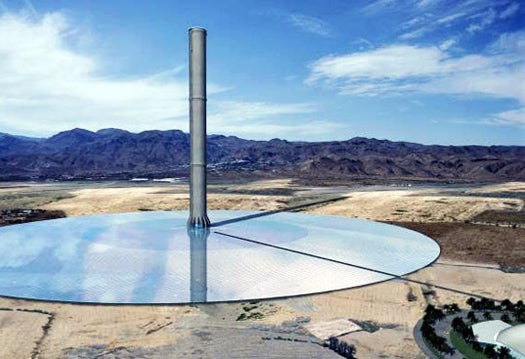
Today's solar power plants work either through photovoltaics or heated steam. If Enviromission gets its way, tomorrow's plants will combine wind and solar, with acre-sized mirrors and multi-thousand-foot-tall chimneys generating turbine-spinning gusts. The technology's called solar updraft, and a $750 million, 200-megawatt project may just bring Enviromission's future into the present.
The plants work by generating pressure differentials between warm and cool air at the surface. Four acres of solar panels sit around a 2,400-foot-tall chimney, and above turbine-laden tunnels. The panels heat the air closer to the chimney far faster than the air at the ends of the tunnels. The warmer, less dense air then serves as a partial vacuum, drawing in the colder, denser air at the edges through the tunnels fast enough to spin the turbines and generate electricity.
Solar updraft technology first broke onto the scene in the 1980s, but this is the first time a company has made a serious go at it. So far, Environmission plans to build two towers in La Paz county, Arizona, and California has cleared Enviromission as a power provider, but has yet to fully sign off on solar updraft technology as method for generating electricity.
Five amazing, clean technologies that will set us free, in this month's energy-focused issue. Also: how to build a better bomb detector, the robotic toys that are raising your children, a human catapult, the world's smallest arcade, and much more.


Online Content Director: Suzanne LaBarre | Email
Senior Editor: Paul Adams | Email
Associate Editor: Dan Nosowitz | Email
Assistant Editor: Colin Lecher | Email
Assistant Editor: Rose Pastore | Email
Contributing Writers:
Rebecca Boyle | Email
Kelsey D. Atherton | Email
Francie Diep | Email
Shaunacy Ferro | Email
great you have powered 200,000 single family homes. now what about the other 5.09 million single family homes in CA? not to mention townhouses/duplex, small business, commercial property, and so on...
I like the idea of generating electricity from the vast desert but I'm left with a couple of questions. How do you keep 4 acres of mirrors clean and free of rock chips? Also, is there any concern that generating huge updrafts of hot air will affect aviation in the area? I'm all for novel ways of using solar to offset some of the old school power production but i'm not quite sure if this is feasable.
200,000 single family homes for the cost is not feasable, it is an over expensive experiment the put on the taxpayer.
The article is mistaken stating "with acre-sized mirrors".
Solar towers using mirrors exist already. The mirrors focus sunlight onto the top of the tower where steam is produced to drive a turbine.
However, the updraft type solar tower doesn't use mirrors at all. Air underneath the circular (in the picture) roof is heated, the hot air rises, up the chiminey and drives a turbine.
... and there's a company called Suntec Solar that is planning to start building three of these this year in Australia.
"200,000 single family homes for the cost is not feasable"
$750 million for 200000 houses is not that much ($3750 per house). Construction cost will be covered in several years.
How does it compare to cost of other solar towers?
That would be great if you could do away with the mirrors, they look like one hell of a dust collector and take up a hell of a lot of room, and locate a tower for every 100,000 homes; that should provide enough power for any surprises. Couldn't they wrap solar panels or nanopaper around the tower and then check with Suntec Solar, as NOM said, for more ideas?
These are good ideas, but it seems like they are dumbing them down and making them unfunctional and so ugly that no one would want them in their backdoor, like the electric car manufacturers are with those electric cars that look like they belong in a circus with clowns crawling out of them.
Shoot it sounds like how we made hot water by letting the sun heat up the pipes way back in boys scouts. The best part about our system is it did not cost a whole lot.
don't see the point of a 750 million dollar project... I'd rather stick with researching higher efficiency of solar panels and having government acts of saying you need at least 1 solar panel per house! Even if it does look unattractive...
Only 200 megawatts? That is less than 1/2 of one turbine generator on one Trident submarine. We need something in the gigawatt range that lasts 24/7 365 x 30years. This is pitiful.
Stuart Fox: Do your research. Solar-updraft concepts do not use "acre-sized mirrors".
JamesDavis: If we continue to worry about what Johnny Suburbanite wants "in their backdoor" we'll never get closer to sustainable energy. Just like the majority of Nevada's and California's citizens continuing to want perfectly lush green lawns out their front door. Continue to worry about the "beauty" of your landscape in this way and we won't have any more beauty to behold.
01/07/10 at 4:19 pm
"200,000 single family homes for the cost is not feasable"
$750 million for 200000 houses is not that much ($3750 per house). Construction cost will be covered in several years.
The high average for the CA residents per year is 180$per month or 2160$ per year. The cost for the plant could be made up for in 2 years. However I agree with cloudmaster and see them make a single panel that can power a house than spent 750million. Also it doesn't mention how long it will take to build, so you could invest the 750million now and not get a return till 7 years down the road.
No I agree with JamesDavis. If you really want this type of thing to become more widespread, these companies must design a system that people will like and easily accept. If the same stupid companies keep saying to you "buy my ugly product because I think you need it, to help the environment" they're never gonna get on the consumer's side. One of the major problems with solar is creating a demand, I'd say marketing is the industries chief problem.
I'm curious as to why you all think this plant is ugly. Frankly, I'd love to have one outside my backyard.
@NOM & Azorus
there are 20 milion people in Australia but there are only 2 cities with populations above 1 million. if this powers 200 000 standard homes then that equates to 5-800 000 people, meaning almost 50% energy generation for any one state if built in the same area, singlehandedly solving our CO2 commitment for the next 100 years with as little as 10 stations or less
now, either it doesnt power 200 000 homes, those homes are VERY small, or one of you is wrong...
where do you get australia?
You are mistaken, Nom is talking about another company that is planning on building something similar in australia. The article covers ones that are planned to be built in CA, AZ.
I believe I read elsewhere that underneath the glass it is basically a greenhouse that could capture some moisture from the air moving through it. It argued it could potentially turn desert into farm land. If that were the case, as in 200,000 powered homes plus 4 acres of desert farm land, I would think it would be an easy sell.
In my opinion, this is an ugly installation, but both the aesthetics and efficiency could be improved by using an up-side-down trumpet shape that gives the tower greater stability at its base and provides better, smoother airflow to the turbines.
I would still rather see every new man-made structure-- every home, office, factory, mall, etc.-- required to have solar panels on all available roof and wall space. It would decentralize our power supply, reduce power losses due to long-distance grid delivery, would eliminate the need for tens of thousands of miles of ugly overhead power lines, would make us far less vulnerable to terrorist attacks that may rely on disabling centralized power grids, and much more.
The more solar panels we install, the more that economies of scale will reduce such costs, and our cost of living will decrease. If battery or ultracapacitor energy storage becomes the norm in homes and businesses, electric vehicles will be even more practical than they are today and we'll be able to stop paying our enemies in OPEC for oil, money they use to finance terror and to suppress their own sub-poverty populations.
Solar panels do not need to look ugly. When designed from the start to be integrated into a home or other structure, they are reasonably attractive and cost-effective, and can be the key technology to reducing pollution, noise, and blight. If the cost of living is sufficiently low, unemployment is far less of a problem, and we can concentrate on areas of our lives that really matter-- education, health care, and our transportation infrastructure.
If we make optimum use of solar, we minimize or eliminate the need for coal and other conventional power plants as well as nuclear, wind farms, and other power sources that would otherwise take up thousands of acres of wilderness and desert. It's distressing to see the loss of vast natural expanses for nothing more than energy generation.
Well said Billdale, I concure completely.
I like this design as well as the huge maglev vertical wind turbine. The good thing about this is it generates power all the time. It doesn't need the sun 24/7. The ground under it will absorb heat and at night the air under it will still remain hotter than the air above which will keep it running.
Zero fuels, no mirrors (why are they talking about mirrors in this article, its not the same as the solar tower in seville) and runs all the time.
Dust is a major plague in Arizona but it will be an interesting test and we just can't move forward without more projects like this. It will provide valuable learning for how we convert more homes and commercial buildings to solar use.
Of course, I wonder if they've seen that article on that new solar panel protective coating that helps resist grime and dirt? Might be another testing opportunity.
You would think both Arizona and Nevada would be in a race to figure this out... because the state that does can sell off its power to California. Really Arizona and Nevada could be the Saudi Arabia of renewable energy. They just need to work out the kinks.
I think the problem everyone has is they expect to provide all the energy from one source. Like the dams or huge wind farms. If you broke it down though. Like instead of putting a 20Mw coal fired plant up at twenty plus billion dollars etc. put one 1 or 2kw system on every house or plant. instead of getting twenty mw of potential power for one state you would end up with maybe lets say 500,000 homes X 2000 potential watts of power per hour. whitch would give you the potential of 1000Mw potential per hour of daylight at a fraction of the cost. Because it is on site use, well you can see the benifits. The major problem that I see of any corporation having is the control of it. Taxing wouldn't be a problem but profit control would and that is in my opinion why you see huge delays in setting up green energy production. Like they say on the evening news follow the money.
the huge misconceptions are cost of install and size. So many people think that it is going to take hundreds of thousands per home to put something like this on their home they think cumulative size to what they use per day not per hour of use. but in actuality an appropriate sized unit would be the same cost as paying for a morning cup of coffee and a biscuit at a fast food shop for one year you will never have free energy even with a one or two kw system per building utility companies charge a flat dwelling or shop fee just to keep conected distribution costs etc. What you dont see is something to touch and look at. unless you accept turning on the lights as a tangable object to own.
Thank You Stuart Fox, POPSCI can be proud to have such a high caliber team of research journalist on it's staff. The articles Top Notch. The achievements brought forward are on a grand scale. every day Im more amazed. Thankful too that even jumping online to discover more, was something that just years ago was only read about in print. POPSCI has always been one to stir the future into the present. Im hanging on tight and enjoying the wild ride !!!
"like the electric car manufacturers are with those electric cars that look like they belong in a circus with clowns crawling out of them"
you no doubt mean the tesla model s and the fisker karma.
to all the naysayers - this energy idea is fantastic, albeit with some details to sort out. but progress has to start somewhere. frankly, the us should be taking the lead considering its globally devastating per capita rate of resource consumption.
regarding aesthetics i have to agree with i_wonder. it looks amazing (taking into account its innacuracy of scale). i guess it just needs to be featured in a blockbuster movie or popular tv show to become more acceptable..