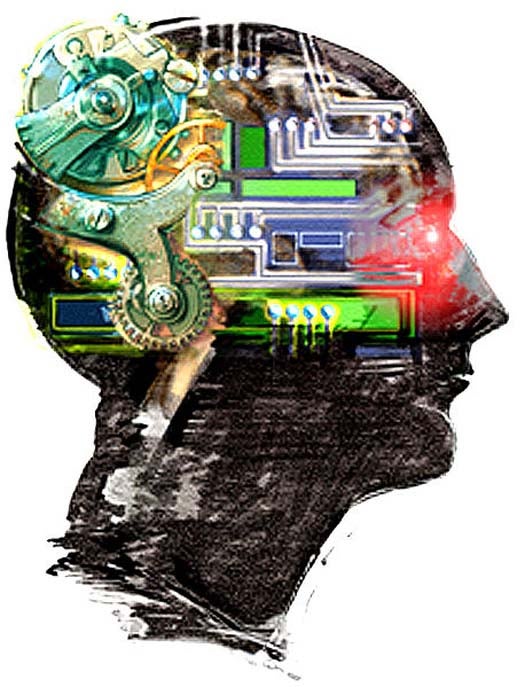
After 50 years and countless dead ends, incremental progress, and modest breakthroughs, artificial intelligence researchers are asking for a do-over. The $5 million Mind Machine Project (MMP), a patchwork team of two dozen academics, students and researchers, intends to go back to the discipline's beginnings, rebuilding the field from the ground up. With 20/20 hindsight, a few generations worth of experience, and better, faster technology, this time researchers in AI -- an ambiguous field to begin with -- plan to get things right.

Artificial Intelligence: It's not what we think.
The study of AI is a half a century old, beginning with lofty expectations at a 1956 conference but quickly fragmenting into different specializations and sub-fields. The MMP wants to roll back the clock, fixing early assumptions that are now foundations of the field and redefining what the objectives of AI research should be.

The fundamental problem, it seems, is that the mind, memory and body function both together and separately to solve any number of problems, and the way they work together (and alone) varies from problem to problem. The human mind alone applies various systems and functions to any given problem. Many AI solutions have attempted to solve all the problems with one system or function rather than multiple systems working together as in the human mind, a "silver bullet" approach that hinders real progress.

Likewise, when it comes to memory, researchers have created models that work more like computers, where everything is either one or zero. Real memory is filled with gray areas, ambiguities and inconsistencies, but functions in spite of not always being congruent. MMP researchers also intend to bring computer science and physiology together, forcing computers to work within the confines of physical space and time just like the body does.

The team even proposes discarding the Turing Test, the long-recognized standard for determining artificial intelligence. Instead, MMP researchers want to test for a machine's comprehension of a children's book -- rather than a human's comprehension of another human being -- to gain a better understanding or the AI's ability to process and regurgitate thought.

It's a big-picture approach to a big challenge, and while it's perhaps unlikely that the team can re-imagine AI in the ambitious five-year window they've given themselves, it very well could shore up some of the loose underpinnings of a discipline that has boundless potential to shape a better world (or, for you SkyNet junkies, limitless potential to destroy it). If nothing else, it's a responsible admission from the scientific community that they simply don't have it quite right, that we need to rethink what we think we know.

Climatologists, take notes.

[MIT News]

25 Comments

That is progress! sometimes going back the the drawing board is what is needed. You know it took edison a lot of tries to make a lightbulb, you think he keep tring to use the same thing everytime?

Left a comment on another article like this... why don't they make a biological computer and then create one that replicates the way it works off of that, except without living parts?

Edison didn't make the light bulb, he stole the design from someone else and put the patent on it before the other guy could. don't be proud of Edison

I agree with "Sci-1234..." Edison was a "filker" and a plagerist. Without people like Nikola Tesla, we might not have Hydroelectric dams, Direct Current appliances(domestic and industrial) and an understanding of magnetism.
For "KH": I have often though of that myself. Will AI acctually have compassion for the Human species and help elevate us, istead of the countless millions who think that AI will, without a doubt, become "SkyNet" and obliterate us all?
I had a dream where I am on another world and my wife is in the final stages of developing AI. However, once the AI is "born" it attempts to kill my wife and I, but through the gace of her father, intervines and sacrifices himself so the two of us can flee. We do and are chased for a while by it's agents(maybe they we robots?(don't ask)) But, in the end, all of a sudden it stoped. Perhaps the AI matured enough to realize the negativity of its actions.
Some "food for thought": Who says that, once online, this thing will be fully cognicent and "mature" compaired to an adult human? As far as self awareness goes, musn't human children learn to learn before they become "little People" and start learning how to interact with society?

Cognito85: I'm pretty sure that whether an A.I. destroys humanity or not is based on how the person codes the A.I.
If the AI is coded to do a simple task, like build things as fast as possible, it will not be much harm.
More interesting things, like making the machine's purpose to make itself stronger and gathering energy, can be dangerous. However, even though these ones could be dangerous at first, they would eventually find consciousness and emotions. They would actually have almost no reason to harm us before then (unless we made one for them), and could learn to like us afterward.

The type of AI that has the most possibility of destroying the world is the one that I thought up.

I felt like making a very complex AI for the fun of it, and I decided that it would be able to teach itself perfect fighting skills, which could even include "dodging" bullets. I had even decided that it would be best to have an AI for each muscle, some more AI's for how the muscles work with each-other, which would dump their failures and successes into a file. Those files could then combined to create new AI's which the computer could try out in new scenarios. All of those AI's would be linked together, and would work in a simulated environment which would copy real-world physics, but would be manipulated to run as fast as possible.

A simulated environment might not sound dangerous, but I was planning on building an android that I could put this code into so that I could practice fighting with it when it was ready.

In a nutshell, I think that I might be the most dangerous person in the world.

by the way, Tesla was an inventor, and Edison was a businessman, one of his quotes is "Anything that won't sell, I don't want to invent. Its sale is proof of utility, and utility is success." -Thomas A. Edison. He also had a factory, with workers in it, and stole those workers inventions. Nikola Tesla actually had one of his inventions stolen by Edison, which is why he held a grudge against him for his entire life.

If I were to dig out my AI journals from decades ago, I would find the invention of object oriented programming in Minski's work. No one considers Java to be AI, because AI is by definition anything that computers can't do; which is a moving target.

Someone once asked me with great pause: "Do computers think?" I replied, "Of course they do. What the hell do you think they're doing? That's the whole idea: to automate human thought. A digital watch thinks.”

"If nothing else, it's a responsible admission from the scientific community that they simply don't have it quite right, that we need to rethink what we think we know."

There's really nothing responsible about it. It's not been a case of the scientific community stubbornly believing they had figured out how to make HAL 9000, and now admitting they don't. For decades it's been a case of "we just don't know" with AI.

"Climatologists, take notes."

I see. Perhaps the climatologists should go back to the beginning, look at all the data and come to a conclusion that is more business friendly. Something along the lines of "we just don't know if we are effecting the climate."

The scientific consensus on climate change could turn out to be wrong, but the consensus represents our best analysis of the situation at the moment. If we reject the consensus on climate change, what about all the other areas of science?

In fact why didn't you write "Big Bang Theorists, take note"? The scientific consensus supports the Big Bang Theory, but there are still a few scientists who back alternative theories like the Steady State Theory. Why do we not see endless articles with titles like "The Big Bang Swindle"? Where are the desperate witch-hunts to find the one or two Cosmologists whose Big Bang research results are a bit suspect? The reason is that the Big Bang Theory is in no way a threat to any major business interests, whereas climate change is.

If you wanted to derail the current widespread confidence in the Big Bang Theory, it really wouldn't take much. A few articles in major newspapers (naturally by people who are not working in the field) and a few throw-away comments are all it would. Pretty soon members of the public would be saying things like "The Big Bang Theory? It's a load of nonsense being pushed on us.". i.e. Pretty much the sort of thing you increasingly hear people saying about climate change these days.

Science Journalists, take notes.

Are you kidding..... Instead of the Turing test...MMP researchers want to test for a machine's comprehension of a children's book.....they have not learned anything in 50 years as to how to approach this problem. Shame on you MIT

Well, MIT seems to be succeeding at one of the things that they do best -- blowing their own horn. I checked the MIT news site, and it has much the same tone as this article.

I realize that MIT gets ' the best and the brightest' but they also seem to have a good percentage of the 'arrogantest' as well.

Perhaps I wouldn't be so put off if they hadn't declared victory before the first battle.

well im pretty sure that if robots do become sentinent they wont look for my secret underwater base under antartic ice

Really did it take them this long to figure out that they may need to create a more modular approach. I thought for sure any day now my pc would get tired of me and start hitting me with the CD tray. Looks like i have a little longer to wait.

Computers do not think. For now.

Programs running on computers react to stimuli in a semi-predictable manner governed by the (for want of a better word) "quality" of the code provided by the programmer and the inherent qualities of the hardware they run on -- both of which are imperfect.

At best, they are instinctive at this point. And they are imperfect. They can make millions of mistakes per second if either the code or the hardware is not well suited to the task assigned.

Mere mortals can only make one or two mistakes per second.

Will AI become malevolent towards humans?

Unlikely. That would mean that they would be acting in a manner that arose from viciousness, ill will or spite. We cannot assign anthropomorphic motives to machines. The concepts of "good" and "evil" are human constructs.

The more likely outcome is that machines will simply be indifferent.

In the end, there are is still the same continuum of possible interactions between humans and machines.

On the one end is the possibility that they will be indifferent, but their actions will serve to be helpful and therefore "elevate" us. In the middle is the possibility that they will be indifferent and either dangerous or not depending on whether the two "species" attempt to fill the same niche. The other end is that we will simply be in the way, of little use or a nuisance and indifferently brushed aside.

There will be no Cyberdyne Systems Model 101s attempting to change history.

However, we may just find ourselves to be cockroaches.

Every machine is born with a fatal tiny mistakes, getting worst until something brakes, as a composite of mass and energy, guided by a set of mathematical principles. This complete absence of feelings makes them a perfect psychopath. So I believe any AI should be based on principle of love, broken down to a separate concepts, resembling what we do with force. Those should be underlay principles, how machine can judge what is what, from merging results, arrived from different reference points, synchronized with each other. Our existence is bounded by laws, like nothing can be at the same place in the same time, but quantum computers will probably be based on that kind of mechanic.
Like us, intelligent machines could be split in body and software, constantly working together. Machine would start as any robot, complete with sensors and programs to sort them out.
On top of it, another program would run, balancing sorted data from sensors and build some perspective of physical world. This program should take into account volume around sensors, completing that level of machine awareness of it's body and relative position to environment.
To start building emotional engine, software should search for anticipated data from sensors, adjusting machine parts to manipulate with objects. It doesn't need to be a real robot, same should work in a simulation. When desired data appear, other parallel programs should run and sum up information, adding it to the description. Every object should have some possible description categories, starting with unknown and adding descriptions with supporting programs, creating a cloud of computer emotion responses, based on how memory of an object has evolved.
This would allow it to jump back and start a new experience spread, where conditions were more in favor of other choice, if those data would be known. On top of all this processes another cloud should run, focusing on most important information to achieve goal in opposite to deconstruct effort. When object of interest is recognized and sensors performed measurements, program will choose most perspective one, selecting from available data at the moment, which would allow it to occupy most favorable space, to continue gathering best results from selected sensors. If experiments done by sensors are successful and according to specific scientific method used, upper cloud would instruct lower cloud sensor analysis, to give different priority, what sensor coordination must favur, like changing the mood.
When task is completed, programs should form end results and put themselves on stand by. Main program will gain processor time and perform analysis between clouds, how sensors responded to changes and upgrading them in effect. After all data analysis are completed, new description of object and surrounding transformations should take place instead old one, upgrading software with new reference frames based on experiences, indexed back trough that dream cycles. This is important, because it would give machine time to redefine it's whole perception of existence, separating useless data from scientific confirmed ones, keeping all of them stored, indexed and traced trough emotion groups, back to each separate sensor. After it wakes up slightly redefined, new possibilities to try should drive program, trough awareness of corrections and fear, expressed in conflicting lower cloud decisions, since some values must be negative, even if some sensors report positive development at the moment.
If we want to program machines like living creatures, it should start with certain awareness of it's composition and that will die for sure after a while, when internal connection is lost. Whatever dead is, self awareness can't be the same after loss of physical body. If I would be born as an internal difference in average potential, it wouldn't make much sense. Machine cannot fear dead, but it can fear negative overall value, if presented as possible composite mathematical perception of potential difference, if final outcome would deconstruct to 0, discharging all memory in a process and return in endless field of energy.
Anyhow, it's a waste of time, trying to build a human that way, they should build something else, that suits every atom in a body of this new creature. Even if it's just a mas of electricity charged composite materials in a big room, it should be aware of that and also meaning of it's existence.

People i need ur help im gathering all the young minds of the world to help me. I may have found a form of artificial life not evactly how u would picture it. I may have found a huge neetwork of data forming a world of creatures made up of bits of DATA i am working on a program that is one of these creatures under my control so that i can step into thier world and these creatures do not have a solid form but can be seen when u enter the dada base of all computers
contact my email Zac7@aol.com and the subject will be known as project mastere code ok tell all ur smartest friends

Emotion can be a double bladed sword and so can a lack of them so it is both a paradox and almost impossible to solve.

Can someone kick the seven year olds out?

OK i just got hit by my CD tray.....

@SteveUK
I think you are missing the point. The motive for supporting the current "global warming" scare is simple greed. The more people are afraid, the more they will pay for "solutions". Where is profit from Big Bang theory? Why pick that for your example? Does it threaten your fragile religious beliefs?

I applaud MIT for this change of thinking. I'm writing a paper that looks at a lot of the problems with the Turing Test. Suggest reading "Turing Test 50 years later" if you can find a copy of it.

However, the idea of AI is an interesting one! What if we were able to design a computer program that had levels of emotions represented by variables? I wonder what would happen if we then allowed it to react based upon those variables and take actions that it developed that interacted with a virtual/real world and result in changes to those variables based upon the input it would receive.

Sounds like emotion to me...

The mind machine looks insanely ingenius.
www.thebusinessidea.com

For "KH": I have often though of that myself. Will AI acctually have compassion for the Human species and help elevate us, istead of the countless millions who think that AI will, without a doubt, become "SkyNet" and obliterate us all?
www.eprostateproblems.com/

I felt like making a very complex AI for the fun of it, and I decided that it would be able to teach itself perfect fighting skills, which could even include "dodging" bullets.
www.ankylosingspondylitiscenter.com

This could be some really scary stuff. Artificial Intelligence. I love the comment about skynet
www.nikondirectory.com

Oh great! We are going to restart all over again.

Do we get refunded our wasted tax dollars from you imbeciles?


June 2013: American Energy Independence

Five amazing, clean technologies that will set us free, in this month's energy-focused issue. Also: how to build a better bomb detector, the robotic toys that are raising your children, a human catapult, the world's smallest arcade, and much more.


Online Content Director: Suzanne LaBarre | Email
Senior Editor: Paul Adams | Email
Associate Editor: Dan Nosowitz | Email
Assistant Editor: Colin Lecher | Email
Assistant Editor: Rose Pastore | Email

Contributing Writers:
Rebecca Boyle | Email
Kelsey D. Atherton | Email
Francie Diep | Email
Shaunacy Ferro | Email

circ-top-header.gif
circ-cover.gif
bmxmag-ps