It turns out the lumbering Spruce Goose could've learned something from its namesake. Researchers at Stanford suggest that airliners flying in formations akin to the "flying V" employed by migrating geese could trim double digits from fuel consumption and emissions, improving overall range efficiency and saving on fuel costs.
Aeronautics experts at Stanford found in previous research that a formation of 25 birds flying in formation -- an echelon, V-shape, etc. -- can improve their range efficincy by a whopping 71 percent over solo flight. This is due to an aerodynamic phenomenon known as upwash that causes the air flowing over a bird's wings to curl upwards as it passes the wingtips. Birds flying in its wake experience reduced drag, expending less energy to fly a given distance.
When the same principle is applied to aircraft, the results are not too different. The Stanford team modeled three planes departing from the West Coast and rendezvousing over Utah in a V formation. If the planes rotate positions so each one spends time in the favorable spots, the team found that the planes could shave 15 percent from both fuel consumption and carbon dioxide emissions, while trimming a quarter from nitrogen oxide output.
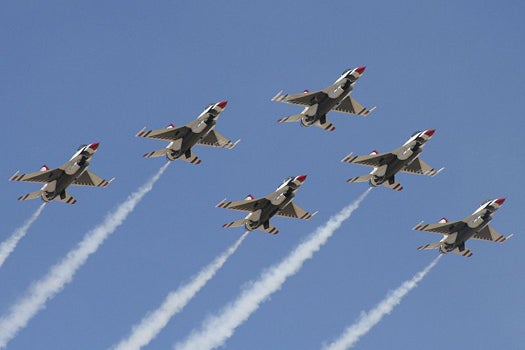
Of course, the biggest obstacle to fuel-saving formations in commercial travel is safety regulation. Currently, the FAA requires commercial aircraft in American airspace to stay five miles apart at cruising altitude. It's also unclear whether commercial air carriers could, or would, coordinate their schedules to take advantage of a formation's efficiencies. But the Stanford team points out that planes don't have to fly in Thunderbirds-style close formation to take advantage of upwash. They could actually fly a handful of nautical miles apart, though FAA would likely have to relax standards a bit.But commercial flight notwithstanding, military convoys could take advantage of upwash-boosting formations, and in fact is already looking into the matter. Taking a page from nature's book, military cargo convoys may soon take advantage of the flying V to increase range and efficiency, as well as to reduce the environmental costs of national defense.
138 years of Popular Science at your fingertips.
Each issue has been completely reimagined for your iPad. See our amazing new vision for magazines that goes far beyond the printed page
Stay up to date on the latest news of the future of science and technology from your iPhone or Android phone with full articles, images and offline viewing
Featuring every article from the magazine and website, plus links from around the Web. Also see our PopSci DIY feed
Science is reinventing play, from extreme sports to gamification to ridiculous roller coasters to the playgrounds of tomorrow, and this issue is chock full of fun. Also, on a less fun note: Did global warming destroy my hometown?
Makes more sense to design an aircraft that is shaped similar to a group of aircraft in a V pattern so it may benefit from its own upwash.
I am appalled that anyone would suggest this ridiculous idea. Apparently you do not understand how the flying v helps to increase efficiency.
Craig1243
Obviously, you have no grasp of the dynamics taking place to suggest designers make a plane that is similar to a V to make use of its own upwash. You would have to stack up many layers of wings, and each has to trail the other at the wingtip in order to utilize the natural phenomenon of upwash to do that. How many wings do you propose a plane should have on each side and how long should they plane be? Not only that, but the extra weight would probably negate any efficiency with the wing design anyways.
The only thing that would be of concern for civilian planes would be proximity to the other planes. Should a plane experience problems/malfunctions that causes it to deviate from the flight path, anyone behind it would have to react very quickly. How many flight attendants would be turned upside down when pilots bank hard to avoid the plane in front of it should it have engine problems or whatnot. I highly doubt passenger planes experience that many engine flame outs, but there are many other reasons that would cause one to slow down, bank, go to a higher elevation, etc.
Also, how would one coordinate changing flight paths due to weather or other airborne obstacles such as migrating geese and what not? Obviously, these pilots would have to be trained in close formation flying, otherwise they're liable to collide mid-air.
When I was in the USAF and stationed *somewhere* in North Texas, it seemed as if every year (the 4 years I was there), there were mid-air collisions resulting in fatalities. And these were tiny little single engine or dual occupancy training jets. Not passenger liners. Imagine the devastation of two, three or four A380s/747s going down all in one horrible accident.
anyone want to volenter to be the first to fly in the commercial airliners that take off in a v formation?
No way. One single mistake and BOOM!!! There goes the whole fleet of planes. Anyways, I don't think they would do it with gigantic aircrafts, too dangerous. And I doubt that they would all head in the same direction since you would need to continue the formation to work.