New technology adds flexibility to wireless communications, and can passively monitor the integrity of bridges and other structures
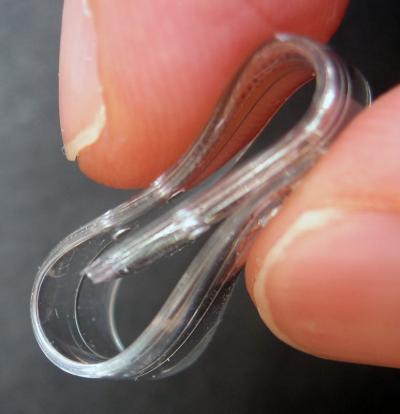
The Shape-Shifting, Elastic Antenna Ju-Hee So, North Carolina State University

The large antennas that used to be part of our everyday lives -- atop the TV, on the boom box, telescoping into the bricklike handsets of our first cordless phones -- have largely been re-engineered over the past two decades to live inside our devices. But the malleable copper and other metals used in standard antennas are somewhat restricting; they can only be bent and straightened so many times before they break.

Using a novel manufacturing process, a group of NC State researchers have created shape-shifting antennas that can be bent, cut, twisted and even stretched, and will return to their original shape.

The durable antennas are made by injecting a liquid metal alloy into elastic casings made of various materials, depending on the specific qualities the user wants. The gallium and indium alloy remains liquid at room temperature, taking on the physical flexibility of the surrounding material. Elastic silicone is good for making very flexible wire-like antennas, and other materials could be custom tailored for specific uses with applications far beyond mere communications.

For instance, the military could roll large antennas up into small packages for deployment, then quickly unroll them to set up a field communications center rapidly. The antennas could also be used to keep tabs on the integrity of naval vessels like submarines. Since its shape dictates an antenna's frequency, it could be embedded into the hull of a vessel; should any deformation occur, the frequency would change, alerting crews to the damage.

The same principle could have myriad civilian applications as well. Antennas built into civil infrastructure like bridges and tunnels could alert authorities if support structures begin to break down. Imagine the tragedy that could've been averted if the government had a means to detect the design flaws that brought down the I-35 bridge in Minneapolis in 2007, or the gridlock (and near tragedy) that could've been avoided on the San Francisco Bay Bridge in October had someone realized a part of the bridge was on the verge of falling.

[PhysOrg]

4 Comments

Not so fast there dipole breath. Some questions

- What is the resistance of the new materials. Transmitting antennae need to have low resistance conductors.

- As far as damage assessment, I'm not sure how effective the antenna will be on largely metal substrates. I know that there's something like this on the new armor, but that's an entirely new design. Adding an antenna over a huge hunk of metal might not work

Hey ford2go, thanks for the interest in this work. I'm an editor for Advanced Functional Materials (the materials science journal that published the paper this article is based on), so I might be able to answer your questions.

But, sad to say, I'm not an expert; if you'd like to know more detail, we've set the paper free to access for the next few weeks; it can be accessed from here: www.materialsviews.com/matview/display/en/1282/TEXT

The material used was eutectic gallium indium; it was chosen because of its unusual oxidization properties (which give the antenna the ability to "self-heal", but as I understand it, it also has high conductivity in the liquid alloy state.

The damage assessment idea is mainly based on the change in the resonant frequency of the antenna upon change in shape (the frequency is inversely propertional to the length); you don't need long-range transmission for it to work, you just need to be able to measure the frequency at which it radiates, and this can tell you if the substrate it's on is deforming.

But, as I say, I'm not an expert; please go read the paper and then tell me why I'm wrong!

something here smells like pineapples.
(if anyone reads his while eating pineapples you will get $5-10 in the next 24 hours)

Coincidentally I have two cans of pineapples next to me.


Download Our iPhone App

Stay up to date on the latest news of the future of science and technology from your iPhone with full articles, images and offline viewing


Grab the Tech Buyer's Guide iPhone App

Carry everything you need to make a smart buy on HDTVs, cameras and 14 other product categories right in your pocket


Follow Us On Twitter

Featuring every article from the magazine and website, plus links from around the Web. Also see our PopSci DIY feed


Become a Fan On Facebook

Share links with friends, comment on stories and more


February 2010: Renovating America

Innovative fixes for five of the country's biggest infrastructure messes, plus a look the quest to read the human mind, the LCD screen that might finally kill paper dead, and the world's scariest science.

Read the issue here.

Popular Science Photo Pool


Share your photos in the Pop Sci pool at www.flickr.com!