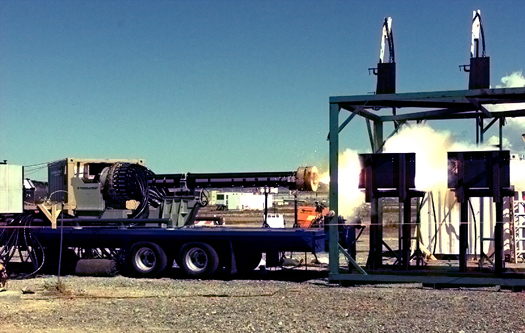
Railguns were first proposed over a century ago, but have not yet made their appearance on the battlefield. They are similar to regular artillery pieces, in that they fire a giant shell, but different in that they do so without the use of combustion.
Instead, railguns mount the projectile on two magnetized rails (hence the name), which then propel the shell out of the muzzle using electrical conductivity. This is different from the so-called Gauss cannon, which uses a magnetic projectile and magnetic fields to accomplish the same task. Either way, magnetic fields can accelerate a shell far faster than gunpowder, increasing the range and speed of the projectile.
General Atomics conducted the test in association with the Office of Naval Research, and plans on continuing testing through next year, when they will finally start launching "tactically relevant aerodynamic rounds".
I don't know what "tactically relevant aerodynamic rounds" are, but it certainly does sound bad-ass.
No video was released, unfortunately, but to substitute, check out this slow-motion test firing of a similar railgun last year--plus an explanation on why there's still muzzle fire from gunpowder-less shot.
[via General Atomics]
Five amazing, clean technologies that will set us free, in this month's energy-focused issue. Also: how to build a better bomb detector, the robotic toys that are raising your children, a human catapult, the world's smallest arcade, and much more.


Online Content Director: Suzanne LaBarre | Email
Senior Editor: Paul Adams | Email
Associate Editor: Dan Nosowitz | Email
Assistant Editor: Colin Lecher | Email
Assistant Editor: Rose Pastore | Email
Contributing Writers:
Rebecca Boyle | Email
Kelsey D. Atherton | Email
Francie Diep | Email
Shaunacy Ferro | Email
I think you mean "This involved the cannon" and not "The involved the cannon."
However, thank you for the Evil Dead reference. Made my day.
I would like to formally put my hat in the ring for an editors position at popsci.com.
Cool gun. They have one of those in Transformers 2, ship mounted.
--GTO--
Rail guns rails have been notorious for fusing together after the first launch, that's why they weren't ever practical before. Hopefully they solved that long un-fixable problem...
"They are similar to regular artillery pieces, in that they fire a giant shell, but different in that they do so without the use of combustion."
No, they DO NOT fire a giant shell. They fire as compact as possible armatures, in order to achieve a huge kinetic energy. The damage on the target is achieved purely due to this extremely high energy. So no, no giant "shell".
"Instead, railguns mount the projectile on two magnetized rails (hence the name), which then propel the shell out of the muzzle using electrical conductivity. This is different from the so-called Gauss cannon, which uses a magnetic projectile and magnetic fields to accomplish the same task. "
Railguns work thru electromagnetic fields. I dont know what you have read upon the subject (doesnt seem to be much if anything), Lorenz forces resulting from the changing of the effective conductor (which is due to the armature being moved along the rails in the first place) essentially PUSH the armature away.
Electrical conductivity isnt a force.
As for the breaking news, Sandia and Maxwell have been experimenting with railguns for years... Sandia holds/held a record with a plasma armature (weight of 0.1 gram) which achieved velocity of 16km/sec.
Maxwells railgun propelled a metal armature of 1.6kg weight to 3300m/sec, although they are probably faster already.
o.o ide like to see the plasma armature.
The Army wants the technology to "slim" down because while you can mount this on tanks and ships, it's not very useful to the Soldier on the battlefield.
Azorus
You know that down the line we will have rail gun M-16s. For "the Soldier on the battlefield."
how much ELECTRICITY does this use? and how is that gigantic amount gonna be available it a military situation...
Its offensive value is in doubt therefore, but its defensive is considerable, connect it to the city grid, wen someone atacks use energy from the grid, since most will be busy fleeing the city, so there wont be many inconviniences on the part of power outages on the count of railguns draining energy.
But then...a squadron could fly over the nearest power plant and bomb it to hell to immobilize the almighty rail guns...
Well wait and see, there is a LOT of things still wrong with rail guns.
On the comment on power, I would imagine the railgun would be quite useful as a ship based weapon to provide ship to ship and ship to shore attacks. I wouldn't worry about power. Just convert ships to nuclear power and you should be set.
"how much ELECTRICITY does this use? and how is that gigantic amount gonna be available it a military situation..."
these kind of applications need a very short massive electric impulse. You obviously dont just connect the rails to any power source.. Imagine pulses of several microseconds length, peaking in the hundreds of million of amps and we might be getting close.. probably at least 10kV..
The 2 most often used, probably only viable options at the moment, is either a massive capacitor bank or a compulsator.
The capacitor banks get charged up with a high voltage generator. Compulsators are considered to be the optimal for real-world-applications, as they have a much higher energy density and arent that dependant on electricity. Imagine a flywheel (carbon, spinning in vacuum, at easily 40k rpm) coupled to a special kind of an alternator that can deliver short massive impulses... the cool thing is it can even be spun up by a mechanical source
Anyway, railguns and coilguns ("electromagnetic mass linear accelerators" :D) are a really interesting topic, and there are a few source of amateur attempts on the net. Coilguns in particular are really fun to mess around and can be made to work with very low energies - of course you wont be achieving high velocities, but even something like 20 volt will be able to propel small steel things across the room ;)
On the other hand, anything that could power a railgun will kill you and 100 other persons lined up with no problems..
BIG BOOM GUN NOT MATTER KUZ I HAZ FORCEFIELD!!!!!!!!!!!!!!!!!!!!!!
@C36054
And i imagine your ingnoring politics on the issue of converting Navy ship to nuclear? (altough im all for it:p)
im sure the eco-freaks wont be happy.....
nuke subs...are more or less out of the way...but warships...
32 MJ, the rating on the video rail gun, isn't so much energy. That's 32,000,000 watt-seconds = 9 kWh. It's less than 9 kW of power, averaged over an hour, which is less than my home heat pump backup electric heater uses. Of course a gun like this would need to fire more than once per hour, but not once per second. The capacitors take time to charge up.
If it fires once every second, it would need about 3600 x 9 kWh = 32 MW. Firing every 10 seconds would need only about 3 MW. A 3 MW (3860 HP) Rolls Royce Proteus gas turbine generator would work. It only weighs about 40 tons, 30% less than an M1 Abrams tank. You wouldn't need a Westinghouse 104 MW nuclear reactor like on a Nimitz class carrier, which has two of them.
@Zhukov
hmm...well if you say so :)
but then theres still the question of stability, overheating, jamming etc.
I doubt you can fire it more than 6x a min with it melting
Obviously from watching the video these rail guns get hot. So you need another MW to run the cooling system. The firing rate will depend on a lot of things like reloading. 6x a minute is probably very ambitious. Once per minute means less power requirement. I'd like to know what the current firing rate is.
"32 MJ, the rating on the video rail gun, isn't so much energy. That's 32,000,000 watt-seconds = 9 kWh. It's less than 9 kW of power, averaged over an hour, which is less than my home heat pump backup electric heater uses."
32 Megajoules is the muzzle energy, not the used energy to propel the projectile.. Figure a max efficiency of 10% and you are looking at a minimum 320 MJ energy per shot, although that is very optimistic.
And seriously, what military vessel would be equipped with several of these?
Typo on the last sentence, meant "wouldnt be equipped"
Actually the Lexington is a nuclear powered aircraft carrier (so are a few others), I know because I've been on it, could use the rail gun (the problem is that it is decommissioned), also, if the military mounted a rail cannon in outer-space on a satellite, wouldn't it be more efficient in terms of mobility and usage (that is if the satellite was equipped with a nuclear reactor and had a bullet assembly plant on it), so that way it could "snipe" enemies on the ground from the sky?
@V3RTIGO
I believe your right :)
brilliant idea, this cannon would do wonders BUUUT...
solar power just wont cut it up in space...and of all things, no politician would want another counties nuclear powered battlestation up is space watching them....
I amend me last comment, for this gun wont have to fire to often....even if it took a year to charge for 1 shot, several of those fired at once in a single energywasting blow would do plenty of damage, sort of like a those single missle lauchers...1 shot and your done.
This would be an AWSOME thing, and very realistic, no major brekthroughs nessasary, the tech already made :) :)
Thanks :)
Neuuubeh,
This article
popularmechanics.com/technology/military_law/4231461.html
has the BAE program manager of the Railgun project at Dahlgren, Dr. Amir Chaboki, who says" firing the 64-megajoule weapon six times per minute would require 16 MW of power" So I was in the ballpark about the continuous power required to fire a 32 MJ gun six times per minute. I was a little low probably because I didn't include efficiency as you mentioned. He doesn't give us the weight and velocity of the projectile, so we can't compare its actual energy with the electrical input. Still you don't need a nuclear reactor.
Chaboki also says "The Navy’s electrically-propelled DDG 100 Destroyer, Chaboki says, is a prime candidate for the final 64-megajoule system." This boat uses four gas turbine generators similar to the Rolls Royces I mentioned, but bigger, for a total output of 75 MW - en.wikipedia.org/wiki/USS_Kidd_(DDG-100)
WOWOWOWOWO.you just enter ======Matchcougar.com=====,and it is OK.you will enjoy yourself
as much as possible.there is a convenient way "Matchcougar c om"to make you meet some rich
women who is rich and alone to go with you.just cool.BE FREE
Is the idea to give capital ships un-dodgeable kinetic anti-missile systems? We can already kill just about anything else within line of sight using missiles and artillery.
If this were put into space, the purpose would be to shoot other things in space. A 10 km/second pellet will do wonders against an ICBM, or satellite.
From orbit, if you want to hit a ground target, just drop something. Doesn't need to be that heavy, because by the time it hits the ground it's really movin'. (streamlined and dense, of course)
I think Jerry Pournelle came up with the "rods of god" idea, which is tungsten telephone poles in stable orbit, with manuever thrusters and a booster. Want something hit on earth? Move a rod over it and accelerate downhill. The purely kinetic "explosion" he calculated was somewhere around a kiloton, with no fall-out.
The barrier to the deployment of all of these space technologies is our resistance to the weaponization of space. We have more to lose up there than anyone else, so we don't want to start the race. I think this project, along with the US and Chinese demonstrations of missiles to "safely destroy" satellites with decaying orbits is evidence that while the race isn't officially "on" we are warming up.
The plain fact is that militarily decisive technologies always engender countermeasures, no matter what we wish. (See the crossbow ban of the middle ages.) If we ever fight a peer nation in a systemic war, satellites will be among the first targets. In fact, the take-down of satellites will probably be one of the signs that some future incident has gotten serious.
Wow a big magnet canon hopefully we don,t need to use it.
@dennymack
Iv been saying the exact same thing for years, a chunk of tossed rock can pulverise New York
BUUT, to take out satalites with that kind of "tossed rock tactic" wouldnt be effective
Think of it in relative ratios if two objects are moving at the same speed, it is the same as if both objects were not moving relatively to each other
7.5 mps : 7.5 mps
0 mps : 0 mps
on earth a standstill target shot by this canon (1mps for example) would cause the same amount of damage as them traveling at orbital speeds in space (7.5 mps) and shooting the 1 mps round since the difference in speeds is exactly the same, 1 mps. So in conclusion:
1) Earth-earth targets need a cannon
2) Space-space targets need a cannon
3) Earth-space targets need a cannon
4) Space-earth targets dont need a cannon!!
Yeah, but using a cannon on Space to Earth would be much cooler, and be MORE effective, as in being more accurate because of faster speeds (due to the worlds spinning and such, launching a weapon/projectile over a distance at a slower speed would dramatically affect its course). We also are going for the "bang for buck", so using a cannon to accelerate the projectile would allow for a much smaller projectile for the same explosion.
Unfortunately,This weapon system is already launched in space and you are all dead,but just not all at once,YET.
Lots of interstellar ships have been built here by the MIC,and Star Wars is a reality,and most published news is just a washing device.
Being a scientist with certain information,I have had my career extinguised and funding removed on my own planet and formerly my own country.
Folks think that these things will not effect them,only save them from the "Terrorists"
Its the terrorists who have over run us.
Robert1234 The big monkey in the room is the recoil of this kind of weapon. Remember, there's no free lunch, even with energy. Shoot something out the front, the "shooter" goes backward with an equal amount of energy. A space mounted rail gun of high energy would have to shoot two projectiles in opposite directions or it would launch itself backwards. The same recoil applies to ground based guns. Those megajoules would produce one hell of a kick. Equal and opposite reaction. Electricity or powder, it doesn't matter.
Well how about a non destructive application for this. If it can move a mass that fast.(ie faster than escape velocity). Then why not build one up the side of a mountain and propel space cargo into orbit. It would be far less polluting to the atmosphere than chemical rockets (solid or liquid) and running from electricity, could reduce the payload cost per pound 3 or 4 times what it currently is. It's a brave new world. The last frontier could be getting canisters of building materials, water, compressed gas, at a fraction of the cost with little or no air pollution. By altering the magnetic fields near the end of the tube or barrel, slightly different trajectories could be obtained. While not suitable for humans (instant g acceleration would prove fatal), for non organic materials, it would be perfect. You could use built up solar power charge, or hydro-electric power to get cargo into space. A technology doesn't have to be a gun to destroy something to be worth developing. The barrel or tube could be several miles long, the diameter of a real rail road car, and hey,,,why not evacuate the atmosphere from it too. The lack of any atmospheric drag as it burst through the end of the tube would really be fast (and less flames). The partition at the end of the tube the mass cargo would have to shatter would only have to be strong enough to hold back 10 to 14.7 psi to get a near vacume condition to improve the ballistics effect. Dream large.
Does it use electricity?
Cyber our electronics would be scrambled if we used a mag gun to launch them into space. It's a good idea but not very practicle.
Not necessarily Thor, if the electronics are shielded then the magnets wouldn't fry them. Also if the mass driver is used to ship raw materials to orbit then we wouldn't have to worry about shielding that from the intense magnetism at all.
Regarding the peaceful use of railguns for launching objects into space, Robert Heinlein described this concept thouroughly about 50 years ago in The Moon is a Harsh Mistress. A longer version of the rails (for more gentle acceleration of 20g or so to escape velocity) was used to ship cargo back and forth from the moon. (Then when the moon colony revolted, it was used as a kinetic energy weapon to bombard the earth). Still a good read that has held up well; way ahead of its time in its description of computers and AI too.
This is so uber!!!!!! mabye we (the US) will be using ionized plasma cartridges in space and firing it at possible enemy spacecraft
I wonder what it would fire other then slugs, Will there be bullet shaped projectiles?
Clearly there is loads of interest in this equipment, both negative and positive. The questions that surround this machinery appears genuine and maybe a hint that the technology is flawed.
www.airsoftking.com