Japanese researchers create a one-way thermal conductor that could lead to a new form of information processing
Conducting Heat Move it along, heat currents Wataru Kobayashi

Japanese researchers have developed a new diode that only transmits heat currents in one direction, and they think it could represent a new future for thermal computing.

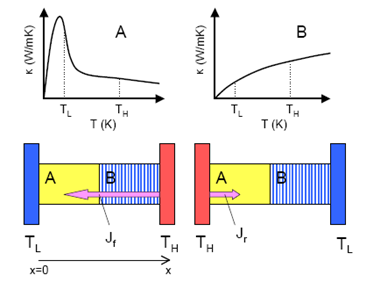
Similar work has succeeded with individual electrons in superconductors and in lone nanotubes, according to Technology Review. But this represents the first time anyone has managed the trick in a bulk solid, which in this case consists of two types of perovskite cobalt oxides.

Researchers have long theorized that such diodes, or thermal rectifiers, could become possible with the right material. Such a material would have to have high thermal conductivity at low temperatures and vice versa, so that that heat would flow continuously in one direction -- and then researchers could combine the material with another having the opposite characteristic.

Such a device has clear use in creating heat sinks that keep microchips running cool. Yet Wataru Kobayashi at Waseda University and his colleagues have put forth a more ambitious goal: controlling heat currents to create a new type of information processing with thermal transistors, thermal logic gates, and thermal memory.

Technology Review proposes that such computing could harness waste heat from electronic devices, and supplement electrical power.

[via Technology Review]

10 Comments

WOW! Now this is a neat discovery This could help build super efficient refrigerators and air conditioners. How about a coat that could keep you warm when worn one way and keep you cool when inside out.

Or buildings that draws heat from outside whenever possible and never radiates heat back in the winter, and do the reverse in the summer.

Both of those sound like awesome ideas, but for some reason I'm waiting for some sciencey-sounding caveat that'll make things like that impossible :\ like, "we can make the material but it can't bend because of X" or "in quantities sufficient to trap heat in / keep heat out of a building, it would be more expensive / worse for the environment than air conditioning", etc.

But if stuff like that did happen, it'd be awesome :3 And thermal memory might not be susceptible to magnetism, which would be fantastic. This is exciting stuff.

i wonder if heat from friction in an engine could be collected to generate more energy in along-side steam engine to boost efficiency. article sounds like it can only be small though

this might be leading Japan in an even more important direction...if it can pass thermal radiation only one way, could their principles be applied with other materials to pass radiation?

The building material sounds like a terrific idea, at the very least for window frame which could be reversed. However I'm reminded of my physics classes and the property that cold does not exist, simply the absence of heat. If this type of material has no on or off switch then it would be continually on. Which could mean the temperature control of a room in question being very difficult due to this thing simply never stopping. I would think this is one of those technologies that come along which result in some absolutely incredible implementation. Lets hope.

In response to JLHettle, the directios can be changed with a simple motor. And for gradual cooling and or heating, the rotation time could be uneven with a clear ration for hot and cold sides.

This makes me think of Maxwell's Demon: allowing energy to flow only in one direction, decreasing entropy! A truly passive heat pump.

one of my friend ask : Can anyone tell me what a one way diode is and what is its purpose?,.

Now,I found this article,. and I thinks it's useful for answer the question. so,Ty..

itcomputer computersland computerslookup beautyhealth worldfashion healthyforlifes

Amazing! I haven't known about this. http://www.amerisleep.com/mattresses.html


July 2013: The Future Of Flight

The incredible innovations, like drone swarms and perpetual flight, bringing aviation into the world of tomorrow. Plus: today's greatest sci-fi writers predict the future, the science behind the summer's biggest blockbusters, a Doctor Who-themed DIY 'bot, the organs you can do without, and much more.


Online Content Director: Suzanne LaBarre | Email
Senior Editor: Paul Adams | Email
Associate Editor: Dan Nosowitz | Email
Assistant Editor: Colin Lecher | Email
Assistant Editor: Rose Pastore | Email

Contributing Writers:

Kelsey D. Atherton | Email
Francie Diep | Email
Shaunacy Ferro | Email

circ-top-header.gif
circ-cover.gif