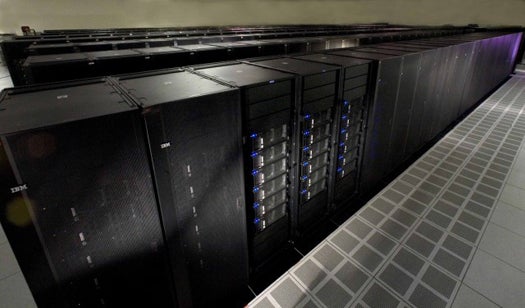
In November of last year, scientists at Los Alamos National Laboratory switched on Roadrunner, the world's fastest computer. IBM and the Department of Energy built the machine to model nuclear explosions, but two new studies, both released today, are proof that the computer's massive power has been at least as devoted to peaceful science as to simulating thermonuclear weapons.
In one experiment, the Roadrunner created the largest family tree of HIV ever produced. The family tree incorporated over 10,000 HIV DNA sequences culled from over 400 infected subjects. And in another use, Roadrunner simulated the Big Bang in an attempt to figure out how dark matter came to pervade the universe.
For the HIV study, Roadrunner donated its processing power to allow scientists to compare the ecosystem of viruses across a number of different patients. A single person can have as many as 100,000 different versions of the the HIV virus in their body at once, and learning how these mutants branch off from the initial infecting agent could help develop a vaccine. Until now, doctors didn't have the computing power to analyze that many sequences at once. By looking at so many different strains across so many different people, the researchers hope to find common elements that a vaccine could attack.
The dark matter story, on the other hand, fell more into Roadrunner's wheelhouse, since the explosion of the Big Bang isn't too dissimilar from the hydrogen bomb detonation Roadrunner was originally tasked to perform. To create the model of the early universe, Roadrunner calculated the physics behind 64 billion proto-galaxies, each one about the size of of a billion of our Sun. Once Roadrunner crunched those giant numbers, the results predicted five-times more dark matter than astronomers have observed to date.
All that, and I bet you could play a pretty awesome game of Call of Duty, too. Although I guess that would defeat the "swords to plowshares" vibe of using a computer designed to model nuclear weapons for helping medicine and physics.
[via Science Daily and Physorg]
Stay up to date on the latest news of the future of science and technology from your iPhone with full articles, images and offline viewing
Featuring every article from the magazine and website, plus links from around the Web. Also see our PopSci DIY feed
Share links with friends, comment on stories and more
In our December issue, Popular Science names the 100 best innovations of the year: bombproof wallpaper, self-parking cars, the fastest helicopter, and 97 more. Plus inventor profiles and videos.
Check out the best of what's new here.
How about a game of Minesweeper where the mine explosions are simulated, 100-Megaton, Thermo-Nuclear blasts?
Now THAT'S an Easter Egg!
Wow, dark matter like totally rocks dude!
RT
www.hide-yer-stuff.se.tc
Next thing you know it'll become sentient and try to take over the earth. Just you wait.
Haha it probably will.
But it top my bank account ?!!?!
But can it top my bank account?!?!?
What a waste of time.
We all know the answer's 42.
It's not suppose to discover the meaning of the universe Kyleb.
I'm wondering how well it runs vista?
Vista probably crashed it
How about computing the pi number?
"of of a billion of" Perhaps PopSci could harness this awesome computer power to spell/grammer check their online articles!
Sure, sure.
But could it ever understand my wife?
mmm... I bet it tastes like chicken :P
Joshua - "Shall we play a game?"
David - "Love to. How about Global Thermonuclear War?"
Joshua - "Wouldn't you prefer a nice game of chess?"
David - "Later. Let's play Global Thermonuclear War."
Joshua - "Fine."
now just think about the computer lets say that we will build a mere 20 years from now. how a bout 40? the human mind is now outdated and a new generation of "intelligence" is created to discover the world for us. Mankind is once again primitive.
How about using the DM density profile equation
25 at my site cosmic dark matter to simulate
galaxy formation?
Hmmm - cross-referencing the DNA lineage of 10,000 HIV strains... okay.
But mathematically extrapolating from 64 billion proto-galaxies to estimate that there's 5x more dark matter in the universe than currently observed? Just how does one write the algorithms to do that when the composition of dark matter isn't understood?
There are unifying theories, dark matter is one of those phenomenons considered ambiguous. Those who are interested in the way code can shape the thoughts of many ideas, and by those I mean people like me who think code is the most interesting approach to any mathematical or logical theological problem, the apologia for all programmers alike, it still hasn't completely failed anyone's expectation as to how powerful programming is to propagate such algorithms.