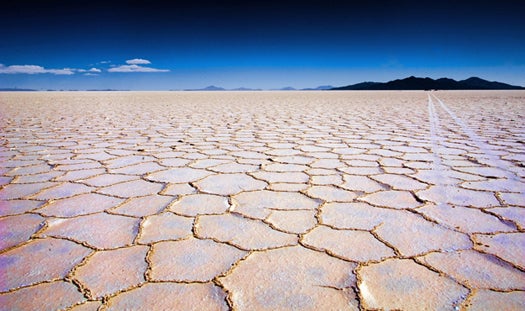
Uyuni Salt Flats Scientists estimate that between 50 and 70 percent of the world's lithium sits in these Bolivian salt flats. via Foreign Policy Magazine

Bolivia is primarily known for two things: being the poorest country in South America, and having a president with a terrible haircut. However, it might soon be known for a third thing: lithium. Turns out Bolivia has the world's largest reserves of the light metal, and according to Foreign Policy, that positions Bolivia as the Saudi Arabia of our carbon-less, battery-powered future.

Lithium already pervades our technology-obsessed society, powering everything from laptops to cell phones to, increasingly, cars. As more and more cars switch from gas to batteries, the demand for lithium will only increase. In fact, consumption of the metal is expected to rise three fold in the next 15 years.

In Bolivia, most of the lithium sits in the Uyuni salt flats. Located in the southwest of the country, the Uyuni is the world's largest salt flat, and it contains between 50 and 70 percent of the world's lithium.

These mineral riches and increasing demand have already set off confrontations between Western corporations that want to mine the precious mineral, and Bolivia's Socialist president, Evo Morales, who prefers nationalized companies. However, that's just the beginning of the problems. The Foreign Policy article also warns that while lithium replacing oil as the main fuel source will help the environment, there's no evidence that changing the place and resource will reduce the conflict between those who have the power, and those who want it.

[via Foreign Policy]

14 Comments

This reminds me of communists nationalizations of everything. There are the capitalists wanting to do it now. So after all there is no difference between capitalism and communism. But I do agree that there are a lot of nay sayers. Until we master every proton and neutron and electron we will have to harvest what BigBang gave us.

Lithium-7 is used in nuclear reactors as well.

Bolivia holds over 56% of the World known lithium reserves.

Personally I don't favor the current Bolivian Administration. Though they have protected their citizens and interests better than previous administrations.

Lithium, batteries and nuclear power are going to determine the future until we can reach Jupiter to mine the Lithium there. Until then, whom ever controls the Uyuni salt flat will become very powerful in economic terms.

Evo Morales is fighting for his people.

I don't blame him for not allowing some foreign (USA) corporation to come in, make HUGE profits and leave nothing for the bolivian citizens.

It's a small country so there probably is no Bolivian Company big enough to undertake the monumental task of managing a resource of his size. This leaves them with the only option of a state-run operation. But why not??? Seems fair to me. It's a natural resource that belongs to that country, before anyone else.

Besides, if it was in the hands of a pivate entity, US corporations would eventually come in and buy them out.

Bolivians don't want a repeat of their water crisis again. Call them communist or whatever you want but remember it's their sovereign right. The voted for their leader...

glad to see a poor country discovering huge resources.

This might be great news for the Bolivians, but let's remember that lithium is a non-renewable natural resource - the Saudi Arabia analogy is very apt. Some scientists are estimating that there are around 13.5 million tons of it on earth, but with our current technology, only about half of that can actually be extracted and used (according to William Tahil and the Meridian International Research - check out www.evworld.com/library/lithium_shortage.pdf . I know it's not the most impartial research group out there, but )

The Chevy Volt's battery setup weighs about 375 lbs., and there were more than 70 million motor vehicles produced in 2008 (I'm not sure how that figure has changed since, given all the economic ups and downs we've been having).

If hybrids like the Volt get anywhere near as popular as internal-combustion cars - and if our culture gets as dependent on them, and on lithium as a power source for them - then those reserves are going to start running out eventually, and we'll be right back where we started: searching anxiously for some new energy source/storage medium, as he world's lithium reserves slowly run dry - starting with those of the USA, whose reserves are only an estimated 38,000 tons.

the lithium used in batteries can be recycled into lithium carbonate which is the form it's mined in and then obviously reprocessed into fresh new batteries. However that used for the medical industry cannot so it's at least mostly a renewable resource to the recyclable extent. I'd say that's alot better than oil which cannot be reused, once it's processed into gasoline and burned it's gone.

Yea, here comes North America Bolivia..Watchout! I wouldnt be surprised if" America" kills hundreds of Bolivians to get what they want. How ever "America" is getting their lithium for cell phones and laptops without invading Bolivia..continue..There is no need to take from the poor.

If, somehow, Saudi's oil were in the US, it will be far more expensive for anyone to buy. period
Secondly, it's US companies who pump out oil in Middle East. period
Thirdly, USA #1 pollutant. period
Fourth, please leave the Saudis alone, not to mention Bolivia. period^2

I agree with most of the comments I see here. Has the average american woke up to the fact that if you keep stealing from others your going to get burnt, or it's just not right?
That's OK.
Corporate America, the bureaucrats, will justify taking it any ways. Watch and see.

If the lithium can be recycled, then that would be ideal, because we wouldn't be depleting resources, or at least not as quickly. The other alternative would be to continue research into new battery technologies that are both more efficient and more easily recycled. These might prevent the problems indicated in this article.

Lithium is not a fuel, it's useful to make rechargeable batteries which may be charged by plants using real fuels. It should be interesting to watch how Morales' nationalized companies try to meet the demand.

But lithium, and batteries in general, are not the only possible energy storage devices. Advances in graphene and other materials may compete well with lithium ion batteries. So maybe the Bolivians can keep their dirt.

If you google St. Andrews Air Battery (abbreviated STAIR), and browse other air battery technologies, you'll see there is good reason to believe we may soon be able to make batteries that have far greater energy density, meaning we'll need far less of anything such as lithium to make a battery with much greater range, and that is much less expensive.

The concept of air batteries has been around for several years now. The idea is to replace the cathode of the battery with atmospheric air, which is practically limitless. If we can do this, we may be able to have batteries with 10 times the storage capacity of those we have today.

Tesla EVs average about 244 miles between charges; recently, an Aussie drove one a distance of 313 miles on a single charge, a world record for EVs. Using that as a yardstick, we can assume that using air battery technology and a battery of the same weight, it would be possible to drive from coast to coast in the USA without recharging. Impressive.

If we did have such a great increase in storage capacity, of course, what would be far more practical would be to make cars with much smaller batteries-- say, 100 lbs. or so-- that would have a much smaller range, but they would be much cheaper, much lighter and nimbler, much quicker in acceleration, and would conserve resources much better.

Other technologies are also capable of increasing a battery's energy density dramatically, and if used in conjunction with air battery technology we could conceivably have batteries weighing only 20 lbs. or so, and still giving us a very satisfying range between charges. Coating the anode with carbon nanotubes, for instance, has been claimed to also give a potential tenfold increase in energy storage-- imagine a Tesla with a battery using both technologies-- air battery and carbon nanotubes on the cathode-- that theoretically could increase range by a factor of 100, possibly giving a Tesla a theoretical driving range of 31,300 miles! The earth's circumference is about 24,800 miles, meaning that we could theoretically drive completely around the equator of the earth on a single charge!

What would be much more practical, of course, is to make the battery only as big as we really need it to drive a comfortable distance... say, 200 miles or so... meaning the car could be extremely light with great acceleration. If the battery could be reduced in weight that much, so could all the rest of the drive train-- the electric motor, the electronic controller, drive shaft, axles, etc. A very powerful, inexpensive, lightweight, practical EV could still have a very good range.

Realistically, batteries may never achieve such spectacular performance, but without doubt they'll get better, cheaper and smaller, and EVs will be able to fully replace ICE-powered cars even if lithium becomes a strategic material. Before we do, though, we need to install an aggressive material recycling program to recover as much as possible of the lithium and other rare elements we'll be using, so it is not squandered.

There have been many innovations to batteries. The problem is, these innovations cost $$$. They use many exotic materials that in many cases can only be found in specific areas of the world (that is if we are talking about the typical mobile phone or flashlight battery). Just 10 years ago, my Nokia mobile phone had a 1 hour talk time and was the size of a water bottle. We have moved away from the NiCad batteries, through the NiMH, and now use Lithium ion. The battery is smaller than the palm of my hand and it powers what is essentially a portable computer that plays music, sends and receives email, plays games, browses the internet, takes pictures, oh and makes phone calls.

www.laptops-battery-online.com


June 2013: American Energy Independence

Five amazing, clean technologies that will set us free, in this month's energy-focused issue. Also: how to build a better bomb detector, the robotic toys that are raising your children, a human catapult, the world's smallest arcade, and much more.


Online Content Director: Suzanne LaBarre | Email
Senior Editor: Paul Adams | Email
Associate Editor: Dan Nosowitz | Email
Assistant Editor: Colin Lecher | Email
Assistant Editor: Rose Pastore | Email

Contributing Writers:
Rebecca Boyle | Email
Kelsey D. Atherton | Email
Francie Diep | Email
Shaunacy Ferro | Email

circ-top-header.gif
circ-cover.gif