Show Me the Honey
New research finds higher-than-expected levels of pesticides in hives
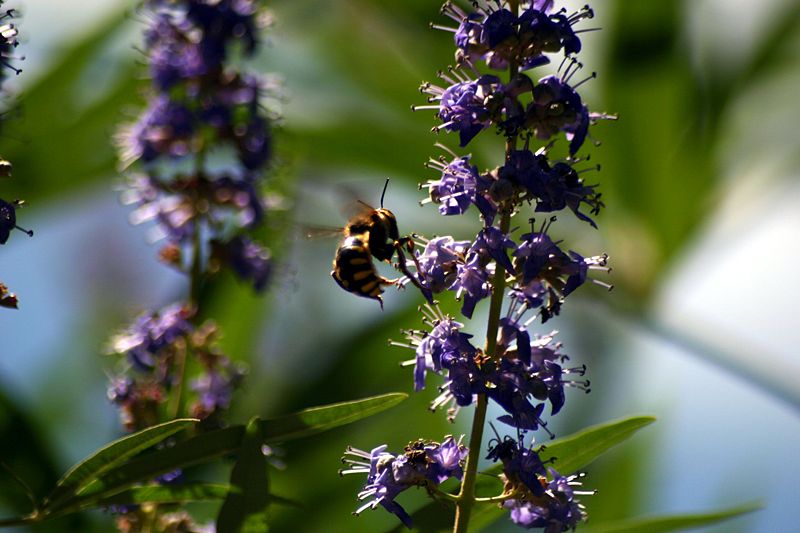
People generally know that substances that are harmless when taken separately in small doses can lead to disorientation, and perhaps uncharacteristic behavior, when mixed. Honey bees, apparently, do not. After all, dabbling is what honey bees do, and it’s what we love them for. These little workers are responsible for billions of annual agricultural industry dollars, thanks to their pollination services. But bees haven’t been staying on task. They’ve been acting a little weird lately–leaving their hives and not coming back–and attracting a lot of attention for it. Haagen-Dazs even created a flavor of ice cream in an effort to raise awareness about the phenomenon — called Colony Collapse Disorder — and funds for research on its causes at Penn State and UC Davis. The disorder is generally attributed to a variety of causes, including (depending on who you ask) parasites, viruses, mites, chemical exposure, and even radiation from cell phone towers.
While pesticides have consistently been acknowledged as a contributing factor within this problematic milieu, recent research at Penn State has revealed that pesticide levels in hives are much higher than researchers predicted. Beekeepers use some pesticides as an inexpensive way to combat varroa mites in their colonies. While the researchers were able to reduce the pesticide levels in beeswax foundation — the wax that beekeepers use to create hive structures — through irradiation, this only addresses part of the problem. The extraordinarily high levels of pesticides discovered in the bees, their honey, and their pollen, showed that pesticide exposure outside of the hives is contributing to the problem.
The U.S. Environmental Protection Agency regulates agricultural pesticide use, but this regulation does not account for the interaction of these chemicals that inevitably takes place through the bees’ pollination processes. Some of these combinations of pesticides have been found to have a synergistic effect hundreds of times more toxic than any of the pesticides individually, says James L. Frazier, professor of entomology at Penn State. Bees’ exposure to these toxic chemical combinations both outside of, and within, the home — er, hive — may cause behavioral changes. These changes include immune system blocks and disorientation, which may help to explain the CCD crisis of late.
Last year, the American Beekeepers’ Federation, in a letter to the Chairman of the House Committee on Agriculture, encouraged Congress to pass the 2007 Farm Bill. The letter highlighted environmental regulation and enforcement as one of the beekeeping industry’s priority issues, stating “the central role of bees in the environment and farm economy should be emphasized in environmental regulation and enforcement, including in the review and approval of new farm chemicals and treatments…. In the Farm Bill or otherwise, Congress should, among other things, mandate that sub-lethal effects on honey bees be considered in the regulatory process for new agricultural treatments.”
Whether Congress follows through or not, organic farming and agricultural practices provide an approach to addressing the problem of pesticide toxicity in bees. The Institute of Science in Society stated in a recent press release that “organic farming practices that retain more natural habitats and avoid the use of chemical pesticides should provide environments that serve as honeybee sanctuaries from the ravages of CCD. There are scientific studies showing that agricultural landscapes with organic crops are far superior environments for both honey- and bumblebees. It would be prudent to create organic bee sanctuaries as widely and as soon as possible… There is every reason to eliminate the use of all pesticides that act synergistically with parasitic fungi, and all Bt crops should be banned for the same reason. Obviously, these problems will disappear with the widespread adoption of organic, non-GM farming.”
Of course, organic agricultural practices are not the industry norm, and bees pollinate both organic and non-organic crops. This is why a “widespread adoption” of organic agricultural practices will indeed be necessary in addressing the pesticide problem.
In the meantime, Haagen-Dazs recommends that individuals plant flowers that attract and sustain local honeybee populations. Supporting organic agricultural practices, too, will help to keep the honeybees chemical-free, going to work for our agricultural economy, and returning to their rightful homes when the work is done.
[Via ScienceDaily]