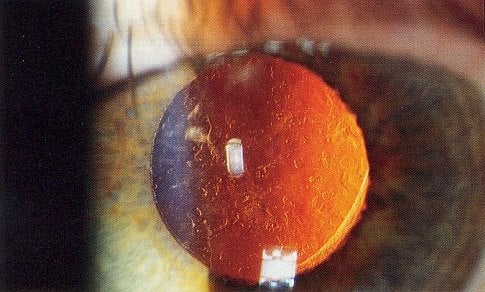
Posterior Capsular Opacification Rakesh Ahuja (CC licensed)

20/20 vision is no longer enough to function in this world. In the latest trend in laser eye surgeries, people are tailoring their eyesight to suit their lifestyle or profession, hoping to give themselves an edge in their respective fields.

Need better long-range vision for some friendly night-time sniping from half a mile away? Tweak it. Want one eye adjusted for distance and the other for reading? Tweak it.

Laser-refractive surgery uses wavefront technology, which was originally developed by NASA to help the focus technology on the Hubble Telescope. Now it can map out 250 points on your cornea and iris, and help repair such conditions as halos around lights at night.

Everyone from politicians to professional athletes to military men are taking advantage of the medical advancement, which in turn is helping to make laser eye surgery a commonplace prodcedure (over 20 million served worldwide).

So until we get bionic implants and augmented reality sensors in our eyes, this is the future. The question is: are you next?

[via Times Online]

Want to learn more about breakthroughs in electronics, medicine, nanotech, and more?
Subscribe to Popular Science today, for less than $1 per issue!

9 Comments

I'm very much looking forward to being able to afford wave-front laser surgery. Soon! My only hesitation is that the doctors performing the operation still wear glasses- what does that tell you? I'd rather not think about it too much!

Me too. As for tuning sight for lifestyle? Why not order some custom contact lenses? This way you can be more versatile. For snipers, adaptive optics in scopes will probably do more than tuning the eyes.

I'll sign up if they can "tune" my eyes enough to give me laser vision.

But seriously, if I were to get this procedure done, I would ask to be able to see better at night. I really despise driving at night, especially in the rain.

I think the author slightly over exaggerates the potential of refractive surgery. Sure low and higher order aberrations can be corrected now with the wavefront guided surgery and those who are tethered to glasses and contacts will feel more free. But even with perfect optics the best visual acuity the human eye can muster is ~20/8 because of the "grain" of the fovea (the density of cones in the fovea/macula area). I'm not saying Lasik is bad but there are risks--namely increased potential for retinal detachment. I just don't think that patients with 20/20 vision should spend the thousands of dollars a quality surgery costs with hopes that they will have "super vision"--it probably won't happen.

I don't see the point in spending thousands of dollars on an eye surgery to give you super vision when it could go wrong so easily and you end up with no vision. 20/20 is better than nothing, that's for sure.

This is old news.

Vin Diesel. Pitch Black. 2000.

I for one find this very encouraging as I have less than perfect eyesight - in addition to 2 past retinal detachments.
So, please keep up the good work, and maybe one day folks like myself can see well again.
Or even very well.

"Learn to Live & Live to Learn"
Alexander von Humboldt

Is there a procedure that would have helped you spot boners like "prodcedure"?

Oh we have to much entitlement. When we have people struggling to meet the basic health needs and then we read an articl such is this. When can we achieve a balanace between those who have and those who do not.

www.optegra.com


138 years of Popular Science at your fingertips.

Innovation Challenges


Popular Science+ For iPad

Each issue has been completely reimagined for your iPad. See our amazing new vision for magazines that goes far beyond the printed page


Download Our App

Stay up to date on the latest news of the future of science and technology from your iPhone or Android phone with full articles, images and offline viewing


Follow Us On Twitter

Featuring every article from the magazine and website, plus links from around the Web. Also see our PopSci DIY feed


February 2012: The Future of Fun

Science is reinventing play, from extreme sports to gamification to ridiculous roller coasters to the playgrounds of tomorrow, and this issue is chock full of fun. Also, on a less fun note: Did global warming destroy my hometown?


circ-top-header.gif
circ-cover.gif
bmxmag-ps