A knife-like boat design provides a covert, fuel-efficient ride
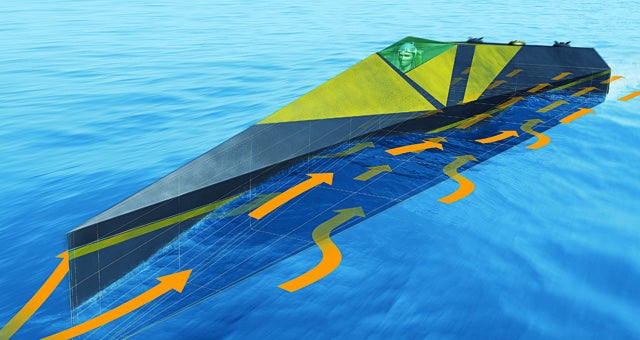
An undercover team of Navy SEALs isn’t worth much if their transport boat’s wake betrays their approach. Nor does it help if they come ashore with back pain and possible organ damage from the boat’s constant bouncing. A sleek new hull design could help troops slip through waves undetected and unscathed, while also setting a new standard for efficient nautical design.

While experimenting with high-speed yacht designs for the America’s Cup sailing race, aerospace engineer A. Calderon began investigating ways to reduce the wake that builds around the vessel’s bow, sides and stern as it cruises through water and grows as the boat moves faster, increasing drag and draining fuel. The bow of Calderon’s concept, called the transonic hull, is shaped like a tight V and cuts through water like a knife, diverting the wake sideways and under the boat to nearly eliminate it altogether. Preliminary tests of a 20-foot wood-and-fiberglass prototype indicate that the model incurs 28 to 38 percent less drag than an ultra-streamlined America’s Cup yacht, which Calderon says could translate to 30 percent better fuel economy than similar boats. And it powered through waves four feet tall without bouncing.

Transonic Hull:  Graham Murdoch

  • Sleek Hull: The sharply angled hull comes together like a knife at the bow to part the water [A] and divert it beneath the boat’s flat, shallow-sitting stern [B]. Water from the bow pushes up on the rear, keeping the nose in the water and allowing the craft to slice through waves without kicking the front end up.
  • Stealth Mode:Shaped like a stealth bomber’s
    fuselage, the XTH-170 military model’s four flat facets above the water hide it from radar, as does the boat’s small side and rear wake.
  • Sneaky MotorsBecause the hull is more than 30 percent more fuel-efficient than current boats, future versions can get by with smaller, cooler, quieter motors that make infrared and acoustic detection more difficult.

The design is still unproven. The early results look promising, says Luigi Martinelli, a fluid-dynamics researcher at Princeton University, but he worries that the hull’s efficiency might not translate well to slow speeds. “Calderon has focused on the right part of the boat to make real progress in reducing bow wake,” he says, but adds that he needs to see more test data and computer simulations to vouch for the concept.

Later this year, Calderon’s Transonic Hull Company plans to build a 100-foot prototype that incorporates strength and stability improvements gleaned from its first tests. If the technology scales up, the company will begin marketing the craft to offshore drilling companies as a boat that zips through storm chop in emergencies and start construction on a 100- to 300-foot stealth model that can take on 20-foot waves at 55 mph aimed at police and military applications.

Want to learn more about breakthroughs in electronics, medicine, nanotech, and more?
Subscribe to Popular Science today, for less than $1 per issue!

7 Comments

In the mid 80's I built several prototypes using this exact same design and offered them to the Navy for the exact same purpose.

They were not interested at that time.

I still have a 40 ft. aluminum prototype in storage.

Also have video of sea trials and lots of engineering data.

Contact me if you think I might be helpful.

Cordially,

Ron Cain

703-799=4056

rcain.caininc@gmail.com

Sabdes already designs yachts like this.

Sure, you can use radar-deflecting panels... or you can just paint it like a dolphin. Boom, instant stealth mode.

We cover this story on episode 027 of my podcast.

scienceTASTIC - Quite possibly the world's only science podcast.
Listen at sciencetastic.net.

true...

looks like the Nautilus from 'League of Extraordinary Men'.

Design looks good and efficiency reduction at top speeds too, but there is one BUT. With fuel becoming increasingly expensive, it s very unlikelly that it is affordable. Wake behind this vessel at lower 15/20 kts speeds is huge, which means your resistance will go up enormously. This design is extreme, which makes it unpracticable.


138 years of Popular Science at your fingertips.

Innovation Challenges


Popular Science+ For iPad

Each issue has been completely reimagined for your iPad. See our amazing new vision for magazines that goes far beyond the printed page


Download Our App

Stay up to date on the latest news of the future of science and technology from your iPhone or Android phone with full articles, images and offline viewing


Follow Us On Twitter

Featuring every article from the magazine and website, plus links from around the Web. Also see our PopSci DIY feed


February 2012: The Future of Fun

Science is reinventing play, from extreme sports to gamification to ridiculous roller coasters to the playgrounds of tomorrow, and this issue is chock full of fun. Also, on a less fun note: Did global warming destroy my hometown?


circ-top-header.gif
circ-cover.gif
bmxmag-ps