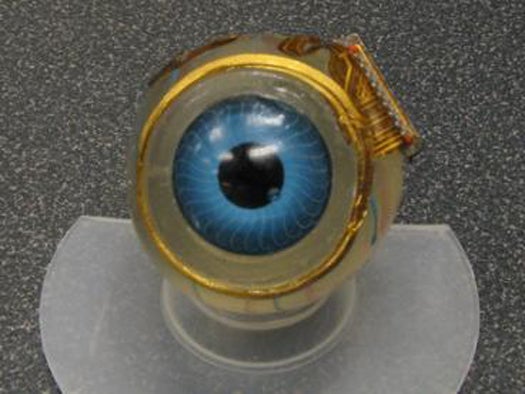
Retinal Implant Model courtesy of MIT

Blindness is the most debilitating of sensory impairments, and also the most vexing to cure. Now, MIT scientists have created a new kind of retinal implant that might help reverse the effects of two common forms of blindness. Drawing on the same principles as the cochlear implants that help the deaf, this implant wouldn't restore vision, but could help the blind navigate through everyday situations.

The system involves both a computer chip implanted on the retina itself and a special pair of glasses that photographs the surroundings and powers the implant. When the camera records a large object like a wall or another person, it sends a signal to the chip, which then electrically stimulates nerves in the retina. The stimulated nerves send an image to the brain that resembles dark splotches. The number and size of the splotches indicate the size and proximity of an object.

While the implant does not create a picture the wearer would recognize as a particular object, the wearer can learn to interpret the blobs in such a way that he or she could navigate a space without danger of injury.

The implant prototype is the result of nearly 20 years of work in the field, starting with the earliest tests that proved electrodes could bypass a damaged retina, connect directly to the optic nerve and produce an image in the brain of a blind person. So far, the device has only been tested in pigs, not humans, but MIT scientists hope to start human testing within the next three years.

[via MIT News]

Want to learn more about breakthroughs in electronics, medicine, nanotech, and more?
Subscribe to Popular Science today, for less than $1 per issue!

8 Comments

"Retinal Microchip Puts Images Directly Into Brain, No Eye Needed"?

Please correct the article's title: the eye is most certainly still needed, or else the biological retina, part of the eye, will die. The photograph is only about a model of the eye, not a replacement.

Regards

10 dots or 11? a wall or a car?

i_rakov: They say the number and size, think of braille with an added level of proximity. A wall most certainly would appear different then a car even with the 'blob' system. That's the great thing about humans, adaptability. We can pick up subtle differences when exposed to it enough; ever heard of Helen Keller?

The direct brain implants that Wired showed 5 years ago are a few steps beyond this.

If it's only been tested in pigs how do they know what it looks like, the shape or the amount? Did they teach the pigs to speak prior to testing?

people wanna rip on this milestone in one of the hardest to come by medical opportunities of the modern era? ok, brainiac, here's an easy one for ya, get yourself a Java scripter, best in the world, for all I care, and try to map the capability of the human hand once. whenever you get done with that, then try the eye. Good luck, trillionaire.

I see this advance more as augmentation, probably more useful, at least in this incarnation, for people with limited visual acuity rather than those totally blind. There are far more of these people in society, and many lose their career to the vision loss, increasing societies' burden. Great work so far, MIT.

The United States has been discussing the issue with all NATO member states, not only with Turkey, he told reporters on Wednesday
www.kabin.org


July 2013: The Future Of Flight

The incredible innovations, like drone swarms and perpetual flight, bringing aviation into the world of tomorrow. Plus: today's greatest sci-fi writers predict the future, the science behind the summer's biggest blockbusters, a Doctor Who-themed DIY 'bot, the organs you can do without, and much more.


Online Content Director: Suzanne LaBarre | Email
Senior Editor: Paul Adams | Email
Associate Editor: Dan Nosowitz | Email
Assistant Editor: Colin Lecher | Email
Assistant Editor: Rose Pastore | Email

Contributing Writers:

Kelsey D. Atherton | Email
Francie Diep | Email
Shaunacy Ferro | Email

circ-top-header.gif
circ-cover.gif