Even though computer memory has become cheaper and cheaper, the materials chemistry behind storage has not changed significantly in a long time. Now, thanks to a breakthrough by Korean scientists, that's all about to change.
The scientists have created the first material that could allow "millipede" data storage, a super-dense form of memory that first debuted ten years ago but has not yet become practical. Millipede memory can store a terabyte of memory per square inch, but until now, it required extremely high temperatures to operate. Thanks to this new material though, chips the size of pencil erasers with more storage space than the largest iPod could soon find their way into watches, pencils, and really almost anything.
Millipede data works the same way as an analog record player, with a super-fine needle carving microscopic grooves into a material, and then running along those pits and grooves to read it. Previous millipede systems invented by IBM required an incredibly hot needle to do the burning, and the same amount of heat to reform the storage material for rewriting.
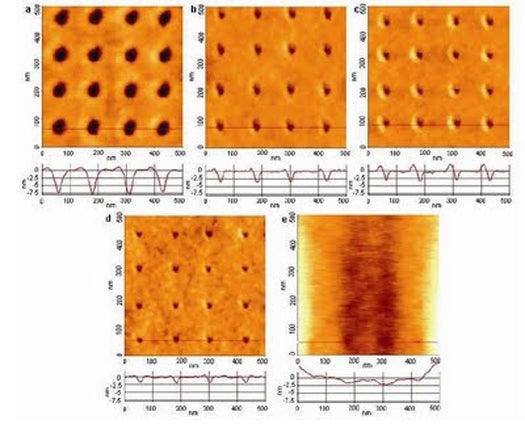
The breakthrough pioneered by scientists at Pohang University of Science and Technology in Kyungbuk, Korea, utilizes a special polymer called a "baroplastic." Baroplastic polymers are usually hard, but they soften under pressure. In this system, pressure replaces heat in the reading and writing of the millipede storage chip, thus allowing the process to occur at room temperature.
However, this does introduce some new problems. The extreme pressure needed to convert the baroplastic polymer from its hard state to its soft state would put considerable wear and tear on the needle, and the need to constantly replace a microscopic needle detracts from the practicality of the system. Luckily, current research into multilayered materials that combines the baroplastic polymers with another material that's easier on the needle offer a way around that problem.
The applications for millipede memory are obvious and vast. I, for one, look forward to finally getting an iPod that I can fit my entire music collection onto. And my entire movie collection. And my entire collection of...you know, never mind.
[via New Scientist]
Five amazing, clean technologies that will set us free, in this month's energy-focused issue. Also: how to build a better bomb detector, the robotic toys that are raising your children, a human catapult, the world's smallest arcade, and much more.


Online Content Director: Suzanne LaBarre | Email
Senior Editor: Paul Adams | Email
Associate Editor: Dan Nosowitz | Email
Assistant Editor: Colin Lecher | Email
Assistant Editor: Rose Pastore | Email
Contributing Writers:
Rebecca Boyle | Email
Kelsey D. Atherton | Email
Francie Diep | Email
Shaunacy Ferro | Email
There is no mention of the read/write speeds. Something about this sounds slow.
wow
twenty billion songs on one ipod.
thats alot.
tvs that can store movies without the need of comcast.
usb memory drives a lot of mems.
You won't see this in a pencil or an iPod any time soon. While the storage density is theoretically higher than current magnetic storage it still operates very similar to current hard drives. The medium would be in the form of a spinning disk with a read/write head. You could expect the form of the device to be identical to current hard drives. The only difference is the method used to read from and write to the medium.
Because the world is hurting for 1TB usb3.0 key drives. I'd be happy if my 16g drive was usb3 the thing takes for ever to transfer :c( woe is me.
This just doesn't seem like a step forward at all. Why go BACK to a mechanical form of storage?!?!?! We all know the problems associated with this: Scratching, heat, speed (or lack there of)..
This would me more practical for something that was going to be stored for ever, in a vault not for a portable media device. and talk about HEAVY. could you imagine, i am sure it could be compared to the standard PC hard drive in size and weight.
who has a collection of "... you know, nevermind" anymore, i thought everyone just streamed it and erased their history... i mean, i would know nothing about that.
You could store an entire OFFICE NETWORK on that thing. Other than that, who would need a terabyte of data.
OR AN EXOBYTE?!?!-DaSonicMan
I am now hungry for baked cheese crackers. Thanks PopSci.
give me one of those 5 square inchs big and say happy life.
oh and khayman: lol
--------------------------------------------------
i wish i was part of this chat about the lame macs
http://boards.ign.com/teh_vestibule/b5296/184755342/r184756381/
Khayman stole the words right out of my mouth. When I first saw this I thought, "How could Cheez-Its be IBM's new super-high-density memory material?"
Mwa3c makes a good point.
When I read analog record player I could not help thinking of the horrible racket produced by the slightest damage or wear of the vinyl, and pictured what any computer would do if that unholy harmony were to be converted into data and crammed through the processor. And what about read/write speeds? Durability? Those are what cause problems with current hard drives, why exacerbate the problem with even more data buried on a similar spinning device? Should we not focus on improvements to the recently commercially available solid state drives?
One hint to the IBM. Think flash
It's an article that outlines simple steps to develop the iPhone app. Often, people ask if one can learn programming and then develop. That's a silly thought. Be smart, go to a quality iPhone developer and save yourself a lot of money and time. And in the bargain get a sellable app ready.
The highly publicized offensive, which was slated to begin in June, was repeatedly put off because of objections by some senior Afghan officials concerned about high civilian casualties
www.kartalprefabrik.com