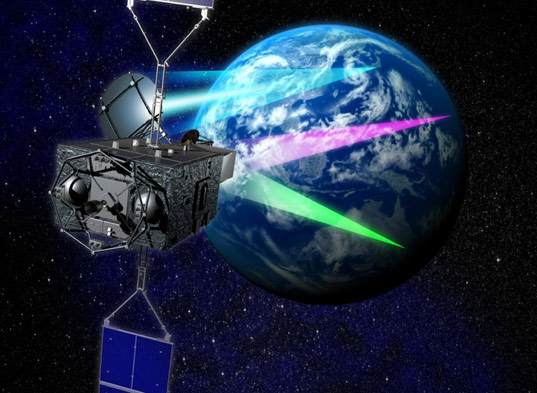
Japan has serious plans to send a solar-panel-equipped satellite into space that could wirelessly beam a gigawatt-strong stream of power down to earth and power nearly 300,000 homes.
The satellite will have a surface area of four square kilometers, and transmit power via microwave to a base station on Earth. Putting solar panels in space bypasses many of the difficulties of installing them on Earth: in orbit, there are no cloudy days, very few zoning laws, and the cold ambient temperature is ideal.
A small test model is scheduled for launch in 2015. To iron out all the kinks and get a fully functional system set up is estimated to take three decades. A major kink, presumably, is coping with the possible dangers when a 1-gigawatt microwave beam aimed at a small spot on Earth misses its target.
The $21 billion project just received major backing from Mitsubishi and designer IHI (in addition to research teams from 14 other countries).
Stay up to date on the latest news of the future of science and technology from your iPhone with full articles, images and offline viewing
Featuring every article from the magazine and website, plus links from around the Web. Also see our PopSci DIY feed
Share links with friends, comment on stories and more
In our December issue, Popular Science names the 100 best innovations of the year: bombproof wallpaper, self-parking cars, the fastest helicopter, and 97 more. Plus inventor profiles and videos.
Check out the best of what's new here.
Is it just me, or does this project remind anyone of a James Bond movie gone bad? Some melodramatic evil dude will soon take over this device and hold cities hostage, haha.
On a serious note, it’s an interesting idea, but it seems a bit far-fetched.
It is similar to the movie Southland Tales, where they are beaming almost perpetual energy through the air.
All they need to do now is figure out a way to have vehicles and mobile devices pick energy out of the air and we never have to turn anything off or charge it.
I do agree with TheWonderer. We need to make sure no crazy super villains take this satalite over and try to fry the worlds supply of (insert something important here).
Anything that has to do with a 1 gigawatt microwave can't be good. A typical consumer microwave oven consumes 1100 watts and if you stick something alive in there...well it's gross. So imagine a giant consentrated 1 gigawatt microwave beam. Can we say magnifying glass + sun = dead ants!!
If I remember correctly they have done test, simulations, whatever to show that such systems would not harm any electronics or organics between said satellite and the ground station. Also safety systems would be built in to shut it off if it strayed by even a couple of inches. Not to mention a no-fly zone over the ground station both as a safety precaution and as a terrorism deterrent.
Yeah, because we want our electricity to be dependent upon a clear path between our receiver and the satellite... I realize it's cool and has useful potential for special purposes; I don't think it's a good idea for day to day use. Economically, even, I'd wager that it's better to lay cable than orbit satellites; depending on how you value the environmental impact.
Without checking the science, does anyone know for a fact that we don't have to be concerned about brain tumors, similar to the tumors caused by the emf around supply lines?
Interesting and dumb. Global warming is occuring partially due to stored energy being released at surface-level. Energy cannot be created or destroy. What they're proposing is to bring energy which had no business being on the planet's surface in the first place, and releasing it at surface-level. Yet another way to add to global warming. The energy will be released as heat, of which not all will radiate back out into space. Yes, there are no cloudy days. However, buy circumventing this issue, there will be a greater increase of surface-level heat. Smart short-term. Dumb long-term.
An excellent idea and a good way to get more assets into space.
Unfortunately, scientists are telling us that there is some chance we are as little as 10 years away from falling off a climate precipice with permafrost methane emissions and ocean acidification forming the leading edge of a very steep slope.
With a World War II type effort we could within 10 years replace all of our dirty expensive air polluting fossil fuel energy sources with a worldwide build of cheap mass produced clean green nuclear power. Westinghouse's recent China sale pegs new nuclear at less than 2 cents kwh way cheaper than all alternatives including burning fossil fuels. In the US,and around the world, it would end the recession putting everybody back to work and would be paid for by ending oil imports.
Ten years from now and long before space based solar becomes practical I would hope fast breeder nukes like the liquid fluorine thorium reactor and fusion technologies like polywell and focus fusion become usable on an industrial scale.
Ike R. Think of it as a sun shade?
trueperspective Electromagnetic radiation is the same stuff from am radio to light and can be described as two components. One is an electrical field and one is a magnetic field. The electric field is like ac current going from positive to negative, the magnetic field goes from north to south. If you weaken one field the other field weakens if you strengthen one field you strengthen the other. These fields are perpendicular from each other.
Think of how an AC motor works, a magnetic field moves around another magnet constantly pulling it or pushing causing it to spin. There are whats called polar molecules and for our purposes we will think of them as little magnets. When these molecules are exposed to strong radio waves they follow the it like the rotor in a motor. This spinning is kinetic energy that is converted to heat that cooks my frozen burritos and your kittens.
Now its impossible (for me) to prove that these molecules are actually 'spinning' or are just going +180° -180° so lets switch analogies. Take a pendulum and glue a string to the bottom of it, if you where to pull on your string in the correct directions at the correct rate you can make the whole thing swing. But if you start going back and forth too fast you'll cancel yourself out and the thing wont move.
If the frequency of the magnetic wave is too rapid the molecules don't have time to orient themselves with the field at first they might hum there moving a few degrees but eventually they stop producing any measurable kinetic energy.
"Guidelines for limiting exposure to time-varying electric, magnetic, and electromagnetic fields" dose not list any guidelines above 10 ghz so I consider stuff above that pity safe.
IT'S ABOUT TIME... Five years ago when I went back to college, I proposed a similar thing, "Beamed Energy," in fact I used in it as my presentation in my advanced writing class with the rendered drawing I made from AUTOCAD see inset image or go to:
www.shineinnovations.com/6112.html
My writing instructor liked the idea so much he asked me if he could use it in his upcoming science fiction book, I was floored and honored, someone is going to cite me for the idea usually they just repackage it and call it their own.
Several years after I first proposed it an oil company came out with the same idea, no cite. Now this company is trying to get it started. It is a far better way to use energy than people can imagine if radio waves or far microwaves are used and the beamed energy spread problem can be solved, remember only 28 percent of the total energy used to process electricity today by nukes or fossil fuels gets to your house...
Umm rlb2 you do have good ideas but your not the only one... Some of "your" ideas I had thought of before seeing that you had also. For instance I thought of the parachute climber before I knew anything about your version. You seem to whine too much and think too highly of yourself :p
Oh and most of the losses from fossil / nuclear are from conversion from heat to kinetic to electrical not in distribution.
Well, yeah, what happens if another lower satellite passes between it and the earth? Or what happens if a passenger flight passes between the two? Or any plane for that matter. Are they fried? Will their electronics konk out? What about birds? Will they be fried? If so, I can just see the environmental lawsuits.
animemaster wrote - Umm rlb2 you do have good ideas but your not the only one... Some of "your" ideas I had thought of before seeing that you had also.
rlb2 - I have a patent pending on "The Skyclimber" back in 2007, I did exhaustive search on it before as required for a patent prior art knowledge, meaning I went back centuries searching for prior art, none was given on the idea I proposed........ I'm not an idea thief, I dislike idea thieves. I never, ever, heard of this idea before..........
For those people who are aghast at electromagnetic radiation talk to your local city hall, every time you turn on your cell phone, etc, etc, you are being radiated by electromagnetic radiation. Certain frequencies if used, yes it can heat you up a bit but anything less than visible light doesn't have the energy to split atoms, in other words can't be related to causing cancer. Most of far Microwave and radio wave go right through you without hitting anything.
I do agree instead of beaming it directly to your house it should be beamed to a collecting station in the neighborhood and sent through the existing power lines to your house. I for one would like to minimize the electromagnetic radiation around us when possible.
wowlfie I see your concern I am concerned too but how close were you ever to a high powered radio station some of those signals are transmitted out at over hundreds of thousands of watts.
rlb2 I have no intention of disputing your patent nor am I saying that the idea is a bad one I wish you the best of luck with it. I am not willing to invest the time and money required to develop it. I question that you will find someone wanting to license the idea. It eliminates or reduces the need for retro rockets air bags and allows the use of smaller parachutes. It adds its own complexities and may not function adequately in cross winds. If I where designing a lander I would likely opt for airbags and a bigger chute. It has terrestrial applications but I cant see it ever being cheaper than a bigger chute here on earth. I still love it as technical solution but I don't see it as being economically feasible but I would love to be wrong and see you succeed with it.
animemaster, landing the Mars Science Laboratory, MSL, at first I was thinking the same way as you about airbag three large chutes because even with that the NASA engineers said it couldn't be done the same way as the MER, Mars Exploration Rovers. So I did the math and found out they were right, then that's how I came up with the Skyclimber.
If the rover is the mass of the MSL, then the mass is too much during impact even with three large chutes and airbags, the impact speed would still be too high and it would damage the rover.
Tesla invented wireless transmission of energy and the potential to power everyone with charged ions from the ionosphere. Why hasn't this taken off?
http://www.electroniccigarettesinc.com
i heard someone about 20 years ago talking about setting up a giant solar array on the moon that powered a network of satellite microwave relays and base stations. this is no doubt just the first phaze of determining if a worldwide renewable energy grid is possible.
What would happen if an airplane flew through the beam?
LOL... this thread is too funny... can't collect my thoughts enough to write them... LOL
I think the practicality of this idea definitely needs more brainstorming
Smart plan - taking advantage of the sun as an existing nuclear power plant (it's already built, it's free, it will last for billions of years).
How we learn to plug into or attach to that source of power will probably have many approaches, this being one of them. Japan is located on a geologically dynamic area of the planet, having their power supply/conduit safely off planet is a wise, long term perspective.
The first attempts at establishing this energy conduit will probably be expensive, but the potential for scaling this up (and bring down costs) seem to make it worthwhile. We could eventually be buying Asian made electric cars that are charged by a solar electric conduit.
wildcat77042 wrote - What would happen if an airplane flew through the beam?
Most likely nothing will happen, similar but much less damaging power source than an airplane getting struck by lightning.
That being said the beam could have a very week failsafe beam that has a wider circumference that is spread around the more intense beam, anything flying into the area would automatically shut off the intense beam before it comes in contact with it until it clears the beams path.
21 billion dollars to power 300,000 homes seems to be real expensive, most of the expense would be in getting all the equipment into orbit.
In my example: www.shineinnovations.com/6112.html
You just beam up energy to a reflector that bounces the beam off and sends it back to earth, it would be much less rocket expensive than to send up all that mass, solar arrays, into orbit. My proposal would supply 10 times more homes for the same cost than the proposed Japanese solar array. The difference in my proposal over the space based solar array is that they would beam that energy to the source, not directly to the house, they would collect the energy in a vacant lot and redistribute it into the neighborhood power grid.
We could use global warming vented gas that is wasted energy at oil fields anyway. Most oil fields burn the unwanted gas off, they do this because methane is a much more dangerous global warming gas that is 23 times or more heat absorbing than CO2. What a waste, use that wasted gas to make usable beamed energy.
You want cheap, clean, and eternal (from a human standpoint), there is only one option: geothermal. Nothing else is as maintaince free, clean, and free of fluctuation.
The problem with this thing is the problem with all large scale solar: night. Geosync orbits have a night. Night means no power. No power means mega batteries during the day. Megabattries = issues of cost, efficieny, etc.
You could put it up in between the Earth and the sun, but then you would need several recieving cites around the globe. Helpful for funding, but still requires massive power storage.
Putting it further out, so that it is not in Earth's shadow only increase the distance, equating to energy loss (and thus cost increaces).
For 21 billion, how many geothermal bores could be drilled and hydro plants installed?
rib2, sorry - but Dr. Peter Glaser introduced the concept in 1968 according to the "Space-based_solar_power" entry in wikipedia.
The idea has been fairly well researched and people a lot smarter than all of us have figured out most of your concerns. They know now that it is feasible, it all comes down to a matter of cost, and ROI.
Google it and check out some of the really cool research and how it all can work.
Read the abstract at my site I am not talking about space based solar I was talking about using earth based beamed energy from different sources included wasted energy, big-g-g-g-g difference...............
rib2 - Sorry now I see your link. That isn't creating energy, just an out of this world concept to redistribute it. So you want to have thousands of micro power plants and think that you can safely beam energy up into space and bounce it off reflectors back to where it can be better utilized.... Your "Innovation" reads like plenty of fiction, not enough science. No, this is certainly not a cheaper solution than the Japanese project.
rib2, after looking over more of your site I just see that you are a dreamer and regurgitator of the ideas of others. Well except for that reflecting energy beams schtick, I haven't seen that yet. Probably because the turning of small amounts of waste energy into power beams idea isn't all that feasable. Your designs and ideas are not grounded in the reality of physics and engineering.
But hey, dream on unfettered by reality, you might get lucky.
BSTUR1I wrote - just see that you are a dreamer and regurgitator of the ideas of others.
rlb2 reply - I can see your purpose is to inflame and call names not to contribute to the discussion......
No, sorry but what I saw on your site I had seen and learned of elsewhere. Most of what I saw was by no means original, just cute designs and ideas, with some interesting twists. They could work in some science fiction stories, but ... as I said dream on. Like getting thousands of your reflecting satellites into space to all hold still and recieve, amplify and redirect energy beams from micro-generating plants to various points all over the earth... Not quite as easy as relaying radio transmissions. Not to mention building and placing all of those micro-generating plants and energy to beam/uplink units, and the earth based receiving units.
Not that it can't be done, but the cost of sending the power output of 1 micro-generator would be prohibative. Now if you were sending the power output of a couple of Hoover Dams, and then distributing it... 1 uplink and multitudes of receiving units, maybe worth it. But in the long run can it compete with the cost of individual home solar installations with storage? I mean if your system could be engineered lets say in a dozen years... by then Solar electricity and it's storage will be affordable by every homeowner. Yes your idea may be doable, but very costly and logistically prohibative.
Cool idea rlb2
I think space based solar arrays are a waste of time but there have been many things in the past described as a waste of time and money like the automobile, the Wright Brothers airplane, wind power, solar power, the list goes on that did finally live up to the hype.
Thanks Timemachine - I agree about space based solar power. Someday they may make it work but until they find a cheap way to space it won't be much of a important green energy saver.
In my proposal we beam up energy from earth to a reflector that bounces the beam off and sends it back to earth, it would be much less expensive than to send up all that mass, solar arrays, into orbit. My proposal would supply 10 times more homes for the same cost than the proposed Japanese solar array and will use any energy source renewable or nonrenewable to power the beamed energy.
We may first use global warming vented gas that is wasted at oil fields anyway. Most oil fields burn the unwanted gas off, they do this because methane is a much more dangerous global warming gas that is 23 times or more heat absorbing
than CO2. What a waste, use that wasted gas to make usable beamed energy.
Another method we discussed would be to use the large natural gas fields like the ones in Alaska to beam the energy to anywhere on earth therefore instead of paying over 40 billion dollars and counting for the Alaska Natural gas pipeline to the lower USA they would use that money to build the infrastructure for beamed energy in space as proposed back in 2004.
Aren't you kind of harsh on rlb2 BSTUR1, from looking at his website he had several items published, several things patent pending, the list is a long one. What have you contributed to society besides a lot of hot air.
rlb2 I am impressed with your work. Most of the things on your website are advanced out of the box, no wonder a simple mind like BSTUR1 couldn't understand them.
I apologize but that's what I see, I mean the graphics are nice and he's taken some ideas that I've seen elsewhere and placed some nice twists on them (pretty much by placing the ideas in space and on Mars) although there's nothing wrong with that. Patents Pending (or granted) doesn't mean that an idea is able to be brought to reality in a cost effective manner. But that's why I said to dream on. Any designer/inventor has to have thousands of dreams before some, if any, come to fruition. So yes, keep dreaming!
But from my very limited point of view, they are grandiose schemes that would work well in science fiction novels. But in our current reality, not so well. Take the 9 summary points of action to "make this happen" rather simplistic without any gauge of the enormity of most of those tasks. Then # 9. (a copy of #1) should probably read "Find a cost effective way to turn light waves back into electricity." Which isn't mentioned...
I guess #5 would be the not so trivial part of developing a system that can accurately focus and aim the uplink beam to the reflector satelite and position the reflector to aim the beam back to the receiver wherever that reciever is. As well as being able to keep the footprint of the beam very focused so much of the energy does not miss the satellite and then again miss the receiver on its' return trip. I mean the footprint of a laser beam spreads out the further away the "target" is and this energy beam technology hasn't even been created yet. Although there was that experiment in the Pacific between a couple of islands which is a very primative start. There will be enourmous amounts of R & D to figure out this component.
RIB2 is stating that this system could be in place of traditional power transmission lines from remote areas with micro-generating systems. To replace power transmission lines, this might work as a line of sight system within our atmosphere, I mean that is basically how communications microwave towers work (although they receive, amplify and retransmit their microwaves - instead of reflecting). With the sending, reflecting, and receiving units located on solid ground as opposed to bouncing beams off of a satelite floating in space.
If money was no object, yes this would be conceivable with several decades of developement, but RIB2 is saying that the cost of this system would compete with power transmission lines for hundreds of remote micro-generating operations...
Or do you think those problems are trivial, Timemachine? I completely understand, all too well, every detail that is on the "Shine Innovation" website and I hope that he continues to dream and design.
Timemachine thanks for the support.
BSTUR1 I can talk about your last post because it is written in a way that tells me that you are trying to understand the thought process behind the idea although I can do without the putdowns.
BSTUR1 wrote - But from my very limited point of view, they are grandiose schemes that would work well in science fiction novels.
rlb2 reply - Since gas prices were 1.29 a gallon when I thought of it technically you are right, my writing instructor who is younger than I am had several science fiction stories published, he liked the idea so much that he ask me at that time if he could include it in his next book, that was back in 2004. That being said you mentioned Dr. Peter Glaser introduced the solar power concept in 1968 which was more of a far-out dream than what I proposed several years ago and today several big players are talking about bringing that idea to light, imagine how cheap gas prices were then, and the efficiency of solar cells were in the single digit...
BSTUR1 wrote - Take the 9 summary points of action to "make this happen" rather simplistic without any gauge of the enormity of most of those tasks. Then # 9. (a copy of #1) should probably read "Find a cost effective way to turn light waves back into electricity." Which isn't mentioned...
rlb2 reply - You read a shortened version of the paper. That abstract was part of a final paper for that class this link is available below the abstract that shows the full completed paper, www.members.cox.net/arrow-space-innovations/Beamed%20energy%20paper%205-07-12-04.htm It's the original one taken from my previous web site Arrow Space Innovations so the images are missing. Some things have changed since then. The paper was also included in my project class for Civil Engineering, my third Engineering degree.
As explained in the full paper if visible light is used, it is much more cost efficient to turn monochromic light, single frequency, back into electricity because you are dealing with the same wavelength. The cost of a monochromic light cell would be much cheaper than solar cells because all of the light waves would be the same frequency. The same would go for capturing microwave and radio waves. The light frequency from the spectrum of the sun is all over the place from radio waves to UV so the most efficient solar cells are costly and have to be layered. The most efficient solar cell can only convert up to 40 percent of the sun light into electricity where monochromic light could theatrically convert over 90 percent of the light back into electricity that hits the receiving cells. The trick is getting all that energy focused enough to strike the receiving cells...
BSTUR1 wrote - I guess #5 would be the not so trivial part of developing a system that can accurately focus and aim the uplink beam to the reflector satellite and position the reflector to aim the beam back to the receiver wherever that receiver is.... I mean the footprint of a laser beam spreads out the further away the "target" is and this energy beam technology hasn't even been created yet. Although there was that experiment in the Pacific between a couple of islands which is a very primitive start. There will be enormous amounts of R & D to figure out this component.
rlb2 wrote - Yes that has always been the most stickier part but today we are farther ahead of this problem then we were just a short time ago. Remember the Pacific example you were referring to was for approximately 22 miles through 1 atm, where we have a inverse square law governing our atmosphere so at about 17, 000 feet, apx. 3.22 miles up, the atmosphere is 1/2 atm so the Pacific test is overkill of an example then the actual resulting beam spread would be and after that anything going through the vacuum of space has a negligible beam spread for the distances we are using. In other words the actual beam spread would be much less than in the Pacific example you were talking about....
Please go to:
www.members.cox.net/arrow-space-innovations/Beamed%20energy%20paper%205-07-12-04.htm
The paper was written as a final convincing argument to
a hypothetical customer promoting my idea for project engineering and I used it in my writing class for a letter grade, I used AUTOCAD to make the 3d rendered drawings.
Since taken that class I have been trying to sell this idea to real potential customers with some of them showing varying interest. The more detailed work I have done since then is proprietary information and will not be disclosed at this time.
its a really optimistic idea......i mean, look at it-21 billion dollars, 30 years, 300,000 homes. and what about upkeep? you can't just say right i am goibng into space to fix this satellite.....but on the other hand, if it works the whole world could benefit, not just japan.....but i won't wait with my fingers crossed. if it works, great. if not, i'm not going to cry my eyes out over it.
sox all the way
trueperspective and wowlfie, you are quite correct in being concerned about the biohazards accompanying the satellite's high-intensity microwaves, as explained in the book Sunstroke by David Kagan. The US EPA wants far more studies to be conducted regarding the microwave irradiating of human, plant and animal tissues at the satellite's ground intensity of 20 milliwatts per square centimeter; they say that it's powerful enough to heat up living tissue. And that's at ground level. That means passesngers aboard an aircraft that accidentally passes through the beam will get flash-roasted-- like popping a dinner into your microwave oven. Also the EPA is concerned about atmospheric heating and telecommunications interference as the beam microwaves its way through all layers of the earth's atmosphere. Remember, Japan is in a heated race with California's PG & E/Solaren to be the first to beam down space solar power in the form of concentrated microwaves.
Also, the power beam will not shut off if the satellite wanders. Instead it's so-called "fail-safe" device is supposed to defocus the beam to a supposedly harmless level. But what happens if something prevents the fail-safe device from kicking in. Read Sunstroke by David Kagan and you'll find out.
rlb2 I can see your proposal working more than the others because of the cost.
zuggerjack the EPA will certainly question the microwave oven effect but not all frequencies vibrate water molecules so I would think there would be several available that would go right through you like so many other microwaves do today, if not don't answer your cell phone. Are you sure about the 20 milliwats per square centimeter number is right because that comes out to 200 watts per square meter which is 1/5 the amount of radiation you would get in direct sunlight, 1000 watts per square meter. Was the EPA talking about cell phone towers in that report?
Hey RIB2, when your abstract says "inferred spectrum" do you mean infra-red spectrum? Well you are talking about light and I can't find any mention of the "inferred spectrum" in the electromagnetic spectrum. It's like you were taking notes in class but never read the textbook, or is it some other special meaning?
Oh and I just watched the Discovery Project Earth show "Orbital Power Plant" about the research into beaming solar energy through from space. From inflateable fresnel lenses to boost sunpower to the multijunction solar cells to the microwave beaming. The microwave experiment was able to detect microwave energy at a distance of 60 miles, the thickness of our atmosphere. This experiment didn't turn the microwave back into useable energy, just showed that it could be detected at that distance. But you'll be using mono-chromatic light waves, bouncing them off parobolic mirrors with pinpoint accuracy to theoretical solarcells... Without even knowing if you can accurately bounce those theoretical, finely focused light waves off of mirrors in space.
It would seem that you have some heavy R&D projects to bring about several breakthrough technologies that you will need to create, to get this idea off the ground. While you may be able to ride on the backs of some current projects for some of your technology, those results will have to be purchased or brought into your labs and perfected. To go along with some technologies you'll just have to create from scratch... And you don't know that it should be spelled "infrared spectrum"... Dream on! Best of luck to you and your investors!
BSTUR1 give it a break rlb2 has far more patients with you than I would. Several of us here would like to find out more about his idea, it is a much better idea than the space based solar beamed energy proposal. You are trying to belittle his intelligence by making smart remarks. Your disruption here is unwanted. I don't like people who purposely try to disrupt the discussions of others looking for misprints or misspelled words, you're like that little kid in class who says outlandish things to get attention that everybody tries to avoid.
I thought this was a public forum to exchange ideas and questions? Timemachine did you read the abstract? If you want to find out more about his idea read his abstract it pretty much spells it out. Just pointing out mistakes and asking questions. These are questions that anyone reading his abstract should be asking. And he should be able to answer.
What is inferred spectrum or inferred light energy? It is mentioned a few times in the abstract. I don't find that term even in wikipedia. Yet his theories of turning energy into light beams and back again seem to rest on it. If he means infrared spectrum and infrared light energy, well that means something in the electromagnetic spectrum. Anybody who has studied the electromagnetic spectrum knows infrared which is on the opposite side of the visible light spectrum from ultraviolet. As I said I can't find a definition for inferred spectrum or inferred light energy....
And it is another idea, not really a better idea than the spaced based solar. If you want to find out more about spaced based power generation watch the Discovery Project Earth show "Orbital Power Plant".
I really do wish RIB2 the best and hope he finds the many answers to all of the questions that face his ideas. Because if he can create his vision, he will have brought a few fantastic breakthroughs to the world of science. The energy to light beam laser technology, the monochromatic PV Solar cell beam receiving technology, and the beam focusing, aiming, and reflecting technology. Those will be monumental scientific advances, because those technologies do not currently exist. I just think that he is overestimating the efficiencies that can be created in his systems and underestimating the difficulties in development, and the cost, for a viable system, let alone what the total cost for R&D will eventually be.
uuuugh...why so optomistic everyone!!
Ching Soo: did I hear that right, 21 billion for 1-gigawatt!
Woo Lee: kon ee tan hai...
(translation): yes, yes arnt we so efficient and progressively thinking people...
Ching Soo: The US currently needs 3300 GW....thats what...
$69,300,000,000,000 worth of sattalites?...excellent job Woo Lee im sure US taxpayers can scrounge a measly 70 trillion from their wallets
Timemachine, thx for your comment. The EPA and the US Congress Office of Technology Assessment evaluated space solar power-beaming via microwaves at the minimum intensity of 23 milliwatts per square centimeter. They determined that intensity would cause heating of biological tissue (human, plant, animal) at the ground level where the rectenna will be located. Their report clearly specifies that at higher altitudes the microwave beam will be far more intense, and could endanger passengers aboard aircraft, as well as birds. You can read this US govn't document titled "Solar Power Satellites" by plugging the title into your search engine.
Be advised that although microwaves are part of the electromagnetic spectrum just as sunlight is, microwaves tend to interact far more with water molecules than sunlight on Earth. Also they possess a different frequency and power levels than simple cell phones. Think microwave oven. Microwaves for power-beaming from orbit are souped-up radio waves akin to radar. Any USAF base will confirm that their radar occasionally literally roasts pigeons that veer too close to their radar arrays. Thx again.
zuggerjack thanks for the quick feedback, it sounds like it is more of a concern than I thought for that low of microwave radiation. rlb2 does point out the hazards in the paper he wrote about what would happen if a airplane or bird flew through the beam and the safety type devices he would use to shut it down before they reach the beam. Nothing is fail safe, how many animals get killed a year with automobiles through road kill, how many people die each year in car accidents? When the first gasoline automobile engine was developed everyone was screaming about the explosive fire hazard of gasoline. Radio waves pass right through you so maybe the best bet is radio waves.
Thank you again, Timemachine, for your in-depth analysis and for getting the truth out there.
There is a good reason why this headline article about Japan's power-beaming project that we're all commenting on included the statement "A major kink, presumably, is coping with the possible dangers when a 1-gigawatt microwave beam aimed at a small spot on Earth misses its target." The environmentally-conscious Japanese have obviously read the US OTA document regarding biohazards should the microwave beam veer away from its rectenna site, and of course other pertinent works. Undoubtedly they've also read the same book I did, Sunstroke by US aerospace engineer David Kagan that explains all of the inherent dangers accompanying such a project.
Regarding your statement that radio waves pass right through you brings to mind the fact that x-rays also pass right through you, and have a tendency to irradiate your body cells in quite severely. Souped-up radio waves in the form of microwave radiation also interact with your cellular structure, especially that of the human brain, and cause human test subjects to hear a weird unnatural clicking sound coming from within their head. These tests and others conducted by the USAF and radiological labs in New Mexico are documented in the US OTA document. Thx for your input.
Interesting and high tech idea, but what about space junk/particulate collisions that could render this thing useless. Also consider that you would always need a redundant back-up power supply, since reliability and repairability must be factored in. It's probably really a 'star wars' national defense strategy against North Korean nukes.
Let's see:
Microwave Death-ray +
Sentient Japanese Robots /
Chinese hackers =
Godzilla versus Mecha-Godzilla, 2030
aryeh5761, hey, think you see the light. Hollywood should really make a blockbuster feature film out of David Kagan's Sunstroke book. Just remember though, it's not only Japan that's building space solar power satellites employing high intensity microwaves, but it's also being developed by California's private sector Pacific Gas & Electric utility corp. in conjunction with the Solaren corp. Japan's in a heated race with them to be the first to beam down power in the form of concentrated microwaves.
mechtech, you're right on the mark here! If you read either the book Sunstroke by David Kagan or the US OTA document titled "Solar Power Satellites" you'll see they devoted entire sections regarding space junk collisions with a microwave power-beaming satellite. They spell out that such a collision could knock out the so-called "fail-safe device" that's supposed to defocus the beam to a "harmless level". Also both Sunstroke and The OTA document spell out that a power-beaming satellite is vulnerable to attack from enemy anti-satellite vehicles such as the kinetic-kill ASAT used last year by the US military to take out a derelict US spy satellite that was in a decaying orbit.
Rib2, glad to see you took my criticisms of your web page and abstract to heart and updated your web pages with much more correct information, and pictures! Sorry if I came off sounding like a jerk. Now it looks like you know what you are talking about. Best of luck!
Hey Timemachine, I bet he took it easy on me because my criticisms of his website and abstract info were valid. They looked like something thrown together without actually knowing the technologies behind what was being proposed. Otherwise he would not have made changes to address the problems that I pointed out.
BSTUR1 yea right a couple typos on a 13 page paper isn't unusual if they were typos at all. You only read the web page that pointed to the abstract. It was clear that you didn't read the original paper. He probably changed them on the web page to shut you up. Why not take it easy on you, as I said before someone acting like you I wouldn't give the time of day too. Now the way you sound you act like you are responsible for the whole idea in the first place. This is why most people in industry don't talk to us anymore because as you confessed to be, a jerk like you always has to disrupt the conversation.
instead of using it to power homes....use it for military..
hmmm I wonder what I would do with giga-watt beam....
on another thread, about the
"multi billion-anti-missle blimp"
the beam would be a better investment...but this tech will not make it into our everyday life
ps. @Timemachine
it always comes down to:
industry/salesmen/beurocracy vs. .::Pure Science::.
Sorry timemachine, I did read it and couldn't understand what inferred spectrum or inferred light energy meant. Didn't you realize that it was incorrect? Or did you think that there was something actually called "inferred energy" in the spectrum? Your presentations have to be perfect if you are trying to convince people to invest billions of dollars to develop your ideas. Or where you going to invest in it???
If you don't correctly identify the part of the electro-magnetic spectrum that you are planning to use to create your power transferance beam, how could anyone believe that you could do it? His website and abstract had childish mistakes, like he had copied and pasted paragraphs from other sources and then ran spell check (that's probably what turned infrared into inferred).
I figured that he was some high school kid who saw the episode of Star Trek where they bounced a phaser of a star's coronashere to destroy their enemy and turned the idea upside down, to reflect beamed energy off of a satellite and back.
I'm just a literalist who knows a lot about a lot of things and plays the devil's advocate at times. I'm no more of a jerk than you are, get over yourself. It was only my idea to point out his screwups. RIB2 was on here hawking his "ideas" and his website, that opens him up to scrutiny. I scrutinized, get over it. If he can't handle criticism and rejection than he shouldn't be trying to peddle his ideas in a public forum.
Hey, Techno, just plug "space solar power, pentagon" into your search engine and you'll find a vast number of bonafide news articles about the US military's great interest in power-beaming microwaves from orbit. Precisely as written about in a really great book called Sunstroke by David Kagan. You know, the US Army already has a land-based microwave beam weapons system called, innocently enough, "Active Denial System". Now they want to send amped-up microwave beams down from huge satellites at taxpayers' expense. What was it that former President Dwight Eisenhower said upon leaving office? Didn't he say "Beware of the military-industrial complex"?
BSTUR1 I generally don't do this but I thought I would give you the benefit of the doubt since all you talked about was rlb2 spelling errors so I checked out who is right and who is wrong. I checked your last 4 paragraphs out and found three spelling errors, transferance (transference), coronashere (coronasphere), screwups (screw-up's), I checked all 13 pages of rlb2's paper and didn't find one spelling error. In the future if you are going to berate someone's else's spelling at least try to spell your own words right.
TechnoFreakFace you have a point. Government bureaucracy is even worse.
What I like most about these ideas, solar space based beam energy or earth based beamed energy is that they can also be used to power solar sails as rlb2 suggested in his paper. Japanese companies getting heavy funding to build the space based solar power stations that or beamed energy technology is obtainable and could propel us to the stars faster than anything else out today. Solar radiation solar sails alone can only take you to a very small percent of the speed of light where beamed energy could get you much closer to the speed of light.
What I don't like about them is as zuggerjack talked about, the threat of frying someone. I like rlb2 ideas more than the other one because of the safety issue. The beam can be controlled from the ground where space based solar arrays can't. Imagine a Terminator situation where robots or hackers got control of the solar arrays and used them against us or they suddenly get hit by space junk as some people here suggested. On the ground it can easily be shut down in a potential dangerous situation.
Not much to do, huh Time?
Rib2 has updated his abstract page, fixing the errors I mentioned and adding the pics. Sorry for my typos, I guess I should Preview Comment before posting, but I'm not trying to convince people to invest in my idea, as Rib2 is.
Timemachine, you still don't get it. Making the mistake once is a typo, twice, well maybe still. But each of 16 times that he meant to type infrared, it was spelled "inferred". That is not a typo and if he had bothered to proof read the abstract and he was actually educated about the electromagnetic spectrum, he should have realized that mistake, because there is no such thing as "inferred" any where in the spectrum. So if he had proofread his abstract after posting it (wouldn't you?), and he actually knew about the electromagnetic spectrum, he should have realized his 16 mistakes. By leaving them all spelled "inferred", he makes it seem that he doesn't know anything about the electromagnetic spectrum, and just copied and pasted the info, without any real understanding.
Very ironic that Rib2 did not know that "inferred" was an incorrect term, as the infrared spectrum is the basis for his energy beam.
BSTUR1 your something else I mean really where do you get your imagination from, he has three engineering degrees as he explained before how many degrees do you have? His work is very impressive with some published works, one of them in Robert Zubrins book, on to Mars 2 as listed on his website I mean comparing your disgusting ramblings to his work is well I can't say the word here. The information he conveys in the paper tells me he knows more about light waves than I do and you couldn't hold a candle to my knowledge on the subject. We are all tired of hearing your ramblings about a misspelled word when you can't even spell yourself -- give it a rest. We would like to talk about the topic here.
Time: you haven't made any spelling mistakes, not to mention grammer mistakes, in this forum? Your statement: "BSTUR1 your something else" Don't you know the difference between your (possessive) and you're (contraction of you are?) Let me explain, in this case you should be using you're, as in "BSTUR1 you are something else". No wonder you don't recognize or care about his other mistakes...
If he has 3 engineering degrees, then how come he did not know that "infrared" was not listed correctly in his abstract until I pointed it out? Tell me that.
You want to talk about the topic... let me start with some other problems that he needs to overcome: like expecting Nlight to create the 80% efficient laser for his beaming technology, the abstract was from 5 years ago, and he says it was being developed- where is it (there is no link to the newspaper article)? Even if they do develop the 80% efficient laser, turning that device into a system that can pump megawatts of energy through it for extended periods of time would take much further R&D.
Expecting an engineer to turn the beam off when a plane would be flying through it? A plane may cross the beam in 2-10 seconds, and there is going to be a warning that requires human intervention to shut the beam off? What do you do with the mega amounts of electricity for those 2-10 seconds, you can't just turn a switch off, count to 10, and turn it on again. If it were even possible, of course it would have to be an automated system, he should not even have mentioned engineer interaction. A human in that loop would be a big mistake.
He thinks that 4 positioning lasers from the ground station and 4 Halls Effect thrusters are going to be good enough to position the satellite absolutely motionless in comparison with the uplink and downlink sites? It will probably need a system akin to that which stabilizes and aims the Hubble. Including double or triple redundancy of the systems, gyroscopes and thrusters. Doesn't even mention the enormity of developing the software to run the systems, or will it run "Windows XP For Space"? (watch out for the Blue Screen of Death-ray...). And do you aim the whole satellite with a fixed mirror as he states, or would the mirror be on a gimbal system? Probably the latter to allow for fine tuning in the aiming of the beam...
in 2004 he had expected to get that satellite flying within a few years... when the satellite should be the last phase of the project, after creating the beaming and the monochromic solar cell technologies and extensive testing on the ground, mountain tops, and probably from high altitude ballons, long before ever launching any prototype satellite. Both technologies are going to take probably a decade to develop and perfect before you would build a parabolic reflector that can work in space and with the energy beam spectrum that gets developed. If it was that "easy" to make the beaming and solar cell technologies in his required 80% efficiencies, they would already exist.
I was curious and Googled nLight three days ago, this must be the original reference he was referring to. 2003 "JDS Uniphase has achieved electrical-to-optical efficiency of around 65%, with its commercial 6390 single 915 nm (near infrared out of visible light range) emitter operating at 25 °C."
www.optics.org/cws/article/research/19838
This is an update at 85 percent efficient within the range of 100W at 976 nm (near infrared) - 2009. There small units but they will need quit a few of these to make it work, they got past their goal of 80 percent efficiency. The ones that nLight is making for the military will power over 100 kilowatt laser.
www.adsabs.harvard.edu/abs/2009SPIE.7325E..20P
There's a lot we don't know about what is behind star wars technology, most of that is kept secret. Shine Innovations, rlb2, also left open the thought of having microwave or radio wave beamed energy as an alternative.
GET REAL, EARTH. Just gotta say this is the best thread in a while! Great stuff, all of you. BUT. The most efficient thing I can think of is to bomb Earth, as in Star Wars SDI. Solar collector refines and amplifies to light, charges plasma ball, send to big catcher's mitt. No microwaved airplane passengers, no fried cities. You can see where the plasma ball is gonna hit before you drop it. Plasma ball can be sealed in a container if possible, or just real big to allow for loss to our atmosphere. If our plasma base atoms could be collected in space, that would be great, but I'm not sure of the density vs capacity rules. The NIF would probably know. This seems to beat the ideas of burning through our magnetosphere and ionosphere, where we know that stimulated particles under proximity boost will carry less accelerated particles along with it, creating active holes that the planet would have to continually absorb, but replace slowly.
Keep in mind that what I'm thinkin is for thermal at the end, only. The gases would have to be released back to pay back what entry cost us in noble gas.
And whenever Japan gets done with this piece of disinformation, a huge microwave is gonna create a huge dead, or worse, mutation zone as the microwaves collect in harder materials in the earth surrounding their collection facility. Whatever spectrum, just takes exposure time and concentration.