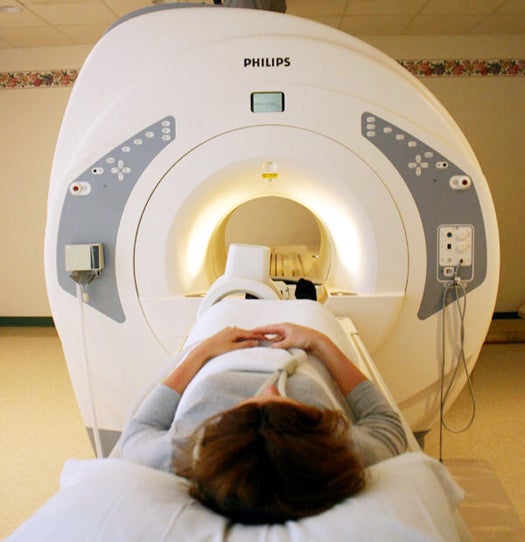
We'll See Who Freeloads Now! via Greene Medical Imaging

The problem of people who take more than their fair share of public services is as old as public services themselves. On a small scale, the problem merely blends into all the other inefficiencies in the system. But if freeloading becomes too pervasive, it can imperil the entire society. This may seem like an abstract economics or social sciences problem, but the tendency of people to request social services without demanding that they pay a fair amount for those services led directly to California bankrupting itself.

Now, scientists at the California Institute of Technology (Cal Tech) claim they have figured out how to avoid the problem of free-riding by using an MRI machine to read people's hidden feelings about a particular public service.

Imagine a business designing a lunch plan for its employees. The fairest way to charge for the lunch would be to make people pay per item, so that those who eat more, pay more. Knowing this, those who are prone to eat more naturally argue for a flat rate, thus ensuring they get a better deal in the long run. This kind of negotiation goes on in many forms throughout society, in areas as disparate as national defense, public transportation, and health care.

The Cal Tech researchers measured the brain patterns of volunteers asked to role-play just that kind of scenario. The scans helped the researchers determine whether or not the participants were lying when they said how much they valued a hypothetical service. Those who told the truth about how much they valued the service got to pay less to receive the service (in this case, an actual cash payout). Those who weren't honest got less money.

With the payments proving the accuracy of the MRI at reading people's honesty, almost everyone in the experiment began voting for a fair distribution of the burden for supporting the service.

The lead author says his research will allow state, local, and Federal governments to forgo the proposition system, and instead brain-scan a random sampling of possible beneficiaries of a new service, as a means to assess how much the public is actually willing to pay. In California, where the ballot initiative process led to so much free-riding that the state became bankrupt, it's easy to see the appeal of this system. However, the idea that any government would monitor its citizens' brains for honesty will doubtless strike even the least paranoid person as rather terrifyingly Orwellian.

[via EurekAlert!]

Want to learn more about breakthroughs in electronics, medicine, nanotech, and more?
Subscribe to Popular Science today, for less than $1 per issue!

8 Comments

if it monitors the brain for honesty, couldn't this thing be used in courts? that would certainly streamline the legal process

How much will you pay for this $5 lunch? Here lets take a $5300 brain scan to find out. The reason California went bankrupt is they actually fund this kind of worthless research. So if they develop a cheap "loser test" then what? The only way to make a difference financially is to kick all the freeloaders out. The ACLU would be all over that.

Too bad you can't do an MRI brain scan on corporations. They pay no taxes, ask for government subsidies despite record profits and don't get me started about how Wall Street pulled one of the most massive thefts in American history.

Since corporations have nearly the same rights as individuals, why not do a scan of the corporation's board of directors?

So, let's see. The guy wants to replace California's proposition system with random brain scans. Good luck getting that one passed.

Not that it's a good idea anyway, let's see
- expensive equipment and staff
- new theory with little proof
- lawsuits over brain damage from scanning
- constant allegations of cheating and improper sampling sure to follow

I won't comment on California poltics, they speak for themselves.

bdhoro87

from coral gables, fl

Why do scientists and science writers alike think they know anything about how the economy should run?

I mean it clearly states in the third paragraph "The fairest way to charge for the lunch would be to make people pay per item, so that those who eat more, pay more." So why not just do it that way? The fairest way - capitalism, you pay for what you get, and so does everybody else.
Also wouldn't you need an fMRI to get any real time data about what people are thinking?

Oh and @freemansullivan you seem kinda confused. The corporate tax rate is anywhere from 15% to 39% and they pay double - once on income and once again when they pay out dividends.

the reason California is bankrupt is because of the millions of 3rd world uneducated, dumb, lazy people living in the state. illegals or otherwise.

Is it just me, or does the brain to brain via computer, combined with this, sound like the beginnings of A.I.? Now we just need to come up with a reason to base a rule on in it's matrix so it becomes symbiotic rather than enemy. How 'bout this. 'We hunt down and destroy those of your kind that do harm to your species, and you do the same for us, that we be more civilized', or something like that.


138 years of Popular Science at your fingertips.

Innovation Challenges


Popular Science+ For iPad

Each issue has been completely reimagined for your iPad. See our amazing new vision for magazines that goes far beyond the printed page


Download Our App

Stay up to date on the latest news of the future of science and technology from your iPhone or Android phone with full articles, images and offline viewing


Follow Us On Twitter

Featuring every article from the magazine and website, plus links from around the Web. Also see our PopSci DIY feed


February 2012: The Future of Fun

Science is reinventing play, from extreme sports to gamification to ridiculous roller coasters to the playgrounds of tomorrow, and this issue is chock full of fun. Also, on a less fun note: Did global warming destroy my hometown?


circ-top-header.gif
circ-cover.gif
bmxmag-ps