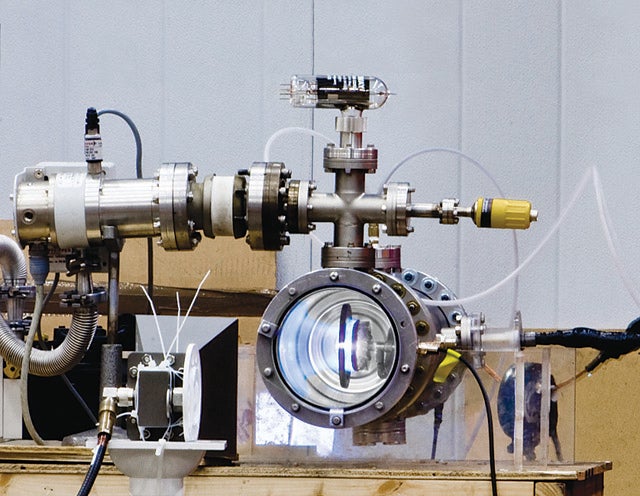
Circuit Breaker Microwaves cause a current surge that kills electronics. Courtesy Texas Tech University

An enemy missile has no strategic value if its computer is down. A high-power-microwave emitter can disable a missile's electronics on the launchpad, leaving bystanders unharmed -- and now Texas Tech University engineers have a plan to scale down the truck-size tech.

To make strong microwaves, you need a lot of electricity, usually from a bulky generator. Instead the team packed small explosives into a five-foot-long, six-inch-wide tube. The detonation produces a burst of electrons, which power a microwave tube—similiar to the type in a microwave oven—that radiates microwaves. An antenna zaps those at a target, where they can cause a circuit-frying current surge in electronics. The explosion destroys the device, and although the U.S. Army funded the work for “educational purposes,” it doesn’t take much imagination to think of uses for a one-shot, missile-shaped electronics buster,says James Benford, a high-power-microwave expert at Microwave Sciences in California.

This spring, the Texas Tech team proved the device by firing a 100-megawatt microwave signal to an antenna 30 feet away. They are now working to pack it into a three-foot-long tube.

Want to learn more about breakthroughs in electronics, medicine, nanotech, and more?
Subscribe to Popular Science today, for less than $1 per issue!

7 Comments

This might work on not only missiles, but aircraft as well. Especially the ones with the fancy "fly by wire" electronics. You wouldn't need to send your own aircraft to intercept a flight of marauding fighters and bombers.

Just point and click. Hopefully, we can keep the technology from the enemy's hands and using them on commercial airliners and such.

technological advance is not always good...the fly-by-wire are an example, automatic gearboxes for cars the theory is the more components there are in something, the greater the chance of it breaking. like the military pistol, the 1911 colt, served the military for 80 years then they got new fancy pistols with with add ons such as some "tesla" layer inside the barrel. 5 years after that they all had to be replaced because of the "tesla" being worn out and creating problems for one reason or other. So much taxpayer money down the drain. I myself own a 1911 colt pistol, I love it for its simplicity and efficiency.

this is the 'ebomb' that pop-sci had an article on several years ago. The description is almost verbatim.

Yes, this would down a modern plane or a UAV. It would also kill communications from an area, disarm some remote detenators, stop some cars, and a host of other things. As the world continues to develop from mechanical to elctro-computational, this could be your all purpose "knock out the tech" weapon against other armies that have adopted high-tech low-soldier militaries like our own.

Cool!!!!

If it frys electronics, and they miss a target it wll probly fry bystanders brains. They should just mount them on ships and destroy cruise missles and also mount them on fighter aircraft to take down enemy fighters.

indeed this would be a very useful defense machine if for example placed around a certain country. if this where to happen then any incoming electronic attack device would be disabled. also this could be used for as an attack strategy: it these devices where to be put into some kinds of capsules and then shot towards and enemy while sending out microwaves then all enemy computers, electronic sensors and all kinds of military equipment would be destroyed. the army would probable be completely ruined because nearly EVERYONE today relies on electronics to fight a war. so if this where used to attack then it would leave the enemy in total chaos and leave the attacker to do nearly anything he likes. (strike, fire missiles since there defenses would be disabled, ect).


138 years of Popular Science at your fingertips.

Innovation Challenges


Popular Science+ For iPad

Each issue has been completely reimagined for your iPad. See our amazing new vision for magazines that goes far beyond the printed page


Download Our App

Stay up to date on the latest news of the future of science and technology from your iPhone or Android phone with full articles, images and offline viewing


Follow Us On Twitter

Featuring every article from the magazine and website, plus links from around the Web. Also see our PopSci DIY feed


February 2012: The Future of Fun

Science is reinventing play, from extreme sports to gamification to ridiculous roller coasters to the playgrounds of tomorrow, and this issue is chock full of fun. Also, on a less fun note: Did global warming destroy my hometown?


circ-top-header.gif
circ-cover.gif