Designing a way to extend shelf life of beverages by removing riboflavin
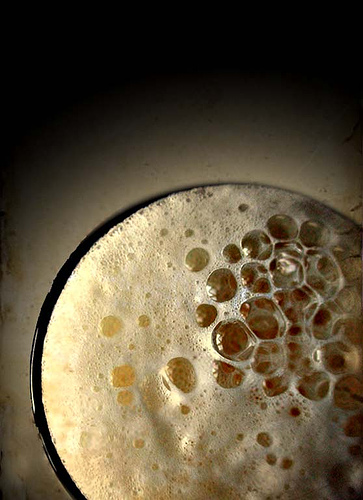
Beer: Everyone's Favorite Source of Riboflavin Flickr/Atilla1000

If you like beer, then perk up those ears, for we have news of an innovation – brought to you by, who else, the Germans – that could lead to longer-lasting brews. The development in question is a polymer that extracts riboflavin, a micronutrient found throughout beer and other beverages that promotes spoilage when exposed to light.

The reason lies in a process called photo-oxidation: when light passing through a translucent container (like that Hoegaarden bottle in your fridge) combines with riboflavin, a chemical reaction ensues that changes the flavor of the ale and decreases its shelf life.

And so, to maintain beer freshness for longer, researchers at the Technical University of Dortmund (commissioned by beer giant Heineken, much to the chagrin of many Germans I'm sure) designed a polymer that, when dipped into beer, can trap and remove the riboflavin molecules by attracting them into crevices molded to the shape of the micronutrient.

That’s the good news. The bad news is that while riboflavin may be bad for beer, it’s actually a pretty important part of our diet. A deficiency of Vitamin B2 (as it’s also called) leads to such horrors as mouth ulcers, inflammation of the lining of the mouth and tongue, cracks at corners of the mouth, and cracked lips. In other words, if you plan on drinking riboflavin-free beer, make sure you’re getting enough riboflavin via other means (i.e., meat, eggs, mushrooms).

[Via BBC News]

Want to learn more about breakthroughs in electronics, medicine, nanotech, and more?
Subscribe to Popular Science today, for less than $1 per issue!

6 Comments

Unless I were stocking up for a nuclear winter I usually don't worry about not drinking my stock of beer prior to it getting skunked ha, butttt this would be very helpful to those in the alcohol industry and to retailers of imports.

Cheers.

Blind6542, it's not time that skunks beer, it's light. Hoegaarden is actually relatively safe from skunking thanks to the brown bottles, which prevent most light from reaching the precious (and delicious) contents. Clear bottles offer no protection; the lime wedge served with your Corona isn't for flavor, it's to mask the potential skunkiness. Green bottles are at risk, which is probably why Heineken sponsored the research. Why change your brand identity when you can remove the riboflavin?
For more: www.chow.com/stories/10573

Well the longer your beer sits around the higher the chance of light exposure, therefore time is a variable to an extent.

Thanks though.

Beer is proof that God love us and wants us to be happy.

-Benjamin Franklin

speak the truth Fedaykin i aggear

The best way to drink beer with minimum light exposure is to drink it from a can rather than a translucient bottle.

No exposure to light. But, I like this idea veeeeery much.

This just means that riboflavin free beer will have to be enjoyed with Hamburgers, T-bones, and Southern Omlettes.

God bless beer.

"Welcome! to the Federation Starship SS Buttcrack!!!"


June 2013: American Energy Independence

Five amazing, clean technologies that will set us free, in this month's energy-focused issue. Also: how to build a better bomb detector, the robotic toys that are raising your children, a human catapult, the world's smallest arcade, and much more.


Online Content Director: Suzanne LaBarre | Email
Senior Editor: Paul Adams | Email
Associate Editor: Dan Nosowitz | Email
Assistant Editor: Colin Lecher | Email
Assistant Editor: Rose Pastore | Email

Contributing Writers:
Rebecca Boyle | Email
Kelsey D. Atherton | Email
Francie Diep | Email
Shaunacy Ferro | Email

circ-top-header.gif
circ-cover.gif