New “Disappearing” Nanoparticle Ink Keeps Messages Cryptic
Remember when, as a kid, you would pen secret messages with “disappearing ink” by writing on paper with lemon juice?...
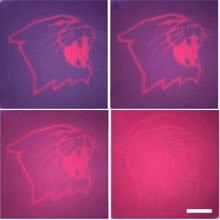
Remember when, as a kid, you would pen secret messages with “disappearing ink” by writing on paper with lemon juice? A team of researchers at Northwestern have taken the idea just a little bit further, engineering a nanoparticle ink that fades away at a predetermined time, keeping maps or messages away from spying eyes.
The scientists used gold and silver nanoparticles — just 5 nanometers wide — embedded in a thin organic gel film to create the disappearing medium. Each nanoparticle is covered in molecules that change shape and attract each other in the presence of ultraviolet light. Using an ultraviolet “pen” or a patterned mask to apply light to the surface causes the molecules struck by UV to cluster and change color, allowing a message or image to be penned on the medium. The more light, the stronger the colors, as the particles bond more tightly. In the absence of light, the particles fall apart, erasing the image/message. How quickly they fall apart depends on how many of the glue-like molecules are coating each nanoparticle, so scientists can precisely control how long it will take an image to fade completely.
Due to this unique chemistry, the “paper” can be engineered to self-erase in a few hours or a few days. If exposed to very bright light or heat, it can be erased immediately, and once erased, there is no way to retrieve the lost message, making the medium ideal for sensitive correspondence. Moreover, because of its sensitivity to bright light, it can’t be placed on a copier. Unlike previous attempts at self-erasing paper, it can be erased and rewritten on hundreds of times without losing quality, and it’s also flexible, so it can be bent, twisted, or rolled up.
Though its Cold War applications are apparent, the creators of the paper also envision self-expiring bus and train tickets. Security firms might also be interested in incorporating the technology into anti-forgery measures for everything from security badges to financial documents. A UK-based firm has already voiced an interest in the tech.